
Dance of Death
Why Angering the Village Witch Is Never A Good Idea

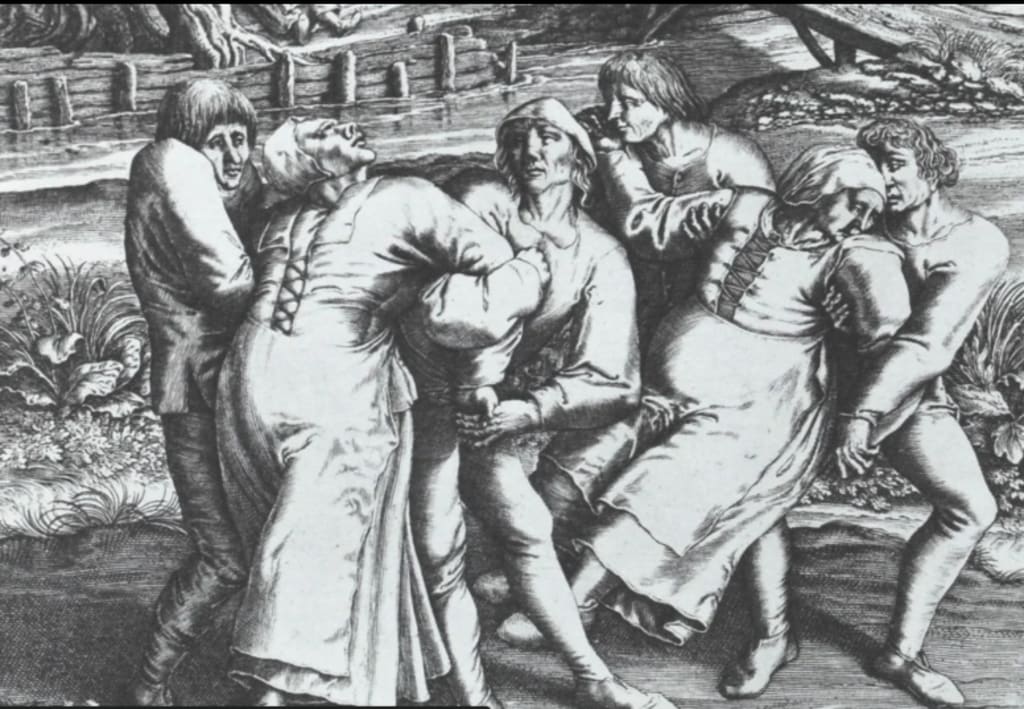
Frau Troffea dabbed the sweat and dirt off her brow with her forearm, tilting her face toward the sky with a heavy sigh. Even for the peak of summer, the bone dry July air was unusually hot. Her small village of Strasbourg had not seen a drop of rain since the first of June 1517, which was over a year ago; the Rhine was the lowest it had been since she was a child, only adding onto the strife her village had suffered in recent years. Last year's crops were quite small, no thanks to a strange black bile that rendered most of it inedible. Abbé Henri - the village priest - declared that it was cursed by St. Vitus for the sins Strasbourg had committed. What those sins were, however, no one was quite sure.
Between last year's pitiful crop and this year's drought, many of Strasbourg's proud citizens now teetered on the brink of starvation. Several of Frau Troffea's neighbors and friends had already succumbed to the famine, as had the bulk of her husband's once thriving flock of sheep. Without grass to feed them or water to sustain them, they simply dropped like flies that had flown too close to the hearth. Almost overnight, their flock had diminished from three hundred strong to just twenty, and Herr Troffea spent every waking moment day and night trying to keep them alive until breeding season. Secretly, Frau Troffea wished her husband would just give up and buy new lambs the following spring. At this point, it would be cheaper than scraping together what few sous they had left to feed the dying sheep and replace all the candles he'd used up. Candles they were sure to need for winter, if Strasbourg even made it to its next winter, that is.
Frau Troffea adjusted her bonnet and dusted off her skirts as she stood, stretching her aching, sweaty back. She would give anything for snow right now, or even a cool breeze. The harsh truth of the matter was it was simply too hot to bring in the harvest... not that there was much worth harvesting. The handful of carrots she'd just pulled up were all no bigger than the tip of her thumb, and more than half carried the same black bile as last year. None of the cabbages she'd planted made it to harvest, each shriveled to a tiny, papery husk by the punishing heat. Her last hope was the barley, which wasn't ready to harvest yet. The handful of sun-bleached stalks were little more than straws, but she prayed to St. Vitus that there would be enough to mill into flour for gruel and bread to sustain her family until next planting season.
As she bundled up her woefully small bounty into her apron, Frau Troffea caught a flicker of movement suddenly out of the corner of her eye. She turned her head quickly, startled by a figure seated on an overturned washtub by her half-timbered house. Frau Troffea had lived in Strasbourg all her life, and she knew every face within it as well as her own as a result. Even at a distance, she recognized the thin, stooped figure in an instant: Frau Hilda.
Frau Hilda wasn't really a member of the village. At least, no one in Strasbourg claimed her as a neighbor willingly. She lived in a small hovel near the riverbank, straddling it and the border of Strasbourg. It was a miracle Frau Hilda was still alive, as she had been an old woman since Frau Troffea was a small girl. She didn't leave her hovel often, except to gather herbs and roots for the tinctures and poultices she was known to make. Concoctions of healing and supposed good fortune that she sold to unwitting travelers at the market in the neighboring village. Suffice it to say, an unsolicited visit from Frau Hilda was never an occurrence to be taken lightly.
The smile on her puckered lips was warm and unassuming, but Frau Troffea knew better than to trust it. Frau Hilda may have looked like a kindly old granny, but she carried a strange aura with her. Bizarre things always happened whenever Frau Hilda was around; sometimes good, but more often than not gruesomely bad. Like everyone else in the village, Frau Troffea knew the rumors about Frau Hilda's youth - which was allegedly spent consorting with the devil - and to avoid Frau Hilda like the plague.
Frau Troffea fixed her gaze on the house with a huff, pretending she didn't see Frau Hilda as she approached the door. She'd only just lain her fingertips on the handle when the old woman's hand shot out like a venomous asp and grabbed her by the wrist.
"Hot today, isn't it, Ma Cherie?" the crone croaked. "Won't you be so kind as to fetch me a drop to drink? Water, milk, or mead will suffice."
Frau Troffea pulled her hand free of Frau Hilda's, holding it to her chest as if she'd been burned. "I have none to offer," she answered brusquely, wincing at the long, deep scratches the old woman's nails left behind on her flesh. "What little water we have is reserved for the sheep and my children; we have no milk - as the cow died and none of our ewes are with lamb - and my husband has already drunk the last of the mead."
A wisp of cloud suddenly blew across the sun on an unexpected breeze, darkening the entire sky for a few anxious beats of Frau Troffea's heart. Although she was grateful for the small gust, she was unnerved by the abrupt and shocking change in temperature. In an instant, she'd gone from sweating through her chemise and heavy woolen skirts to shivering.
"You would forsake a poor old woman on a day such as this?" Frau Hilda mused, her watery blue eyes flashing and her bony, twisted hands tightening on the head of her gnarled walking stick. "For shame, Ma Cherie. Did you forget that it was I who cured your little daughter's fever last winter? I don't recall if I ever received payment for my services. My memory is not quite what it was, you see."
Frau Troffea bristled at the implication, pressing her back to the rough-hewn wooden door. "You were paid," she insisted crossly. "My husband gave you a fatted lamb for your cauldron that same night, the best of his flock I might add! I have no time to quarrel with you, Madame, so please go way now! My children and husband are hungry, and I must prepare their supper!"
The old crone's eyes were sharper than bone needles whittled to fine points as they bored into Frau Troffea. After a heart-pounding few minutes, her wrinkled face split into that unsettlingly warm, toothless grin she was known for.
"I stand corrected, Ma Cherie," she said amiably. "In that case, I believe I have regained enough of my strength to continue on. Good luck with that stew... oh, and be sure to drop by the market tomorrow morning. Herr Gustaf just harvested three large bushels of cabbages. Produce that fine and fresh will sell quickly. It's best you get there early if you want first pick of the bunch."
Frau Troffea didn't take her eyes off the old woman as she shuffled off toward the mostly barren fields, only daring to breathe once Frau Hilda was out of sight. She never mentioned that she was planning on making a stew, but she chose not to think about Frau Hilda or her odd comments again for the rest of the day. Try as she might, however, she couldn't stop thinking about one thing the old woman had said.
Herr Gustaf grew the largest and most tender cabbages in Alsace. If he had some to sell, it would be foolish not to buy one if she could. Frau Troffea thought about it all night instead of sleeping, craving the taste of cabbage more than she ever had in her life. The next morning, after her husband and eldest sons left to tend the sheep, she borrowed his coin purse, counted the sous clinking around in it, then headed off to the market.
She was certain it would be hotter today than it was yesterday, as sweat was rolling down the back of her chemise within a minute of stepping outside. It was barely an hour after dawn, and the sun was already unbearable. Just standing under it made her head spin more furiously than the wheel she spun wool on at home. Frau Troffea had to stop many times along the road to the market, leaning on fences, wagons, and doorposts until she got her bearings again. More than once, her daughters begged her to go back home and wait for them, claiming they could buy a cabbage without her. Frau Troffea was undaunted, however. While she trusted their ability to tell a good cabbage from a bad one, she worried that Herr Gustaf might try to cheat them. He was a good man, but more often than not his finger weighed a little too heavily on his scales, and her daughters were not yet wise to his shrewd trickery when conducting business.
When she finally stumbled up to his overflowing cart of cabbages, Frau Troffea was as weak and wispy as a spring sapling. She was drenched in perspiration, yet she shivered madly. No one else seemed aware of the sudden cold, which confused Frau Troffea greatly. She made quick work of buying her cabbage - for a price that left Herr Gustaf seething - giving it to her eldest daughter, Marie, to carry as they walked home. They'd almost made it back when Frau Troffea stopped in her tracks abruptly in the middle of the narrow, cobblestone street.
What happened next, Frau Troffea had no explanation for. Perhaps it was her body's rapid and drastic shifting from hot to cold, playing tricks on her senses, or the devil trying to deceive her. Whatever the reason, Frau Troffea did not doubt what she saw. Right in front of her home, there was a handsome, flaxen-haired young man, playing a jaunty tune on a silver fife. A pair of pretty maidens in white dresses twirled and danced along to the music, both of whom wore their black tresses long and loose down their backs. All three were barefoot, giggling as gleefully as children as they carried on. After a moment, one of the maidens sprinted over and took Frau Troffea by the hands, her blue eyes glimmering with delight and otherworldly mischief.
"Come," she insisted, "dance with us! You must dance, Ma Cherie; the day is good and the music is sweet! It's the only thing to do!"
Frau Troffea had no reason to argue with the maiden, as everything she'd said was unquestionably true. Dancing seemed like an excellent thing to do, so dance she did. Slowly at first, mainly just swaying side to side while the maiden held tight to her hands. Soon, however, Frau Troffea was spinning round and round in place, flailing her arms and swishing her skirts to the reedy strains of the fife.
"Maman, what is the matter?" Marie asked, her warm brown eyes wide with fright and befuddlement. "Why are you doing this? Are you unwell?"
Frau Troffea stretched her fingers toward the sky as she twirled again, certain she could pluck the sun from it and hold it in her hands like a precious jewel. "I must dance," she mumbled, already breathless from her spirited jig. "Why do you ask such a silly question, girl? Why shouldn't I dance, when the day is so good and the music so sweet?"
"There is no music, Maman," Marie argued, pushing Frau Troffea toward the house. "Please, you must go inside and lie down! I shall fetch Papa and the doctor right away!"
Frau Troffea had never heard such a foolish notion. Why should she lie down on a day such as this? With a dazed smile on her flushed face, she grasped her daughters' hands, drawing them into the dance with her. A few of her neighbors stopped what they were doing not long after, drawn to the strange scene. Some approached with laughter on their lips, joining in on Frau Troffea's odd and spirited dance. When three hours passed and she continued to dance wildly up and down the street, however, their laughter was silenced by fear.
Abbé Henri was sent for immediately, as Frau Troffea's friends and neighbors feared a demon had possessed her. The priest blessed her shoes with holy water and gave her communion, praying by her side until nightfall. Nothing he tried could stop her dance, though, so he encouraged the rest of the congregated villagers to pray for her as well. Some of her neighbors were a bit more proactive, fetching ropes and leather cords to bind her. Unfortunately, Frau Troffea was dancing and flailing too much for them to hold her despite their efforts. Just when the citizens of Strasbourg were beginning to lose all hope to stop her dancing, another woman began dancing in the same fashion a few hours before dawn. By midday, ten people were dancing in the street... and by the next morning, there were thirty-five.
Most of the dancers seemed to be lost in a trance just like Frau Troffea. Others were clearly shocked and distressed by their spontaneous need to dance, begging Abbé Henri and their neighbors for help. By day three, Frau Troffea and her fellow dancers added up to a hundred. They were pale and exhausted from dancing, some collapsing on the spot only to get up and continue dancing again as soon as they were the tiniest bit rested. Their feet were swollen and bleeding at sunset on day four; at sunrise on day five, Frau Troffea finally stopped dancing, dropping dead to the cobblestones as soon as the cock crowed.
The people of Strasbourg continued to dance against their wills for weeks on end, only stopping for good if they expired from exhaustion. Abbé Henri and a few priests he consulted with from neighboring parishes again determined it to be part of St. Vitus' curse, encouraging the villagers to repent to stop the epidemic. In early September, the few remaining dancers were sent away to a nearby mountaintop to pray for absolution, and with that, the dancing plague ended as suddenly as it began.
No one really knew what happened to Frau Troffea that day, but rumors quickly spread concerning her strange affliction after Marie let slip that Frau Hilda had visited them the day before it started. Ever since then, whenever Frau Hilda came shuffling up to their door, they treated her with kindness and warmest hospitality, giving her whatever she asked for without question. Just in case another dancing plague decided to sweep through their quiet little town.
About the Creator
Natalie Gray
Welcome, Travelers! Allow me to introduce you to a compelling world of Magick and Mystery. My stories are not for the faint of heart, but should you deign to read them I hope you will find them entertaining and intriguing to say the least.
Keep reading
More stories from Natalie Gray and writers in History and other communities.
A Man Named Albert
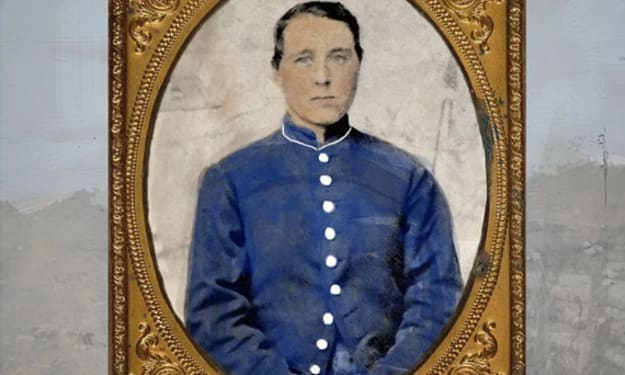
The Civil War is probably one of the most important facets of American history taught in schools today, and for very good reason. It was by far the bloodiest and most brutal war Americans have ever been engaged in; brothers killing brothers, almost destroying the entire country from within. Perhaps that speaks to the stubbornness of Southern Americans in general, and their deeply ingrained inability to admit when they are wrong. The Civil War might just have been the darkest period in United States' history, which is why it's so important for our young people to study it. American schoolchildren are taught endlessly about the battles that were fought, the reasons their forefathers went to war, and the important figures who emerged on either side of it. More often than not, however, there are some people who are regularly forgotten. And of the forgotten few, one man just may be the most important of them all.
By Natalie Gray10 months ago in History
Year 1892 in Review: Fun Facts, Trivia, and Historic Highlights
This quick read is a collection of fun facts, trivia, and historical events from the year 1892. Discover the year’s top news stories, most influential people, U.S. economic trends, historic firsts, entertainment news, and much more.
By Gregory DeVictor5 days ago in History


Comments
There are no comments for this story
Be the first to respond and start the conversation.