
Cuba Takes Center Stage in Rome: A Cultural Event in Memory of José Martí
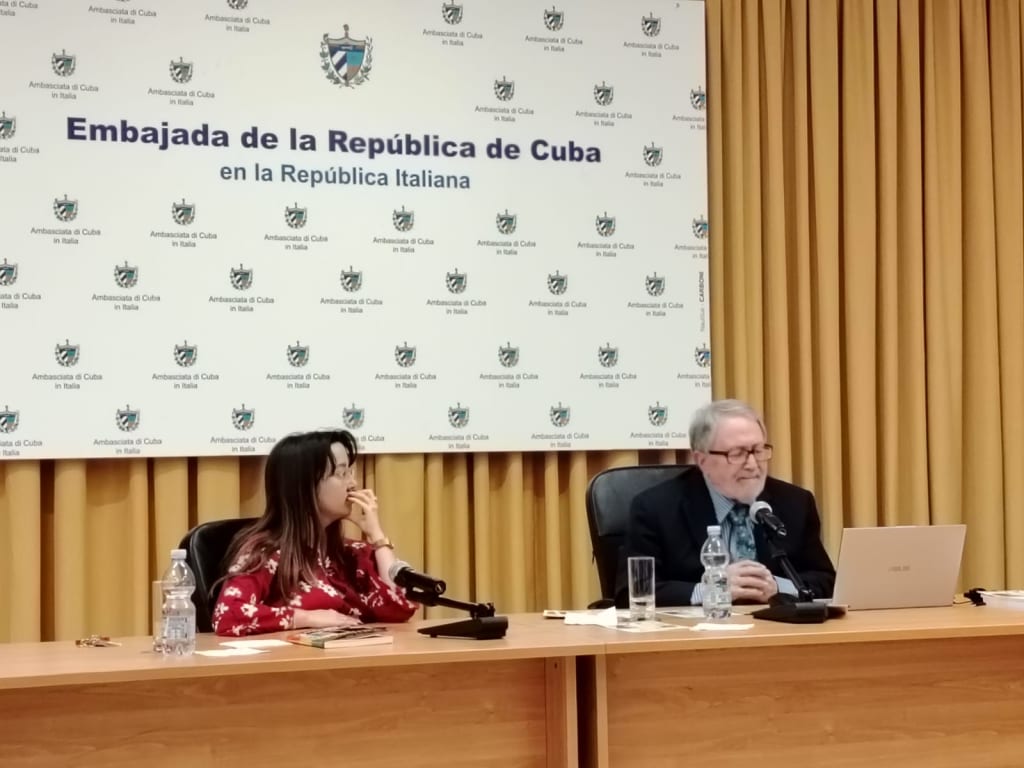
On Monday, May 19, 2025, at 6:00 PM, a significant cultural gathering was held at the Embassy of Cuba in Italy, located at Via Licinia 7 in Rome. The event commemorated the 130th anniversary of the death in battle of José Martí, Cuba's national hero and a universal symbol of the struggle for independence and social justice.
by Maddalena Celano
The event featured Professor Pasquale Amato, a distinguished historian and scholar of relations between Europe and Latin America, who delivered a lecture titled:
"The Global Centrality of Havana in 18th-Century Hispanic America."
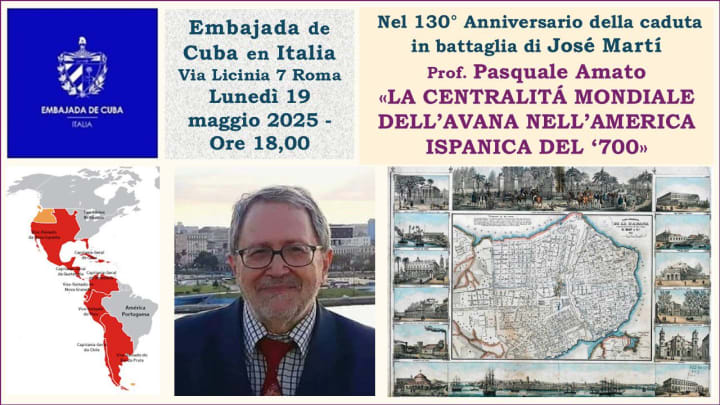
In his presentation, Professor Amato passionately and meticulously illustrated the strategic, political, and economic role that Havana assumed during the 18th century. He described the Cuban capital as a genuine global hub of the Hispanic world, fundamental within the Spanish colonial system and the transatlantic routes connecting Europe, Africa, and the Americas. Havana was portrayed as a vital center of power, commerce, and culture that helped define the geopolitical balances of the era.
The initiative, promoted by the Cuban Embassy, served not only as an opportunity for historical insight but also as a tribute and remembrance of José Martí—a poet, journalist, philosopher, and revolutionary. His ideas and sacrifice continue to inspire the peoples of Latin America and beyond in their pursuit of dignity, freedom, and emancipation.
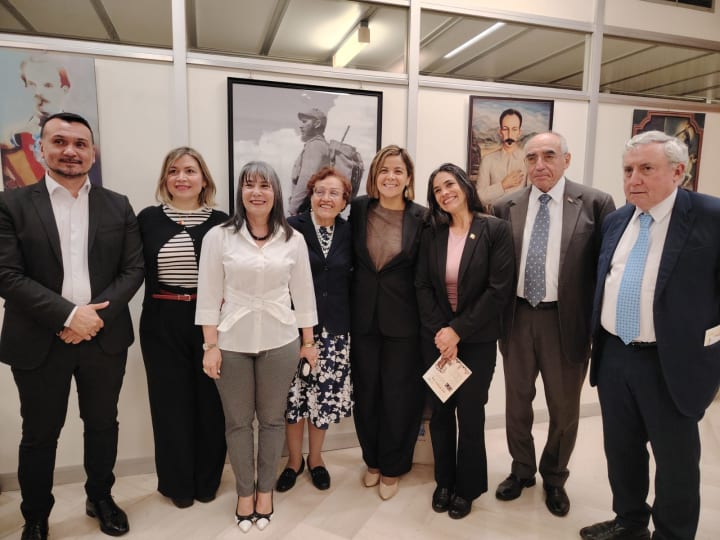
The gathering was attended by scholars, various representatives of the Latin American diplomatic corps, international solidarity activists, members of social-progressive and social-communist political parties, and history enthusiasts, all contributing to an atmosphere of keen attention and profound respect.
This event reaffirmed the historical and cultural ties between Italy and Cuba, strengthening the dialogue between peoples and the shared memory of great struggles for independence and social justice.
Professor Amato emphasized:
"Martí is a central figure in the history of Cuban independence and in the political thought of Latin America. He symbolizes the fight for freedom, dignity, and the sovereignty of peoples. His legacy is immense—not only for what he wrote and did during his life but also for how he united culture and politics, poetry and revolution. Martí taught us that intellectuals should not retreat into ivory towers but must put their knowledge at the service of social justice and the liberation of peoples."
Encyclopedia Britannica
His most renowned work, Nuestra América, published in 1891, remains an essential reference for anyone seeking to understand the identity and challenges of Latin America. In it, Martí warns against the dangers of U.S. imperialism and calls on Latin American peoples to unite, recognize their cultural wealth, and build an autonomous destiny. He wrote: "Trincheras de ideas valen más que trincheras de piedra"—"Trenches of ideas are worth more than trenches of stone." This phrase encapsulates his belief in the power of ideas, culture, and knowledge as tools for resistance and emancipation.
Professor Amato added:
"Today, as we celebrate his memory, we must also ask ourselves what it means, in the contemporary world, to remain faithful to José Martí's legacy. It perhaps means continuing to defend the right of peoples to choose their own destiny without external interference, economic blackmail, or cultural impositions. It means recognizing the dignity of differences—languages, traditions, local histories. It means building a multipolar world where solidarity prevails over competition, and cooperation is more important than profit."
Therefore, Martí's figure does not belong solely to Cuba but to all humanity. His life and work speak to all who fight against oppression, who believe in justice, who seek alternatives to the logic of war and exploitation. In an era like ours, marked by conflicts, growing inequalities, and environmental and moral crises, Martí's message resonates with extraordinary relevance. He reminds us that another world is possible, but building it requires courage, consistency, and above all, love for humanity.
As a true revolutionary, Martí did not hate his enemies. He fought them with pen and sword, always with dignity. He believed in education as a tool for transformation, in culture as a means of redemption, in poetry as an expression of the deepest truths. It's no coincidence that among his writings are tender verses dedicated to children, nature, and freedom—verses still taught in Cuban schools today, forming part of a people's identity.
Martí grew up in this context, among schools, intellectual circles, and vibrant environments. His education was cosmopolitan yet rooted in Latin American values. He studied in Spain and the United States, where he grasped that country's internal dynamics and imperialist tendencies. This understanding led him to write illuminating pages on what could happen to Cuba and all of Latin America if the U.S. imposed its worldview. Martí realized that political independence was insufficient; cultural, linguistic, and spiritual autonomy were also necessary. Hence, the urgency to build Nuestra América—our America—distinct from Anglo-Saxon America, a reality based on solidarity, plural identity, and respect for differences.
These values are more relevant than ever in a world still experiencing conflicts, inequalities, and attempts at cultural homogenization. Remembering Martí is not just paying homage to the past but also a commitment to the present and future. His thought invites us to reflect on the kind of world we wish to build: one based on domination or cooperation? On oppression or solidarity?
Professor Amato concluded his speech on this special day by reaffirming that the memory of José Martí reminds us that every people has the right to self-determination, to tell their own stories, to build a future according to their needs, dreams, and values. He added: "Poetry—as the Nosside Prize clearly demonstrates—can play a fundamental role. Because poetry, as Martí taught us, is not just aesthetic expression but also a tool for freedom, denunciation, and the construction of an alternative political imagination."
With this spirit, I thank you again for your presence and attention.
Long live José Martí. Long live Cuba. Long live the friendship among peoples.
About the Creator
Keep reading
More stories from Maddalena Celano and writers in History and other communities.
The Arba'in Pilgrimage: Faith, Culture, and Memory in Motion
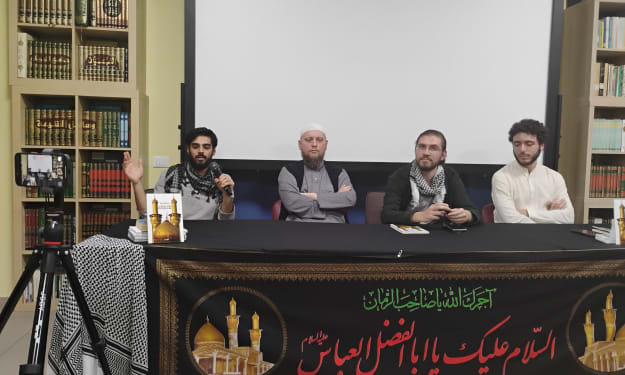
A Journey Through Images, Stories, and Testimonies The event opened with a moving and intense photographic exhibition that visually documented the march of pilgrims from Najaf to Karbala. The shots, capturing faces marked by fatigue and spontaneous acts of solidarity, conveyed the deep sense of community and resistance that characterizes the pilgrimage. The images spoke for themselves: men, women, children, the elderly—all united in remembrance of Imam Husayn, a key figure in Shia spirituality and a symbol of the struggle against tyranny.
By Maddalena Celano9 months ago in History
Who Replaces the United Nations If It Fails?
Who Replaces the United Nations If It Fails? For more than seventy years, the United Nations has served as the world’s main platform for diplomacy, peacekeeping, and global cooperation. Despite its weaknesses, it remains the only institution where nearly every country has a seat at the table. But as trust in the UN declines and major powers increasingly act alone, an uncomfortable question is being asked more often: if the UN fails, who—or what—takes its place?
By Wings of Time about an hour ago in History
Where the Pulse Ends
© 2026 Sai Marie Johnson The humidity in the city didn’t just hang; it leaned. It was a thick, stagnant soup of diesel exhaust, ozone, and the metallic tang of blood that drifted from the "Compliance Zones." Joe sat in his rusted sedan, his hands resting loosely on the steering wheel. He wasn't gripping it. He wasn't angry. Anger was a chemical spike, a biological inefficiency. Joe was simply... focused.
By Sai Marie Johnson4 days ago in History


Comments
There are no comments for this story
Be the first to respond and start the conversation.