
Clash of Titans: The History and Impact of the Pakistan-India Wars
Exploring the Causes, Battles, and Consequences of a Rivalry that Shaped South Asia

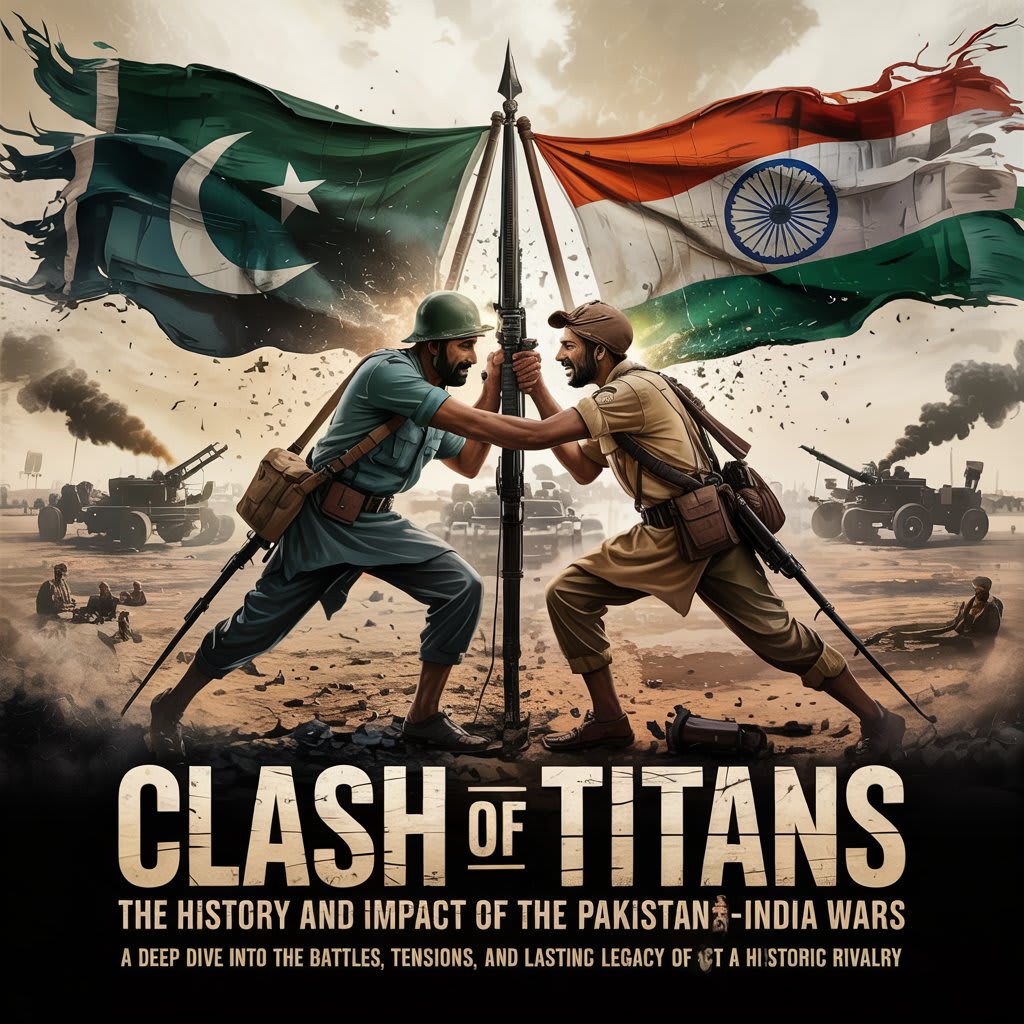
A Deep Dive into the Battles, Tensions, and Lasting Legacy of a Historic Rivalry
The story of the Pakistan-India wars is not just about military clashes; it is a tale of two nations born from a single land, whose destinies became locked in a fierce rivalry. Since their independence from British rule in 1947, Pakistan and India have engaged in multiple conflicts, each shaping their national identities and their future relations.
The Root of Division
The seeds of conflict were sown during the Partition of British India. What was meant to be a peaceful transition into two sovereign nations—India and Pakistan—turned into one of the bloodiest migrations in history. Millions were displaced, and communal violence left deep scars on both sides. One key issue remained unresolved: the princely state of Jammu and Kashmir. Although its ruler chose to join India, Pakistan disputed the decision, claiming that the Muslim-majority region rightfully belonged to them. This disagreement ignited the first war between the two nations.
The First Indo-Pak War (1947–1948)
The First Indo-Pak War began when Pakistani tribal militias, supported by regular Pakistani forces, invaded Kashmir. India responded by airlifting troops to defend the region after the Maharaja signed the Instrument of Accession. The fighting was fierce but inconclusive. In 1949, under the supervision of the United Nations, a ceasefire was declared. Kashmir was divided along a Line of Control, but the territory remained a flashpoint, unresolved and heavily contested.
The Second Indo-Pak War (1965)
Tensions boiled over once again in 1965. Pakistan launched Operation Gibraltar, sending forces into Indian-administered Kashmir to incite rebellion. However, the plan backfired, and full-scale war erupted between the two armies. The battles were brutal, with significant losses on both sides. Ultimately, a ceasefire was brokered by the Soviet Union and the United States, resulting in the Tashkent Agreement. Despite restoring the pre-war boundaries, the underlying issues, particularly over Kashmir, remained unresolved.
The Third Indo-Pak War (1971)
The most decisive of the conflicts came in 1971, but this time the theater of war was not Kashmir—it was East Pakistan (modern-day Bangladesh). Political and ethnic tensions in East Pakistan led to widespread unrest and a brutal military crackdown by West Pakistan. Millions of refugees poured into India, prompting India to intervene militarily. The war was swift and decisive. In just two weeks, Indian forces, alongside Bengali nationalist forces, defeated Pakistani troops. East Pakistan emerged as the new nation of Bangladesh. The war not only reshaped the map of South Asia but also left Pakistan deeply humiliated and politically unstable for years.
Kargil Conflict (1999)
Despite peace efforts, conflict returned in 1999 with the Kargil War. Pakistani soldiers and militants occupied strategic heights in the Kargil sector of Indian-administered Kashmir. India launched a massive military operation to reclaim the territory. After intense fighting and significant international pressure, Pakistani forces withdrew. The Kargil conflict once again highlighted how fragile peace between the two countries remained.
The Legacy of Conflict
The wars between Pakistan and India have had a profound impact on the region. Both countries have invested heavily in their militaries, including nuclear arsenals, leading to a dangerous arms race. Diplomatic relations have remained volatile, with periods of intense hostility punctuated by fragile attempts at peace.
Beyond the political and military consequences, the human cost has been immense. Tens of thousands of soldiers and civilians have lost their lives. Millions live in constant fear along the borders, especially in Kashmir, where daily life is often marked by violence and uncertainty.
Despite the heavy history, there have been moments of hope. Cultural exchanges, people-to-people initiatives, and dialogue efforts have shown that beneath the layers of political hostility, there exists a shared history, language, and love for peace.
Conclusion
The story of the Pakistan-India wars is a stark reminder of how unresolved issues, combined with mistrust and political ambition, can lead to decades of conflict. Yet, it also highlights the resilience of the human spirit—the desire for peace, dignity, and coexistence. As both nations move forward, the lessons of the past remain crucial. True peace will require courage, compromise, and a recognition that in the end, the real enemy is not each other, but the hatred that has fueled decades of division.
About the Creator
Keep reading
More stories from Majeed Afridi and writers in History and other communities.
The Lion of Lahore: The Imran Khan Story
Cricket built him. Politics tested him. Pakistan defined him. From the thunderous roar of cricket stadiums to the charged air of political rallies, Imran Khan’s life has been anything but ordinary. A man molded by victory, controversy, and conviction, he rose from the cricket pitch to the political battlefield, driven not by ambition alone, but by a profound sense of purpose.
By Majeed Afridi10 months ago in History
Abandoned: The All American Ruins Podcast
There are some podcasts that define genre classification and would never be considered by large podcast networks, worried about recouping their investment in the show. Abandoned: All-American Ruins is one of those podcasts.
By Frank Racioppiabout 2 hours ago in History
Tensions, Transitions, and a Fragile Global Balance
Today’s World Affairs: Tensions, Change, and an Unstable Balance Today’s world affairs show a global system under great pressure. Many countries are facing political tension, economic uncertainty, and security challenges at the same time. The world is changing quickly, and no single event explains everything. Instead, a mix of conflicts, power struggles, and new technology is shaping how nations deal with each other.
By Wings of Time about 7 hours ago in History
The Blue Ridge Stalker
Tom had left the Ford down the way, its spark plugs finally exhausted and no mechanics for a dozen miles back through the foothills to Strossburg. No matter, he had worn his boots—almost as if he planned for this to happen. The puzzle he sought to solve emanated from the woods clinging to the slopes above; the valley behind held no mysteries.
By Stephen A. Roddewig7 days ago in Fiction




Comments
There are no comments for this story
Be the first to respond and start the conversation.