
Childhood of Ronaldo
How a Boy From Madeira Chased a Dream Bigger Than an Island

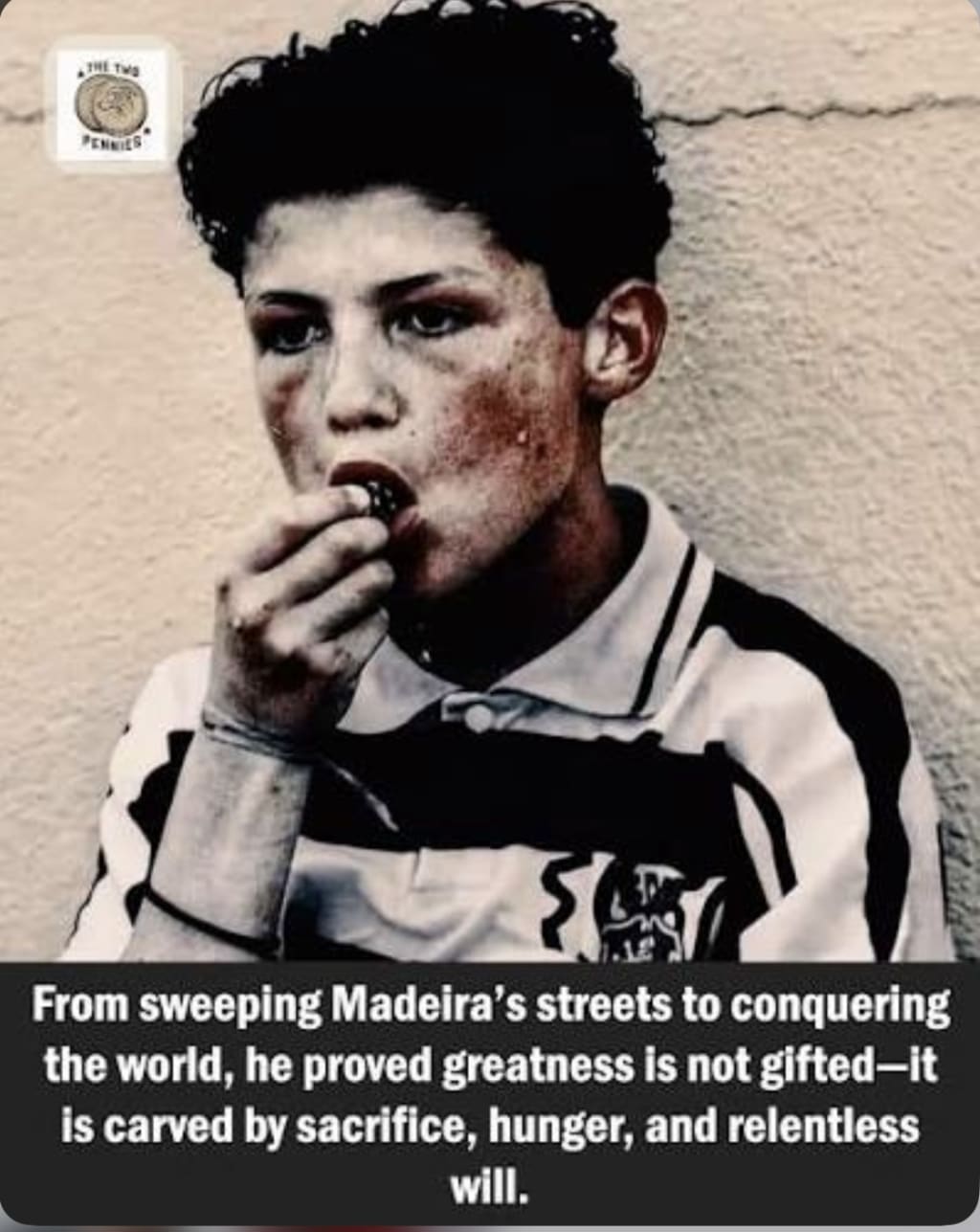
Childhood of Ronaldo
( written by Haris )
How a Boy From Madeira Chased a Dream Bigger Than an Island
Cristiano Ronaldo dos Santos Aveiro was born on February 5, 1985, on the small Portuguese island of Madeira—a place of steep mountains, ocean winds, and narrow streets where children played football until the sun sank into the Atlantic. No one on that island imagined that one of those children would grow up to become one of the greatest footballers the world had ever known. But before the trophies, before the stadium lights, before the name “Ronaldo” echoed throughout continents, there was simply a boy who loved to run, barefoot and breathless, after a ball.
Cristiano grew up in a modest neighborhood in Funchal, the island’s capital. His family’s home was small and often chaotic, filled with the smells of cooking, the sound of siblings arguing, and the steady rhythm of his mother’s sewing machine. His father, José Dinis Aveiro, worked as a kitman at a local football club and sometimes took extra jobs to support the family. Money was tight, but what they lacked in wealth they made up for in resilience and warmth.
From the moment Cristiano could walk, he dribbled anything he could find—crumpled paper, oranges, worn-out tennis balls. He kicked them across the kitchen tiles, against the front wall, down the steep slope outside their house. His mother, Dolores, used to joke that he had more energy than the entire island combined. He wasn’t just hyperactive; he was obsessed—with movement, with winning, with playing longer, harder, faster than any child around him.
At school, however, Cristiano struggled. He was restless, impatient, and uninterested in textbooks. His teachers often complained that he refused to sit still, that he cared more about the football pitch than the classroom. And they were right. Every day after school, he ran straight to the street field where the neighborhood children gathered. Some played barefoot; others shared torn sneakers. But they all knew one truth: Cristiano was different.
He wasn’t the biggest or the strongest, but he was the quickest. He darted between defenders like a spark of lightning, leaving dust and laughter in his wake. Older boys, frustrated and embarrassed, sometimes tried to rough him up or push him aside. Cristiano would simply stand back up, eyes burning, and try again. There was a fire in him—one that couldn’t be dimmed by teasing or bruises.
His first real opportunity came when he joined Clube Futebol Andorinha, the small team where his father worked. He was only eight years old, thin as a reed, but already showing flashes of brilliance. The coaches noticed his footwork, his determination, and the strange way he trained with absolute seriousness. While other children joked around, Cristiano practiced shooting against the wall, over and over, until darkness forced him home.
By the age of nine, everyone in the local leagues knew who he was. Opposing coaches warned their players, “Watch out for the skinny one. He’s faster than he looks.” His teammates adored him, not because he was the star, but because he played with joy—pure, unfiltered joy.
But the moment that changed everything came when Cristiano moved to Nacional, another club on Madeira. He continued to shine, scoring goals effortlessly, leaving defenders behind like shadows. Eventually, his performances earned him a trial with Sporting CP, one of Portugal’s biggest clubs, located in Lisbon—far away from the quiet island he had always known.
When Sporting invited him for a week-long test, his mother cried tears of pride and fear. Her youngest son had never been alone, never left the island. But she also knew that his dreams were bigger than Madeira. And so, at the age of twelve, Cristiano left home—carrying a suitcase, a heart full of hope, and a determination far beyond his years.
Arriving in Lisbon was overwhelming. The city was huge, loud, and unfamiliar. He was homesick, barely sleeping at night, missing his mother, father, and siblings. Many boys at Sporting were older, stronger, and came from better circumstances. Some mocked his accent, calling him “the islander.” Others underestimated him completely.
But Cristiano did what he always did—he fought back not with words, but with effort.
He trained harder than anyone. When practice ended, he stayed behind, running sprints until his legs burned or practicing his shots until his feet ached. Coaches sometimes had to drag him off the pitch. His drive became legendary even within the academy.
Yet beneath that determination lay a vulnerable boy struggling with solitude. Phone calls home became a ritual. His mother would remind him, “If you want to be the best, you must work like the best.” Those words stayed with him.
At age fourteen, a teacher insulted him, saying football would never feed him. Cristiano reacted with such fierce anger that he left school altogether, deciding to put everything—every minute, every breath—into football. It was a bold decision, risky even, but one he believed in with absolute certainty.
His turning point came soon after when Sporting’s coaches noticed something rare in him: not just raw talent, but an unbreakable spirit. They promoted him rapidly through the youth ranks. At only sixteen, he was playing with the senior team. By seventeen, he was dazzling crowds with his footwork. By eighteen, his performance against Manchester United made Sir Alex Ferguson take notice—a moment that would forever change the trajectory of his life.
But none of that—none of the trophies, records, or worldwide fame—could erase where he came from: a small island, a small house, and a childhood filled with big dreams.
Ronaldo’s rise was not built on privilege or luck. It was built on the barefoot boy who practiced until his toes were sore, on the teenager who left home to chase a future no one else could see, on the child who believed, stubbornly and fiercely, that he was meant for something extraordinary.
Even today, when asked about his hunger, his drive, his obsession with improvement, Ronaldo often returns to those early years. To Madeira. To the tight streets and steep hills. To the feeling of running after a ball with the entire world in front of him.
Because the truth is simple:
Greatness didn’t find Ronaldo. He chased it—relentlessly—from childhood.
About the Creator
Muhammad Haris khan afridi
Storyteller at heart ✨ I share fiction, reflections, and creative tales that inspire, entertain, and spark connection. Writing to explore imagination, celebrate life, and remind us that every story has the power to touch a soul.
Keep reading
More stories from Muhammad Haris khan afridi and writers in History and other communities.
The Relentless Journey of Cristiano Ronaldo: From Madeira to Immortality
The Relentless Journey of Cristiano Ronaldo: From Madeira to Immortality ⸻ 1. Humble Beginnings in Madeira In the small island of Madeira, Portugal, on February 5, 1985, a boy named Cristiano Ronaldo dos Santos Aveiro was born into a poor family. His father worked as a kit man at a local football club, and his mother was a cook. Life wasn’t easy for the Aveiro family. Yet, in their youngest son, they saw a spark — an unshakable passion for football that would soon change everything.
By Muhammad Haris khan afridi5 months ago in History
The Year 1983 in Review: Fun Facts, Trivia, and Historic Highlights
This quick read is a collection of fun facts, trivia, and historical events from the year 1983. Discover the year’s top news stories, most influential people, sports facts, computer trivia, grocery and other retail prices, and much more.
By Gregory DeVictor4 days ago in History
Becca
"Everything is so... flat." Denille said stupidly as she looked around her new neighborhood. She looked around at the muted desert where even the smallest sign of life seemed to have given up. The plant life was shrubs that were half cooked by the heat and where there should have been a lawn, a mess of white rocks laid glistening in the sun. Even the sky looked stretched thin, like the sun had ironed it smooth. She’d moved from Riverside, where at least there were hills, but here in Barstow, everything felt baked and brittle.
By Sara Wilson7 days ago in Fiction


Comments
There are no comments for this story
Be the first to respond and start the conversation.