
Chichén Itzá: Legacy of Maya Civilization
Ancient pyramid city showcasing Maya astronomy, architecture, and spiritual traditions.
Chichén Itzá: The Sacred City of the Maya
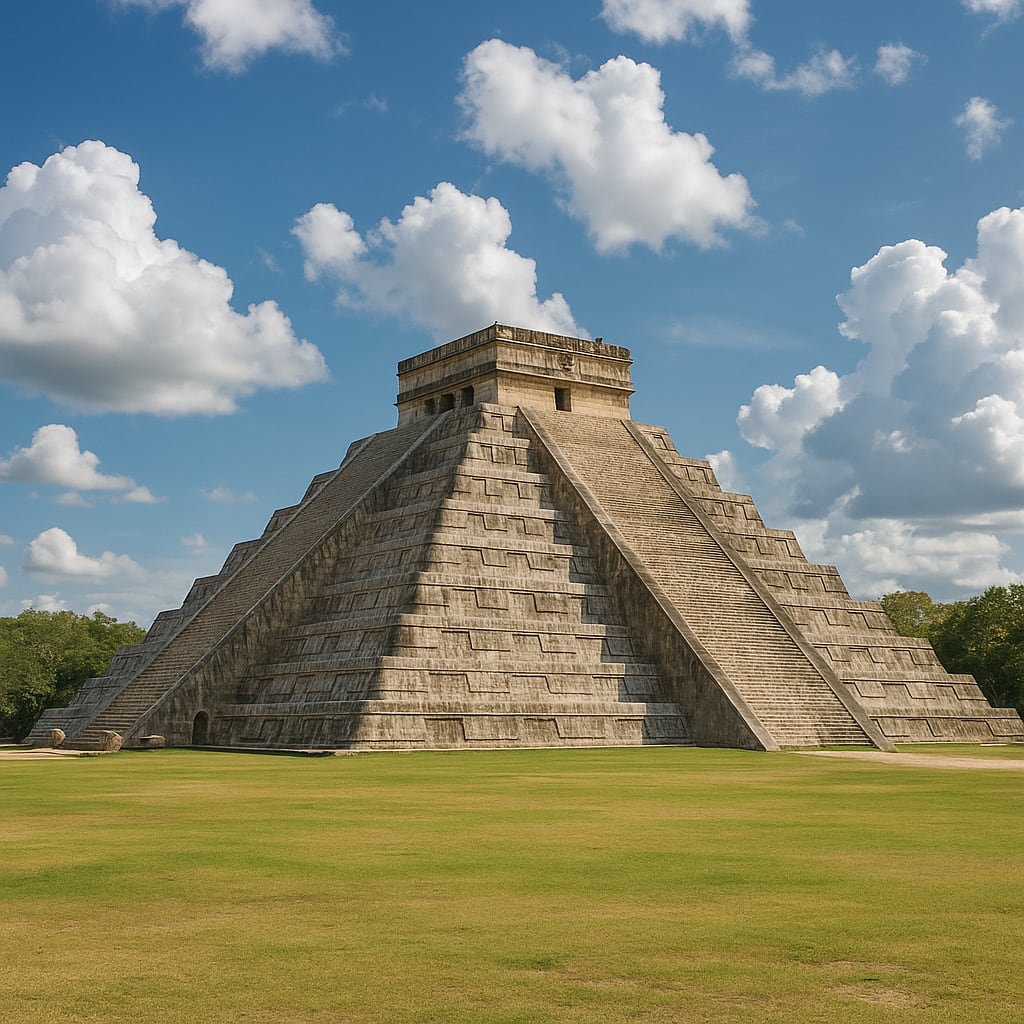
Chichén Itzá, one of the most iconic archaeological sites in the world, is a magnificent pre-Columbian city built by the Maya civilization in the Yucatán Peninsula of Mexico. Dominated by the grand pyramid known as El Castillo (also called the Temple of Kukulcán), the site is a powerful symbol of the ingenuity, astronomical precision, and architectural brilliance of the ancient Maya. Today, it stands as a UNESCO World Heritage Site and one of the New Seven Wonders of the World, drawing millions of visitors every year.
Origins and Significance
Chichén Itzá was founded around the 5th to 6th century CE. Its name in the Mayan language means “At the mouth of the well of the Itzá,” referencing the nearby sacred cenotes—natural sinkholes filled with water that were used for both everyday needs and religious ceremonies. The Itzá were a prominent group of the Maya people who dominated the region in the late Classic and early Postclassic periods.
The city rose to power between 800 and 1000 CE, becoming one of the most important political, economic, and religious centers in Mesoamerica. Its strategic location allowed it to control trade routes across the Yucatán, facilitating the exchange of goods such as salt, honey, cotton, cacao, and obsidian.
El Castillo – Temple of Kukulcán
The most famous structure in Chichén Itzá is El Castillo, a massive step pyramid that rises about 30 meters (98 feet) above the Great Plaza. Dedicated to Kukulcán, the feathered serpent deity (equivalent to Quetzalcoatl in Aztec culture), the pyramid is a stunning demonstration of Maya cosmology and astronomy.
El Castillo has 365 steps—one for each day of the solar year—distributed across its four sides. Each side has 91 steps, and when the top platform is added, the total becomes 365. This alignment reflects the Maya’s advanced understanding of solar cycles.
During the spring and autumn equinoxes, a remarkable phenomenon occurs: as the sun sets, a series of triangular shadows create the illusion of a serpent slithering down the northern staircase. This event draws thousands of spectators and highlights the Maya’s astronomical sophistication.
Architecture and Urban Planning
Chichén Itzá is not just home to El Castillo; it is a sprawling complex with numerous impressive structures. The Temple of the Warriors features rows of carved columns depicting armed figures, while the Great Ball Court—the largest in Mesoamerica—is where ritual ball games were played, often with religious and political significance. According to some interpretations, these games sometimes ended with human sacrifices.
Other notable structures include the Observatory (El Caracol), used to track celestial events, and the Temple of the Jaguars, adorned with intricate carvings and murals. These constructions reveal a blend of Maya and Toltec styles, suggesting that Chichén Itzá was a melting pot of cultural influences.
Religious and Ritual Importance
Religion permeated every aspect of life in Chichén Itzá. The Sacred Cenote, a large sinkhole near the city, was used for sacrifices and offerings to the gods. Archaeologists have recovered human remains, gold, jade, pottery, and other artifacts from its depths, evidence of the ceremonial importance of water and the underworld in Maya cosmology.
Kukulcán, the feathered serpent god, was central to Chichén Itzá’s spiritual life. His temple, El Castillo, was a place of pilgrimage and ritual. Other deities worshipped in the city included Chaac (the rain god) and Itzamná (a creator god).
Decline and Legacy
Chichén Itzá’s decline began around the 13th century, though it remained a site of pilgrimage for centuries afterward. Historians debate the reasons for its abandonment, pointing to possible droughts, political strife, or shifting trade routes.
By the time the Spanish arrived in the 16th century, the city was largely deserted, though it remained a sacred site for the Maya. In the centuries that followed, the jungle reclaimed much of the site until modern archaeology rediscovered and restored it.
Modern Recognition
Today, Chichén Itzá is a symbol of Mexico’s rich cultural heritage. It was declared a UNESCO World Heritage Site in 1988 and selected as one of the New Seven Wonders of the World in 2007. Its preservation and popularity are a testament to the enduring fascination with the Maya civilization.
Visitors who gaze upon El Castillo often marvel not only at its imposing size but also at the layers of meaning built into every stone. Chichén Itzá represents the pinnacle of Maya science, spirituality, and statecraft—a powerful reminder of a civilization that, despite its fall, left behind a legacy that continues to captivate the world.
About the Creator
Keep reading
More stories from Mukhtiar Ahmad and writers in History and other communities.
Parthenon: Timeless Symbol of Ancient Greece
The Parthenon: A Timeless Symbol of Ancient Greece Perched majestically atop the Acropolis of Athens, the Parthenon is one of the most enduring symbols of ancient Greece and classical architecture. Built in the 5th century BCE, this temple was dedicated to Athena Parthenos, the patron goddess of the city. Over the centuries, it has withstood wars, transformations, and natural decay, yet it remains a powerful reminder of Greece’s rich cultural legacy.
By Mukhtiar Ahmad10 months ago in History
The Year 1975 in Review: Fun Facts, Trivia, and Historic Highlights
This quick read is a collection of fun facts, trivia, and historical events from the year 1975. Discover the year’s top news stories, most influential people, sports facts, computer history, entertainment trivia, and much more.
By Gregory DeVictor5 days ago in History


Comments (1)
Chichén Itzá is truly amazing. I've always been fascinated by ancient architecture. The way El Castillo aligns with the solar year is mind-blowing. It makes me wonder how they achieved such precision without modern tools. And the fact that it was a major trade hub too, shows how important it was back then. How did they manage to build such a complex city so long ago?