
Che Guevara
Revolutionary Icon, Rebel Spirit, and Global Symbol of Resistance

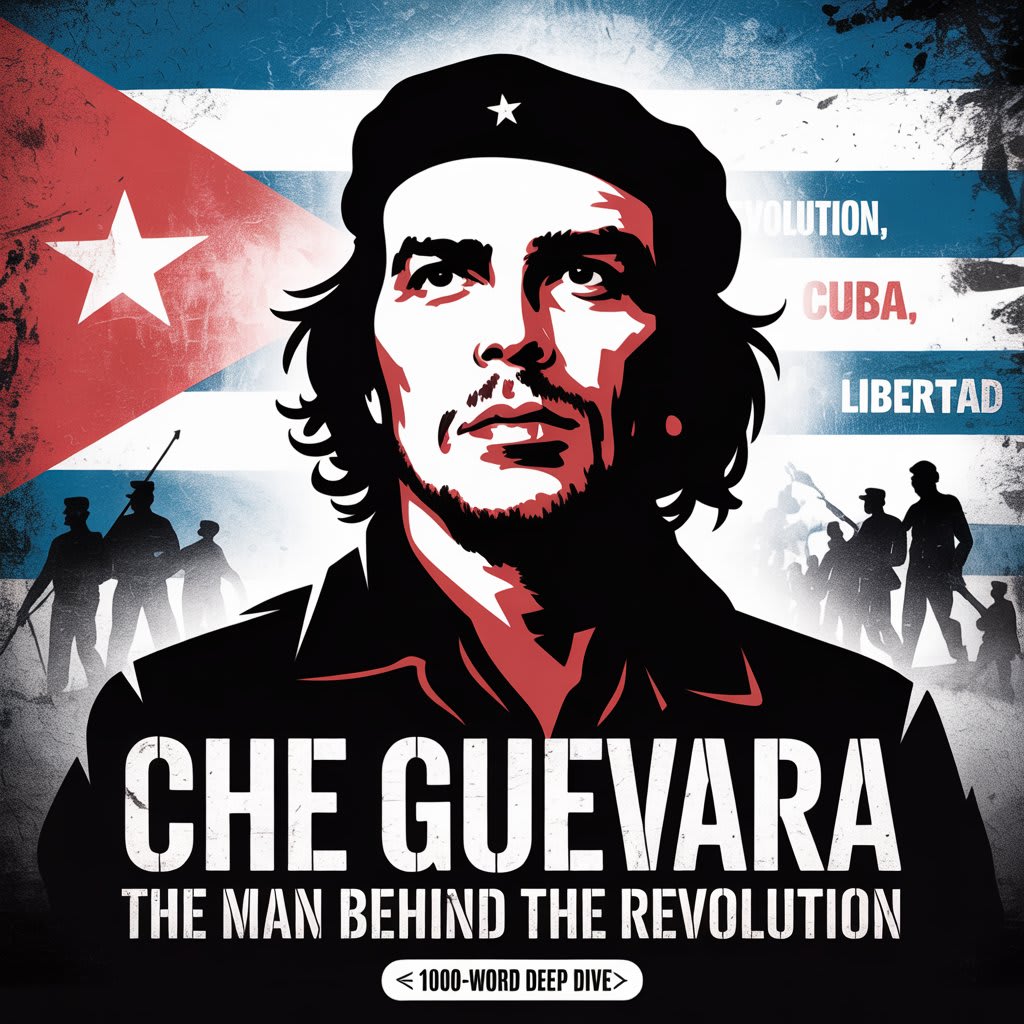
Introduction: Who Was Che Guevara?
Che Guevara, born Ernesto Guevara, was an Argentine Marxist revolutionary, physician, guerrilla leader, and global symbol of rebellion. His iconic image and legacy continue to inspire millions around the world. From a young boy reading Marx and Neruda to a fierce freedom fighter who died for his beliefs, Che’s story is one of courage, controversy, and conviction.
In this article, we’ll explore Che Guevara’s life in depth—his early years, revolutionary activities, ideology, and how he became one of the most influential political figures of the 20th century.
Early Life and Education
Ernesto Guevara was born on June 14, 1928, in Rosario, Argentina, to a middle-class family. Despite suffering from chronic asthma, young Ernesto was incredibly active—he played chess, loved rugby, and had a deep interest in reading. His family owned thousands of books, including works by Karl Marx, Sigmund Freud, Pablo Neruda, and Jules Verne.
In 1948, he enrolled in medical school at the University of Buenos Aires, where he pursued his dream of becoming a doctor. But it wasn’t medicine that would define his life—it was a journey across South America that changed everything.
The Motorcycle Diaries: A Political Awakening
In 1952, Che embarked on an epic motorcycle journey with his friend Alberto Granado, traveling over 8,000 miles across South America. What he witnessed—poverty, injustice, and exploitation—had a profound effect on him.
In Chile, Peru, and Colombia, Che saw how indigenous communities and working-class people were oppressed under capitalist regimes. The conditions in the leper colonies especially moved him. This journey was later documented in his memoir, “The Motorcycle Diaries,” which became a bestseller and a critically acclaimed film.
By the time he returned, Ernesto Guevara was no longer just a medical student—he had become Che, a revolutionary in the making.
Guatemala and the CIA Coup
In 1954, Che traveled to Guatemala, where President Jacobo Árbenz was introducing land reforms to reduce U.S. corporate control. The CIA soon backed a coup to remove Árbenz, pushing Che further into Marxist ideology. He saw firsthand how imperialist interests sabotaged progressive change in Latin America.
It was here that he formed the belief that armed revolution was the only path to true liberation from U.S. and capitalist oppression.
Meeting Fidel Castro and the Cuban Revolution
Fleeing Guatemala, Che landed in Mexico, where he met Fidel and Raúl Castro, exiled Cuban revolutionaries plotting to overthrow dictator Fulgencio Batista. Che joined the 26th of July Movement as a guerrilla doctor, but soon proved himself a natural leader.
In 1956, he landed in Cuba with 81 rebels. Despite heavy losses, he survived and led key battles during the guerrilla war in the Sierra Maestra mountains. Che’s military strategy, discipline, and courage made him a central figure in the revolution.
By January 1, 1959, Batista had fled, and the Cuban Revolution succeeded. Che Guevara was now a national hero.
Che in Power: From Guerrilla to Government
After the revolution, Che held various positions in Cuba, including:
President of the National Bank of Cuba
Minister of Industries
Diplomat representing Cuba internationally
He led agrarian reforms, promoted industrialization, and pushed for collective labor. Che believed in creating a "new man"—a citizen driven not by profit but by social duty and revolutionary ethics.
However, his economic policies faced criticism and limited success. Still, he remained committed to global socialist expansion.
Spreading Revolution: Congo and Bolivia
Che was never satisfied with revolution in just one country. In 1965, he left Cuba to incite uprisings elsewhere. First, he went to the Congo to support anti-colonial fighters, but the mission failed due to poor organization and lack of support.
In 1966, he resurfaced in Bolivia, where he hoped to start a Latin American-wide revolution. But the Bolivian campaign was poorly planned. The rural population didn’t support him, and the CIA, working with Bolivian forces, tracked him down.
Capture and Execution
On October 8, 1967, Che Guevara was captured by the Bolivian army. The next day, he was executed by order of the CIA. His last words were defiant:
“Shoot me, you coward! You are only going to kill a man.”
At age 39, Che was dead—but his legend had only just begun.
Legacy: Icon of Rebellion
Today, Che Guevara remains one of the most controversial yet iconic figures of the 20th century. His image—immortalized by Alberto Korda's famous photograph—is a universal symbol of rebellion, resistance, and youth activism.
He’s celebrated by socialists, condemned by capitalists, and commodified by pop culture. Whether on T-shirts, protest banners, or street art, Che continues to inspire new generations fighting for justice and equality.
Criticism and Controversy
Not everyone views Che as a hero. Critics point to his role in post-revolutionary Cuba, where he ordered the execution of alleged traitors and opponents—sometimes without fair trial. Others criticize his authoritarian tendencies and romanticization of violence.
But even his critics cannot ignore his unshakable commitment to anti-imperialism, equality, and solidarity with the oppressed.
Conclusion: Che Guevara's Enduring Influence
Che Guevara was not just a revolutionary fighter—he was an idea. An idea that people deserve dignity, that empires can be challenged, and that one life can ignite global change. He lived by his ideals, died for them, and became a legend in the process.
Whether you see him as a hero or a villain, one thing is clear: Che Guevara changed the world, and his spirit of resistance will never be forgotten.
About the Creator
Muhammad waqas
Turning Dreams into Reality – One Story at a Time
I'm passionate about telling real success stories that inspire and empower. From ordinary beginnings to extraordinary achievements, I share journeys of resilience, hope, and transformation.
Keep reading
More stories from Muhammad waqas and writers in History and other communities.
First world war E03,The Battle of Verdun
Introduction The Battle of Verdun stands as one of the most brutal and symbolic conflicts of the First World War. Fought between Germany and France from February to December 1916, this battle became the longest engagement of the war, lasting 302 days. Verdun was not just a military confrontation; it was a test of endurance, national pride, and human survival. Germany’s attempt to break French resistance ultimately failed, but the human cost was staggering.
By Muhammad waqas3 months ago in History


Comments
There are no comments for this story
Be the first to respond and start the conversation.