
Charles Darwin: The Man Who Changed How We See Life
From the Voyage of the Beagle to the Theory of Evolution, the Journey of a Revolutionary Thinker

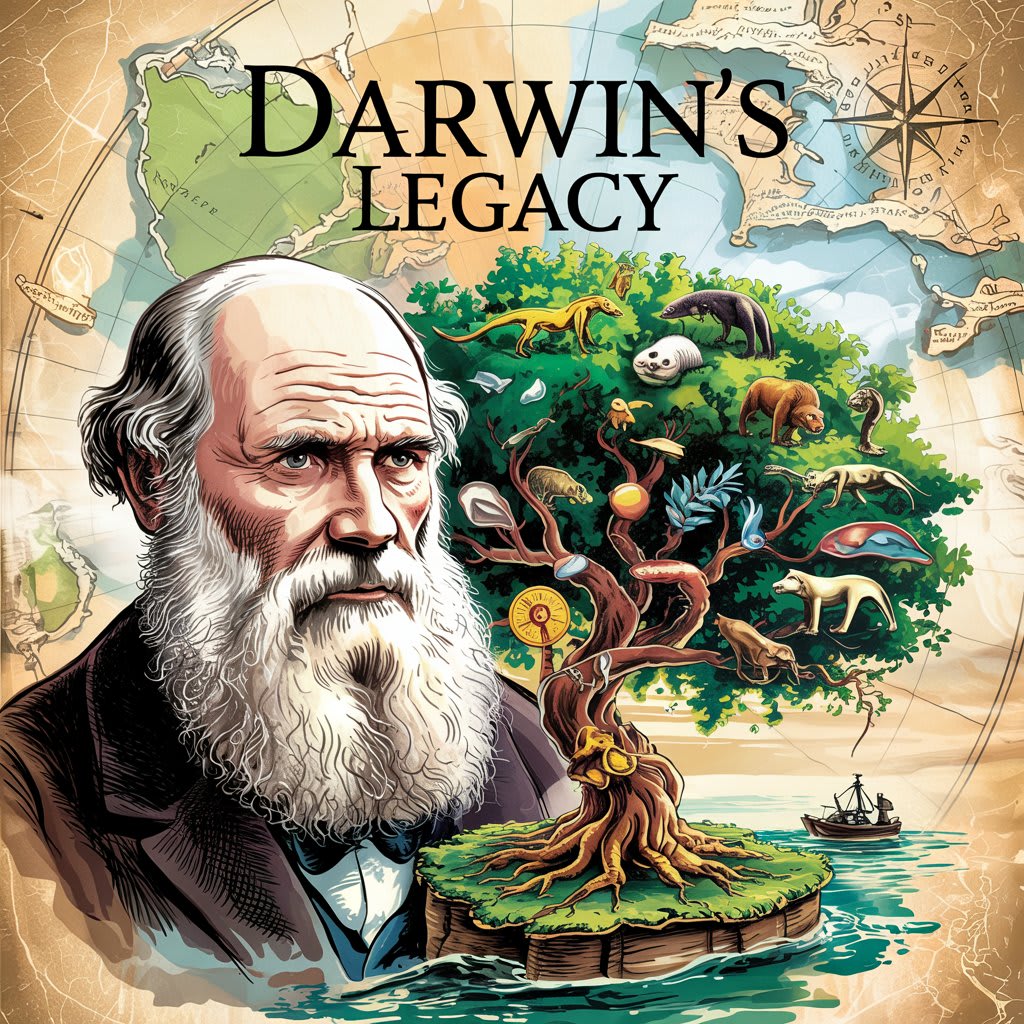
In the early 19th century, when the world still believed that all life was fixed and unchanging, a young boy named Charles Darwin grew up quietly in the English countryside. Born on February 12, 1809, in Shrewsbury, England, Darwin seemed destined for a life in medicine or the church, following the expectations of his wealthy family. But destiny had other plans.
As a child, Darwin was curious about the natural world. He loved collecting beetles, studying plants, and exploring the woods near his home. Though he struggled with formal education, often finding lectures boring, his mind was alive with questions. How did the diversity of life come to be? Why were some creatures so perfectly adapted to their environments?
In 1831, an extraordinary opportunity came knocking. Darwin was invited to join a scientific expedition aboard HMS Beagle as a naturalist. The voyage was meant to chart the coast of South America, but for Darwin, it became something much greater. Over nearly five years, he traveled across oceans, visited exotic lands, and collected a massive range of specimens—from fossils to birds to plants.
One stop would change his life forever: the Galápagos Islands.
These volcanic islands, isolated from the rest of the world, were home to strange creatures found nowhere else. Darwin noticed that finches on different islands had beaks perfectly suited to their specific diets—some cracked seeds, others sipped nectar, and a few crushed insects. These tiny variations planted a powerful idea in his mind: species might not be fixed after all. They could change over time.
Returning to England, Darwin spent the next two decades studying, thinking, and quietly building evidence for a theory that would shake the foundations of science and religion alike. He corresponded with other scientists, raised pigeons to observe variation, and meticulously compared fossil records with living species.
In 1859, after years of careful preparation and growing competition from other naturalists like Alfred Russel Wallace, Darwin finally published his groundbreaking work: "On the Origin of Species."
The book laid out his theory of natural selection—the idea that organisms better adapted to their environments survive and reproduce, passing their traits to the next generation. Over time, this process could lead to the formation of entirely new species.
The reaction was immediate and explosive. Some hailed Darwin as a visionary. Others condemned him for challenging traditional beliefs about the divine creation of life. Debates erupted in universities, churches, and public halls. Cartoonists mocked him by drawing Darwin with the body of an ape. Yet, his ideas were too powerful to ignore.
Darwin did not claim to have all the answers. He openly admitted the gaps in his knowledge, especially regarding genetics, which wouldn’t be understood until long after his death. But his theory provided a unifying explanation for the incredible diversity of life on Earth. It transformed biology from a collection of observations into a science rooted in understanding change and adaptation.
Despite suffering from chronic illnesses for much of his later life, Darwin continued to work quietly at his home, Down House. He published several more influential books on topics ranging from orchids to earthworms, further exploring the interconnectedness of life.
When Darwin died on April 19, 1882, he was buried with great honor in Westminster Abbey, close to Isaac Newton—a recognition of his profound impact on human thought.
Today, Charles Darwin is remembered not just for a single theory, but for changing the very way we view ourselves and the natural world. His legacy reminds us that science is not about clinging to old beliefs, but about questioning, observing, and being willing to follow evidence wherever it leads.
Darwin showed us that life is not a static masterpiece, but a dynamic, ever-evolving tapestry. He taught us that we, too, are a part of nature—not separate from it. In doing so, he reshaped the story of life itself.
Word Count: ~860 words
About the Creator
Farhan
Storyteller blending history and motivation. Sharing powerful tales of the past that inspire the present. Join me on Vocal Media for stories that spark change.
The Great Gold Coin Heist: $4 Million Treasure Stolen from German Museum
In one of the most astonishing museum thefts in recent history, a massive gold coin valued at nearly $4 million was stolen from a museum in Germany. The dramatic robbery captured international attention due to the coin’s enormous size, historical importance, and the audacity of the criminals who managed to escape with such a valuable artifact.
By Irshad Abbasi a day ago in History
A More Human Vocal
When we launched Vocal nearly a decade ago, the world was a very different place. LLMs did not exist, and stories were created one at a time by people sitting down to write, revise, and share something personal. Many of our assumptions about publishing, trust, and participation were built for a world where effort and output were inseparable.
By Justin @ Vocal7 days ago in Resources




Comments (3)
Fabulous story ♦️♦️♦️
Helpful story
Wonderful story and well wirtten, good luck.