
California gold rush-1849
There’s gold in those hills.


The discovery of gold in California led to the biggest migration of Americans in history to date, flooding into the Sierra Nevada mountains. They came mostly from the east coast, abandoning their homes, their families, their jobs, in the hopes of making easy money by just picking up gold off the ground. They mortgaged their houses, took their savings, to buy supplies for the trip. In a society that was increasingly becoming run on wage labor, the notion that gold could just be found and picked up by hand was irresistible and men left in droves, leaving women to run the businesses and homes alone.
25,000 immigrants came that first year, 1849, and most of the already arrived imigrants in Oregan and Washington gravitated to the Sierras, so that by 1850 there were 180,000 people in California. Prior to this time there were 800 non native people in California in March 1840 and 20,000 by the end 1840.
Luckily that first year the weather was mild and the hard journey over the Rockies was easy, but soon the food sources ran out. Game disappeared, Grass for the oxen and cows was eaten, clean water dried up, and the journey became harsh. The weather changed, became cold, snow and ice appeared in the higher elevations. People became trapped in the mountain passes, like the Donna Party,at Truckee, and some died. But still they came. The easy gold disappeared, and most of the gold had to be mined by digging and using expensive technology and equipment. Mining changed from entrepreneurship to wage labor. Mining camps were crowded and lawless, with businesses like hotels, brothels, saloons and hardware stores springing up everywhere. That was where the money was being made now, not by the average miner. The town names became colorful, Dry Diggings,(named because miners had to take their buckets of dirt they dug down the the river to wash it out to find the gold), later changed to Hang Town ( crime was so rampant with banditry, robbery and murder, that residents resorted to hanging the captured criminals from the oak tree in the center of town as punishment), before the name was finally changed to Placerville. Suckers Flat, which was a miners camp just outside of present day Smartsville, Murderer’s Bay, which was located on a sand bar between the middle fork of the American River near what is now Auburn, and Indian Gulch, which was later changed to West Point. The small port town of San Francisco became a Raucaus, bustling frontier city. California was named the 31st state by 1850.
Imigrants of the gold rush era in 1849 ( named the 49er’s) didn’t only come overland, but also by sea from all over the world as well as from the east coast of America. Europe, China, Australia, the Sandwich Islands(Hawaii), South America. The ships sailed through Panama, around the southern most cape of South America.The journey could take months, and was very hazardous.
Quickly, the large mining companies turned to a new method of mining, hydrolic mining. Actually not a new technology, it was used by the Romans centuries before in Europe, but it was new to the method being used in California, when they switched from placer mining to hydrolic mining. It was devastating to the ecology and ruined farming in the Central Valley, causing silt to clog the rivers preventing ships to navigate up the Sacramento River to Marysville, known as the gateway to the gold fields. It was outlawed by the zcalifornia legislature in 1853.
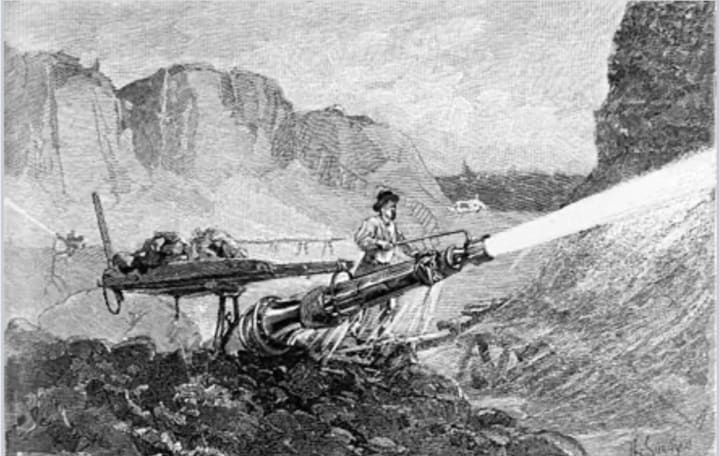
even to this day you can see the damage caused by hydrolic mining in the mountains of the Sierra Nevada.
I live right on the trail used by the 49er’s to get to the gold fields, close to the Yuba River. Steam boats would sail from Marysville to Grass Valley carrying miners and their supplies to and from the mines. The river is still not recovered from the silting damage caused by the hydroloic mining operations used in those gold rush days, and is not navigable. The docks at Marysville are long gone, but metal detectors still uncover coins dropped by travelers in those long ago days. There are no gold mines operating now.
About the Creator
Guy lynn
born and raised in Southern Rhodesia, a British colony in Southern CentralAfrica.I lived in South Africa during the 1970’s, on the south coast,Natal .Emigrated to the U.S.A. In 1980, specifically The San Francisco Bay Area, California.
Reader insights
Nice work
Very well written. Keep up the good work!
Top insights
Compelling and original writing
Creative use of language & vocab
Easy to read and follow
Well-structured & engaging content
Excellent storytelling
Original narrative & well developed characters
Expert insights and opinions
Arguments were carefully researched and presented
Eye opening
Niche topic & fresh perspectives
Heartfelt and relatable
The story invoked strong personal emotions
Masterful proofreading
Zero grammar & spelling mistakes
On-point and relevant
Writing reflected the title & theme
"Scream 7" (2026): Running out of Fresh Screams
This is the seventh time we’ve had a Ghostface crisis. Scream 7 is the latest edition of the Scream franchise. Sydney Prescott and her family are under attack by another anonymous killer dressed in a Ghostface costume. While having issues with her daughter, Tatum, they run from the bloody murders, trying to determine who is behind it all.
By Marielle Sabbag5 days ago in Horror




Comments (1)
Wow! Very interesting. Thanks for sharing Guy! It's very sad to live and experience the devastating effects of mining on the environment. My family also live beside a creek that once upon a time was used for bathing, laundrying, cooking, drinking, fishing etc. But not anymore. It has been polluted by mining activities upstream. I hope there is a safer and cleaner way of extracting gold from the land or riverbeds without destroying the environment and it's ecology.