
Brief history of Israel- Palestine Conflict


Israel, being the singular Jewish nation globally, did not gain official recognition until 1948. However, it is often closely linked to the persistent conflict with Palestine, characterized by violence and centered around disputes over land, political dominance, and resources. In order to comprehend the origins of this conflict, it is necessary to delve into the historical context spanning several millennia.
Strong theological and cultural links exist between Jews and Muslims in the area, which date back approximately 4,000 years to Abraham, who is regarded as the founder of both faiths. The Old Testament states that God instructed Abraham and his descendants to go to a place called Canaan, which is roughly where modern-day Israel is located. The Israelite monarchy was founded by King Saul around 1,000 BCE, and it was upheld by King David and his son Solomon, who constructed the first Jewish temple in Jerusalem.
The Jewish claim to the territory of Israel included this historical inheritance. Various factions, including the Persians, Greeks, Romans, Arabs, Egyptians, Fatimids, Seljuks, Crusaders, Mamluks, and the Ottomans, who called the region Palestine, would continue to conquer and dominate the land. Numerous locations that are revered by Christians, Muslims, and Jews would eventually call it home. Jews were compelled to leave the region during these changes, which led to their dispersion from their country of origin, or diaspora. However, the Jewish diaspora in Europe also experienced persecution and suffering. Thus, a large Jewish population began to return to the promised land in Palestine, which was under Ottoman rule, in the 1880s. More than 75,000 Jews lived in the region in 1914. Following World War I, the Ottoman Empire lost sovereignty of what is now modern-day Israel, Palestine, and Jordan to Great Britain.
The League of Nations accepted a British proclamation in 1922 that promised the Jewish people a national home in Palestine, but it would take more than two decades for that promise to materialise. World War II began in 1939. During the Holocaust, millions more Jews were displaced and over 6 million Jews were slaughtered. Following the conclusion of the war, the United Nations divided Palestine into the Arab state of Palestine and the Jewish state of Israel in 1947. Although borders were established for two states and Israel consented to the division, many Arab citizens believed the Jewish community was unfairly given preference. Soon, violence started.
Israel was founded on May 14, 1948, and David Ben-Gurion became its prime minister. The surrounding Arab nations that make up the Arab League attacked and rejected the split almost immediately. After more than nine months of fighting, Israel's armed forces retaliated and took control of a large portion of the territory that was meant to become the Arab state of Palestine. The Gaza Strip came under Egyptian authority. Jordan, known as Transjordan at the time, seized authority over the West Bank.
A Palestinian state was never intended to be established. Approximately 720,000 Arabs were forced to flee or were driven from their homes as a result of this historic event, with many of them seeking refuge in the West Bank and Gaza Strip. Nonetheless, many Jews saw this as a victory. The Catastrophe in Arabic and the War of Independence in Hebrew are the names given to this conflict, respectively. There would be decades of tension in the area between Arab Muslims and Jews. For the next sixty years, there was intermittent fighting between Israel and its Arab neighbours. In 1964, the Palestine Liberation Organisation was established with the aim of uniting the numerous small Palestinian factions. Israel took control of a sizable portion of territory after defeating the armies of Egypt, Syria, and Jordan during the six-day war in 1967. A violent uprising known as the First Intifada, which claimed hundreds of lives and affected a sizable area, was led by Palestinian militia in 1987 in response to an incident involving Israeli defence forces that claimed the lives of four Palestinian refugees.
Following the First Intifada, Israel and the PLO formulated the Oslo Accords, a peace schedule. In 2000, additional peace negotiations failed to produce results because of disagreements over issues including Jerusalem's status, refugee rights, and the expansion of Jewish settlements on Palestinian land. Later that year, Jerusalem's Temple Mount, which is home to the Al-Aqsa Mosque, was visited by Ariel Sharon, who would go on to become prime minister of Israel. an action that offended a lot of Palestinians. There were riots, suicide bombings, attacks, and violent protests. Any peace that had resulted from the Oslo Accords was ended during this nearly five-year-long period of violence known as the Second Intifada. When Israel left Gaza in 2005, the violence came to an end.
The Palestinian legislative elections were won by Hamas, a militant Sunni Islamist organisation, in 2006. Because of their tactics, which include calling for the destruction of Israel and executing suicide bombings, many nations view Hamas as a terrorist organisation. Israel and Hamas kept up their violent sparring. Although Hamas did not formally recognise Israel as a state, it did call for the creation of a Palestinian state based on the 1967 borders in 2017. Israel therefore declined. Palestine is still fighting for its independence today. The ongoing settlement of Israelis in the West Bank exacerbates the conflict. In recent years, a number of nations have advocated for peace accords, with numerous proposing a two-state resolution. Despite the lack of a peaceful resolution, the area continues to hold significance for individuals from diverse ethnic and religious backgrounds.
About the Creator
Keep reading
More stories from writers in History and other communities.
The Epic of 1917
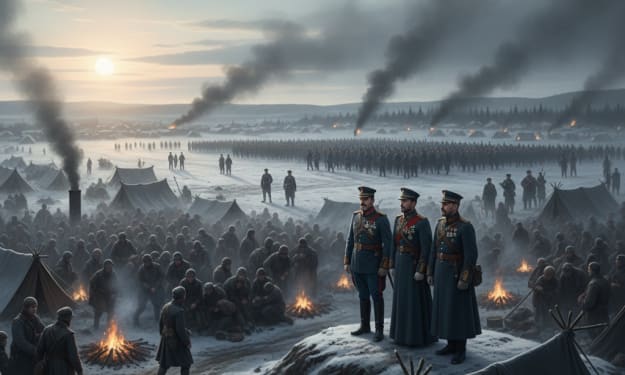
Before discussing the cannons of Mărăști, one must understand the deplorable state of the country at the beginning of 1917. Following the disastrous campaign of 1916, two-thirds of Romanian territory, including Bucharest, was under German and Austro-Hungarian occupation. The Government, the Royal Family, and the remnants of the army had retreated to Moldavia.Moldavia had become a vast refugee camp. Famine, the biting cold, and typhus were ravaging the population, killing more people than the enemy's bullets. However, amidst this apocalyptic landscape, a miracle occurred: the reorganization of the army. Under the guidance of the French Military Mission led by General Henri Berthelot, the Romanian soldier was rearmed, trained in modern warfare tactics, and, most importantly, restored to his dignity. King Ferdinand’s promises regarding land reform and universal suffrage transformed peasants into soldiers ready for the ultimate sacrifice.
By alin butuc7 days ago in History
The Amber Room: History, Glory, and the Greatest Lost Treasure of Europe
Origins of the Amber Room The story of the Amber Room begins in Prussia (modern-day Germany) in the early 1700s. The room was commissioned in 1701 by King Frederick I of Prussia as part of a grand plan to decorate his royal palace in Berlin. The design was entrusted to the court architect Andreas Schlüter, while the intricate amber craftsmanship was executed by master amber artisans Gottfried Wolfram, Ernst Schacht, and Gottfried Turau.
By Say the truth 3 days ago in History
Whiskey At Dusk
Guess the whiskey was more important to you in the end, wasn’t it? It was more than the well-being of your friends; more vital than showing up to the places you promised you would and could come to; more critical of a matter than fulfilling your damn responsibilities and getting the press off your back.
By Snarky Lisa6 days ago in Humans
Living in a hemp house
Hemp, a multi-purpose crop that delivers fibres, shivs, seeds, and pharmaceuticals is currently used in insulation materials and bio-composites for a more sustainable construction industry. Russ Martin and his wife Karon Korp tell their story as owners of the first hemp house in the U.S.
By Susan Fourtané 5 days ago in Interview


Comments