
Bertha Benz: The Woman Who Drove the Future
How a 19th-Century Woman Took the World’s First Long-Distance Car Journey and Ignited the Automotive Revolution
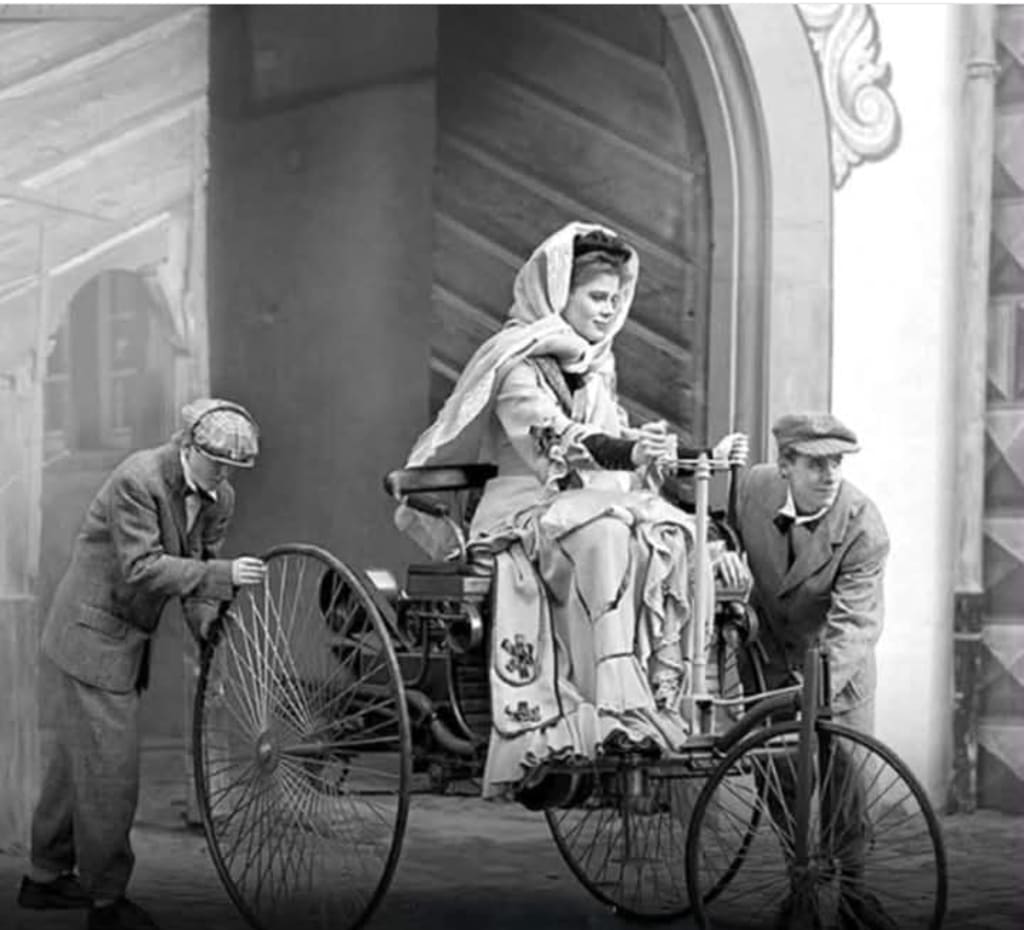
In the tapestry of history woven with inventions and revolutions, some stories shine brighter not because of loud triumphs, but due to quiet courage. One such tale is that of Bertha Benz, the woman who, in 1888, dared to do the unimaginable: she drove a car over 100 kilometers at a time when people barely understood what a car was.
This is the story of determination, intelligence, and a woman whose name deserves to stand beside the great pioneers of the world.
---
The Birth of a Dream
Bertha Benz was born Bertha Cäcilie Ringer on May 3, 1849, in Pforzheim, Germany. She grew up in a well-educated and financially stable family, something not common for women of that time. Her curiosity for the world, combined with her keen intellect, set her apart from many young women of her generation.
In 1872, she married Carl Benz, a passionate engineer obsessed with machines, engines, and most of all—creating a horseless carriage. At a time when most women had no say in technical or business matters, Bertha not only supported Carl emotionally but also financially. In fact, it was her dowry that funded Carl Benz's work on the Motorwagen, the world’s first automobile.
But while Carl was a genius engineer, he lacked confidence in promoting his invention. The Motorwagen was a revolutionary creation, but it remained hidden in their workshop, away from public eyes. Bertha knew it needed more than nuts, bolts, and engines—it needed proof that it could work in the real world.
And so, one quiet summer morning, without telling her husband, Bertha decided to show the world what this "horseless carriage" could truly do.
---
The Journey That Changed Everything
On August 5, 1888, Bertha, then 39 years old, set out on a daring mission. Accompanied by her two teenage sons, Eugen and Richard, she left her home in Mannheim and headed toward her mother’s house in Pforzheim—a journey of about 106 kilometers (66 miles).
But this was no ordinary journey.
There were no gas stations, no repair shops, no maps, and no paved roads. The vehicle—the Benz Patent-Motorwagen—was experimental, prone to breakdowns, and completely unfamiliar to anyone who saw it. Most people had never even heard of a car, let alone seen one in action.
Bertha’s goal was simple yet revolutionary: to prove the Motorwagen could be trusted, driven, and used by everyday people.
---
Overcoming Obstacles, One Turn at a Time
From the moment the journey began, challenges followed. Fuel for the car—called ligroin, a type of petroleum—wasn't sold in stores. It was only available in pharmacies. The first “refueling station” in automotive history? A pharmacy in the town of Wiesloch, where Bertha stopped and bought ligroin, making Wiesloch the world’s first gas station.
The car faced mechanical issues. When a fuel pipe clogged, Bertha used a hairpin to clear it. When insulation on a wire broke, she fixed it using her garter. When the car’s brakes wore down, she visited a blacksmith and had leather brake pads made—introducing the first brake lining in automotive history.
People in villages stared in awe. Some were frightened. Rumors of a “devil’s chariot” spread, as the loud, smoke-puffing machine passed through cobbled streets. But Bertha pressed on.
What kept her going? A clear vision. She knew that the world was standing at the edge of a new era, and someone had to take the first step. She wasn’t just driving a car—she was driving change.
---
A Triumph of Innovation and Grit
After more than 12 hours on the road, Bertha and her sons finally arrived in Pforzheim. The message was clear: the automobile worked, and it could go long distances. This was no longer a prototype—it was a real, functioning mode of transportation.
Carl Benz was shocked—and proud. Bertha’s journey gave him the confidence he needed to move forward. He refined the Motorwagen, adding new improvements based on her feedback from the road.
The event brought massive attention. People began to believe in the concept of the automobile. Orders followed, and the Benz company laid the foundation for what would become Mercedes-Benz, one of the most iconic car manufacturers in the world.
---
A Legacy Too Long Overlooked
For decades, Carl Benz was celebrated as the inventor of the car. But the role Bertha played was rarely mentioned in history books. Only recently has the world begun to recognize her as a true pioneer of mobility.
Her journey is now commemorated through the Bertha Benz Memorial Route, a scenic route through southwestern Germany that traces her historic path. It reminds us that while Carl invented the car, Bertha proved its worth.
In 2011, she was finally honored in the German Industrial Hall of Fame. Today, she’s considered a symbol of vision, bravery, and the transformative power of belief in one’s dreams.
---
Why Bertha Benz Still Matters Today
Bertha’s story is not just about cars or mechanics—it’s about challenging norms. In a time when women weren’t even allowed to vote, she drove through towns, handled mechanical breakdowns, and proved her intellect without permission or applause.
She is a role model for entrepreneurs, engineers, dreamers, and especially women around the world who are told “you can’t” or “you shouldn’t.”
Her story is also a reminder that great inventions need not only creators—but champions. People who believe in an idea, nurture it, and push it into the light, even when the world isn’t ready.
---
Final Thoughts: Driving into the Future with the Past
When Bertha Benz took her secret journey in 1888, she probably had no idea she was making history. She simply believed in her husband, her family, and the machine they had built.
She didn’t wait for permission. She didn’t wait for the “right time.” She just started the engine and went.
And in doing so, she didn’t just change her family’s destiny—she helped create an industry that would transform the modern world.
The next time you step into a car, remember the woman who took the wheel before anyone else dared. Her name was Bertha Benz, and she drove the future.
About the Creator
Hasbanullah
I write to awaken hearts, honor untold stories, and give voice to silence. From truth to fiction, every word I share is a step toward deeper connection. Welcome to my world of meaningful storytelling.
Keep reading
More stories from Hasbanullah and writers in History and other communities.
The Hair That Told Her Story
In the lush highlands of southern Mexico, nestled among the rolling hills and vibrant markets of Oaxaca, a girl named Julia Morales came into the world under the brilliant morning sun. She was born healthy, strong—and covered in thick, dark hair that blanketed not just her head, but her entire body.
By Hasbanullah6 months ago in History
3 Completely Normal Jobs With Disturbing Hidden Histories
Every job has a backstory. Some are boring, some are inspiring, and some are better left buried. While modern versions of certain professions look harmless—sometimes even respectable—their origins tell a much darker story.
By Enoch Sagini2 days ago in History
Albert Einstein: The Mind That Changed the Universe
Albert Einstein was not born a legend. When he entered the world on March 14, 1879, in the quiet German city of Ulm, nothing about his early life suggested that he would one day transform science forever. In fact, his beginnings were remarkably ordinary—and in some ways, difficult. As a child, Einstein spoke slowly, so slowly that his parents worried something might be wrong. Teachers considered him distracted and stubborn, a boy who questioned too much and obeyed too little. Yet hidden beneath that quiet exterior was a restless, powerful curiosity that would later reshape the universe itself.
By The best writer a day ago in History
Wild Card Weekend Recap: What Happens Now?
I think I figured out why I love Wild Card Weekend so much. It's because it's the first playoff anything of the calendar year. The NFL season starts in the fall, and once upon a time, the champion was crowned either on or slightly before New Year's. The evolution of the NFL schedule has resulted in the playoffs starting just into the New Year, and currently, the final week of the season falls on the first weekend of the New Year, with Wild Card Weekend coming a week after that. So yes, chronologically, the NFL's Wild Card Weekend serves as the first playoff anything of the calendar year.
By Clyde E. Dawkins4 days ago in Unbalanced




Comments
There are no comments for this story
Be the first to respond and start the conversation.