
Bangladesh’s March for Gaza: A Cry for Justice Amid Global Silence
Free Palestine, Free Palestine
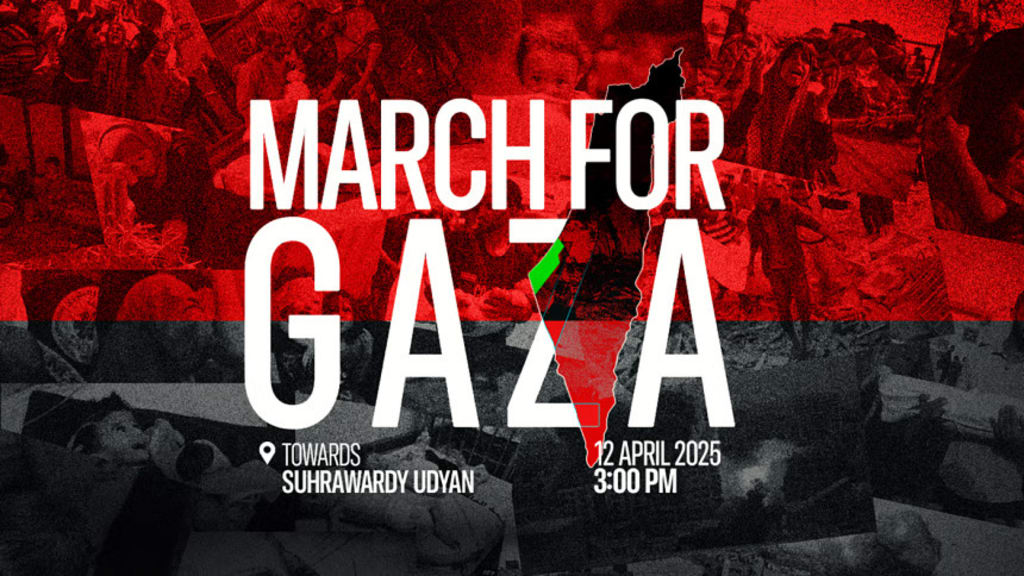
As hundreds of people gathered for the "March for Gaza," a potent protest led by the Palestine Solidarity Movement Bangladesh, the streets of Dhaka throbbed with purpose on April 12, 2025. Converging at Suhrawardy Udyan, this historic event was more than just a protest; it was an appeal for humanity in the face of what participants and organizers referred to as "genocide and ethnic cleansing" in Gaza. Bangladesh's steadfast support for Palestine stood out against the backdrop of international apathy, demonstrating a profound empathy derived from its own struggle.
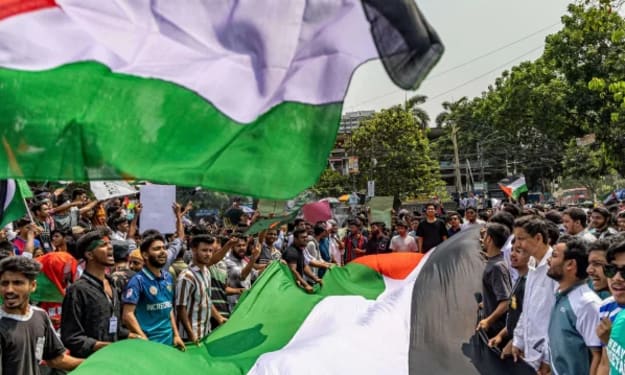
People from all walks of life were urged to come together when the march was urgently announced on April 11. By the early hours of the morning, families, professionals, students, and religious leaders were swarming around the Raju Sculpture at Dhaka University, which served as a symbolic focal point. Above the sea of Palestinian and Bangladeshi flags, placards with the words "Free Palestine" and "Stop Genocide in Gaza" bobbed. At a 3:00 PM meeting, volunteers kept the peace by guiding marchers from five starting points—Kakrail Mor, Zero Point, Bakshibazar Mor, Nilkhet Mor and others—toward Suhrawardy Udyan. The ceremony, which was presided over by Baitul Mukarram National Mosque Khatib Maulana Abdul Malek, sought to put the humanitarian crisis as its only emphasis and to put aside political differences.
Support for Palestine by Bangladesh is not new. The country, which fought for its own independence in 1971, recognizes similarities with Palestine's struggle for independence. Bangladesh has been steadfast since gaining its independence: it has no diplomatic relations with Israel, consistently denounces Israeli policies, and actively advocates for its cause on international forums. Just in April 2025, the Foreign Affairs Ministry denounced the "mass killing and gross violations of human rights," and Chief Advisor Muhammad Yunus called Israel's activities in Gaza "ethnic cleansing." Bangladesh has demonstrated its commitment to alleviating suffering by sending food, medical supplies, and other necessities to Gaza, demonstrating that its solidarity goes beyond rhetoric.
A surge of demonstrations earlier in the month served as the foundation for the March for Gaza. Universities in Bangladesh, including Dhaka University and Jahangirnagar University, suspended courses and exams on April 7 in solidarity with the global "World Stops for Gaza" movement. Demanding an immediate ceasefire, students constructed human chains, screamed "Free, Free Palestine," and set fire to effigies of conflict actors. These measures weren't without controversy, though; some demonstrations outside the US Embassy descended into chaos, and shops thought to be participating were vandalized. Such actions highlighted the unadulterated rage driving the movement, even as they were criticized for damaging local livelihoods.
What's causing this passion? Many Bangladeshis take it personally. At the march, Shahina Al Mansur, a Narayanganj businesswoman, told reporters, "The genocide against Muslims in Palestine is intolerable. I'm here to voice my opposition for humanity." This was echoed by students like Tamim Ahsan, who referred to Israel's conduct as "demonic" and urged Bangladesh to spearhead an anti-Israel non-cooperation effort. Rooted in a common Muslim identity and recollections of Bangladesh's own struggle against oppression, the idea strikes a chord with people of all ages. "When we see Gaza’s children buried under rubble, it feels like our own wounds reopened," one protester said.
However, the march was a cry for accountability as much as it was about rage. Participants accused the UN, the Organization of Islamic Cooperation, and world powers of failing Gaza's residents by remaining silent. Placards called for a boycott of Israeli goods and war crimes tribunals. The organizers of the event placed a strong emphasis on peace, telling marchers to steer clear of political insignia and concentrate on unity. In a silent but impactful display of unity, local shopkeepers near Dhaka University hoisted Palestinian flags alongside Bangladeshi ones.
There were others who opposed the March for Gaza. There are still unsubstantiated and disputed charges that some posts on X are encouraging anti-Semitic or anti-US attitudes. However, organizers emphasized that the goal was humanitarian rather than malevolent. The size of the gathering—thousands strong, well-organized, and determined—proved its purpose: to draw attention to Gaza's suffering and demand justice.
The voices of the protesters echoed as the sun sank over Suhrawardy Udyan, serving as a reminder of Bangladesh's moral stance. This 170 million-person country refused to remain silent in the face of a world that is frequently indifferent to Gaza's agony. The March for Gaza was more than a single event; it was a movement that calls on people everywhere to take action before more people die.
About the Creator
Keep reading
More stories from Mushfiqur Rahman and writers in History and other communities.
Global Strike for Gaza: April 7, 2025 – A Day of Worldwide Solidarity for Palestine
The international struggle for Palestinian rights underwent a significant sea change on April 7, 2025. A united appeal for a "Global Strike for Gaza" prompted people from all walks of life to demonstrate their solidarity with the Palestinian people and urge for an end to the carnage in Gaza by taking to the streets, public areas, and campuses. The strike, which was extensively publicized under the motto "No Work, No School, No Genocide," aimed to put pressure on institutions and governments around the world that were involved in the continuing humanitarian catastrophe.
By Mushfiqur Rahman10 months ago in History
Antarctica Map
Antarctica is the coldest, driest, and windiest continent on Earth. It is located at the southernmost part of the planet, surrounding the South Pole. Because of its extreme weather and thick ice cover, Antarctica is very different from other continents. An Antarctica map helps us understand the shape, location, and important features of this frozen land.
By Farhan Sayed7 days ago in History
Affection and Healing for Yourself
During the night of the last quarter moon, I gathered my ritual supplies. I carefully handled the chunk of black tourmaline that would protect me from your overall negative and narcissistic energy. I carefully walked the house with my stick of selenite in hand, asking the universe to cleanse our working space.
By Alisha Wilkins ✒️🦋🖋️4 days ago in Fiction



Comments
There are no comments for this story
Be the first to respond and start the conversation.