
Bahauddin Zakariya: The Saint Who United Hearts and Reformed a Region
A spiritual light in 13th-century India who shaped not just souls, but societies

Introduction: A Saint Born for an Age of Chaos
In the turbulent 13th century, when invasions tore through India and dynasties rose and fell like the tides, one man built something that outlasted empires — hearts united in love, faith, and knowledge. That man was Hazrat Bahauddin Zakariya Multani, a saint, scholar, and reformer whose teachings still echo through the lands of South Punjab and beyond.
Founder of the Suhrawardi Sufi order in the Indian subcontinent, he made Multan not just a city of trade, but a city of saints. Through deep Islamic scholarship and spiritual wisdom, he countered injustice, revived Islamic values, and unified fragmented communities under the banner of love and Divine remembrance.
Early Life and Lineage: A Heritage of Light
Bahauddin Zakariya was born around 1170 CE in Kot Kehror, Layyah, near Multan, in present-day Pakistan. His family traced their lineage to Hazrat Ali (R.A), the cousin and son-in-law of Prophet Muhammad (PBUH). This noble lineage, however, was not his only claim to greatness — it was his relentless pursuit of knowledge and service that made him beloved.
His early education began at home, under the guidance of his father and local scholars. He then traveled to Baghdad, the center of Islamic learning, where he studied under Shaikh Shahabuddin Suhrawardi, the spiritual master and founder of the Suhrawardi Sufi order.
The Return to Multan: A Mission Begins
After receiving ijazah (authorization) from his teacher, Bahauddin Zakariya returned to the Indian subcontinent, determined to spread the true spirit of Islam — based on love, knowledge, and compassion. He chose Multan as his base, a city with strategic importance and diverse communities, but also deep religious divides.
Multan was already home to many spiritual traditions, but none had organized networks or solid educational institutions. Bahauddin Zakariya changed that. He established a madrasa (religious school) that taught Quran, Hadith, logic, jurisprudence, and spirituality, attracting students from across Asia.
The Suhrawardi Order: Balancing the World and the Soul
Unlike some Sufi orders that embraced poverty and renunciation, the Suhrawardi order preached a balanced life — one could be spiritual and still participate in society. Bahauddin Zakariya himself was a wealthy landowner, showing that Islam did not forbid wealth but urged ethical use of it.
He taught:
“The true Sufi is not he who withdraws from the world, but he who brings God into the world.”
This approach made his message accessible to traders, rulers, scholars, and common people alike, helping to spread Islamic teachings deeply and peacefully across the subcontinent.
Service to the People: A Sufi Statesman
Unlike many spiritual leaders, Bahauddin Zakariya was also deeply engaged in civic life. He was an advisor to rulers, a voice of reason in political disputes, and often mediated conflicts between tribes and communities. His influence was such that even the Delhi Sultanate acknowledged his role in maintaining regional stability.
He encouraged justice, honesty in trade, and fair treatment of Hindus and non-Muslims — earning him love across religious lines.
He famously said, “Spirituality without service is a tree without fruit.”
During famines, he opened food banks, distributed wealth among the poor, and personally took care of orphans and widows.
Legacy of Multan: The City of Saints
Under Bahauddin Zakariya’s leadership, Multan became a center of Islamic learning, culture, and spirituality. His network of disciples (murids) spread across Punjab, Sindh, and Khyber Pakhtunkhwa, each starting schools and spiritual centers.
Some of his most famous disciples included:
Shaikh Rukn-e-Alam – his grandson, whose tomb is a symbol of Sufi architecture.
Jalaluddin Surkh-Posh Bukhari – who further expanded the teachings in Uch Sharif.
These saints, influenced by Bahauddin Zakariya, played a key role in spreading Islam peacefully across the Indian subcontinent, particularly among the rural and tribal populations.
Opposition and Challenges
Despite his popularity, Bahauddin Zakariya faced criticism from both political elites and rival religious groups. Some orthodox scholars accused him of mixing Sufism with worldly power, while others opposed his open-mindedness toward people of different faiths.
But he silenced critics not through argument, but through action. His scholarship was unmatched, and his character beyond reproach.
Once, a critic accused him of luxury, to which he replied:
“If a king owns the world but his heart fears God, he is a dervish. If a beggar owns nothing but his heart is proud, he is a tyrant.”
Death and Tomb: A Light That Never Went Out
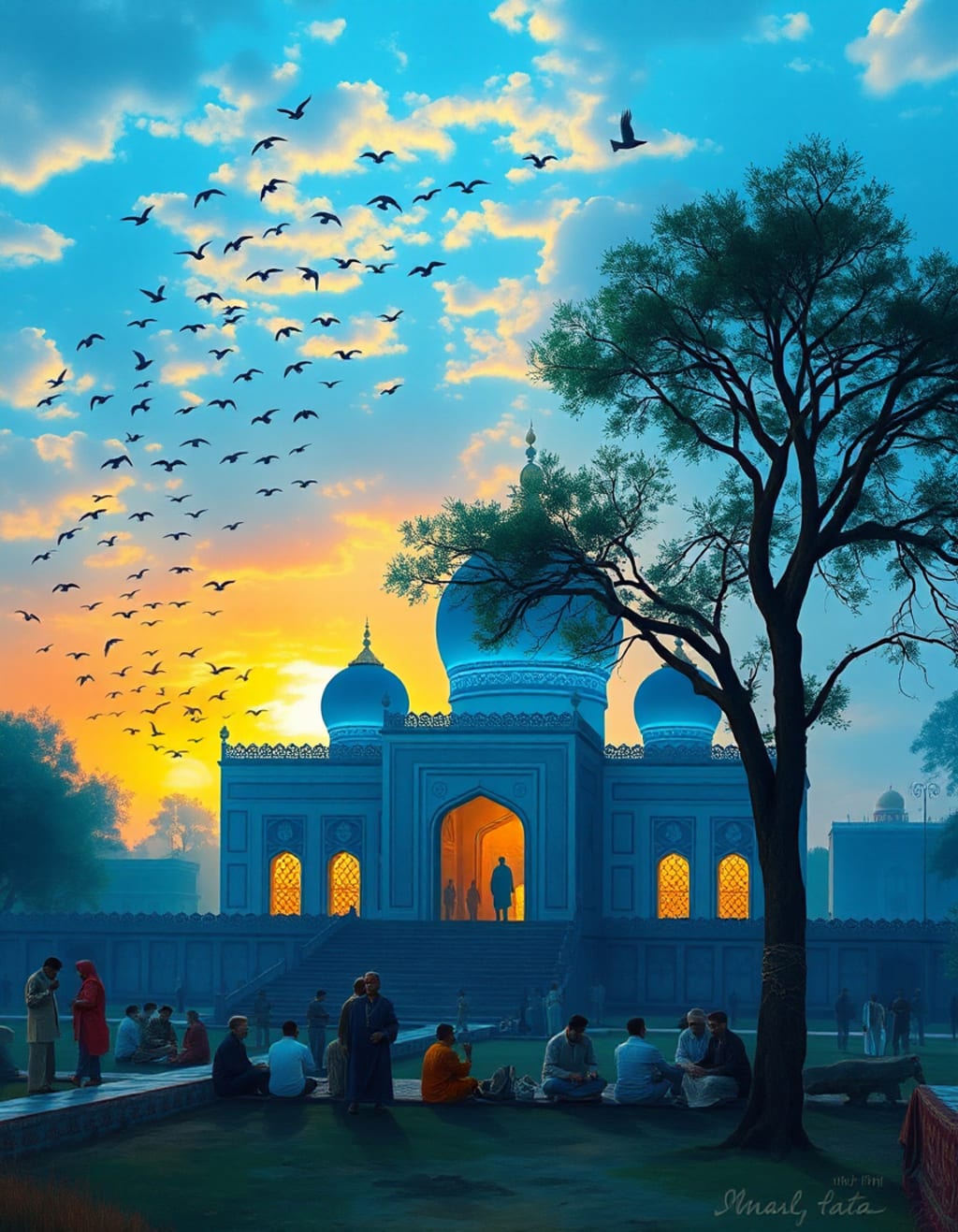
Bahauddin Zakariya passed away in 1267 CE, but his light did not dim. His tomb in Multan remains one of the most visited Sufi shrines in South Asia, drawing thousands of visitors every year — Muslims, Hindus, Sikhs, and even secular seekers.
Built in the classic Tughlaq architectural style, the shrine features blue tiles, soaring domes, and a spiritual atmosphere that can silence even the busiest mind.
Teachings and Philosophy: A Revolution of the Heart
Bahauddin Zakariya’s teachings revolved around a few key principles:
Tawheed (Unity of God): Everything in the universe is connected through the Divine.
Service to Humanity: Feeding the hungry, educating the poor, and standing with the oppressed.
Knowledge over Ignorance: Faith without reason is weak, and reason without faith is blind.
Balance in Life: Neither extreme poverty nor extreme indulgence — moderation is closest to righteousness.
Interfaith Respect: He never called for conversion by force — instead, he invited through love.
Impact on South Asia and Islam
Bahauddin Zakariya was a spiritual architect of South Asia. His model of Islamic propagation laid the foundation for:
Peaceful conversion of large parts of Punjab and Sindh.
Establishment of interfaith harmony that lasted centuries.
Creation of educational institutions that blended logic, language, and law.
His descendants and followers continued to play important roles in shaping the religious and social culture of the region. Today, his name is invoked not just in prayer, but in courtrooms, classrooms, and community gatherings.
Why Bahauddin Zakariya Still Matters
In a world divided by sectarianism, political strife, and spiritual confusion, Bahauddin Zakariya offers a timeless path:
Live with purpose.
Serve others selflessly.
Embrace both the intellect and the heart.
Unite, don’t divide.
Conclusion: The Saint of Light and Logic
Bahauddin Zakariya was not merely a mystic — he was a transformer of society. His spirituality wasn’t about escaping the world; it was about healing it. Through the light of the Quran, the wisdom of the Prophet (PBUH), and the compassion of his heart, he carved a path of balance and brotherhood.
Today, when we visit his shrine or read his writings, we are reminded that true power is not in the sword, the crown, or the bank — it is in the soul that uplifts others.
About the Creator
rayyan
🌟 Love stories that stir the soul? ✨
Subscribe now for exclusive tales, early access, and hidden gems delivered straight to your inbox! 💌
Join the journey—one click, endless imagination. 🚀📚 #SubscribeNow
"The Power of Belief: Ideology in the Roman Kingdom"
The Rise of Ideology in the Roman Kingdom In the earliest days of Rome, long before it became a republic or an empire, the Roman Kingdom was bound together by more than kings, armies, or stone walls. What truly unified Rome was a powerful and carefully shaped ideology—one that defined how Romans understood authority, duty, morality, and identity. This ideological foundation transformed a small settlement on the banks of the Tiber River into a disciplined and resilient civilization, prepared to rule others long after its kings were gone.
By The best writer 7 days ago in History
THE TREASURE IN THE FOREST
The canoe drifted quietly toward the island, where a wide bay opened beneath a blazing sky. A narrow gap in the white reef marked the mouth of a small river, its path visible by the darker green of thick forest spilling down the hillside. Beyond it, mountains rose like frozen waves. The sea was calm, almost unnaturally so.
By Faisal Khan7 days ago in History




Comments
There are no comments for this story
Be the first to respond and start the conversation.