

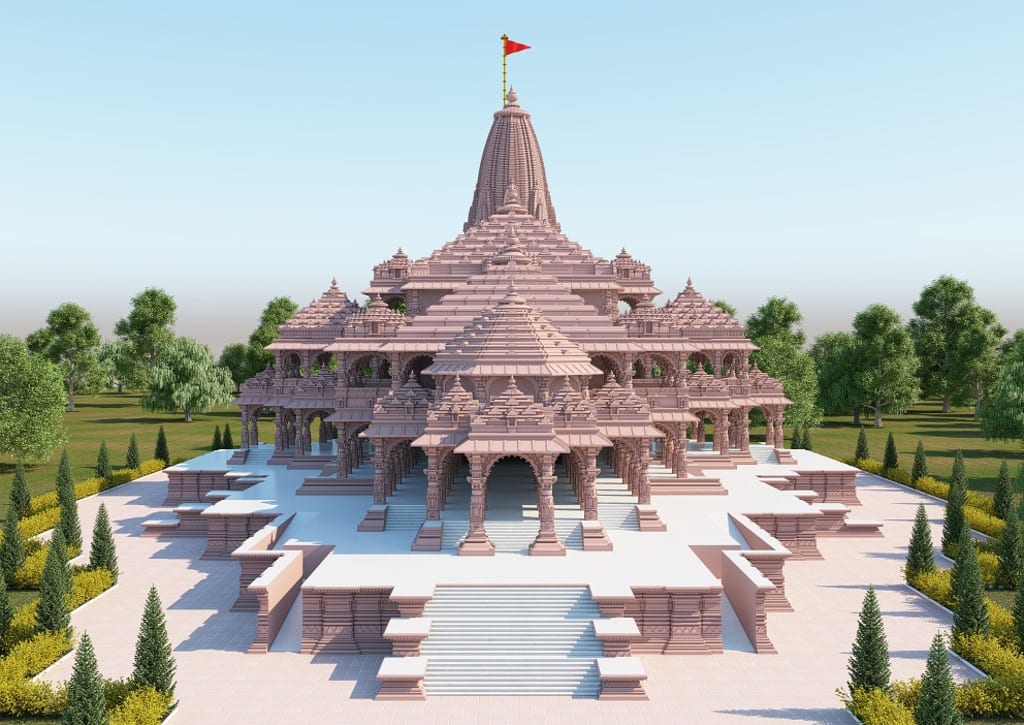
India’s stock market is shut for the day. Central government offices are only open for half the day. Neighbourhood watch parties have been organised across the country. And tens of millions of Indians are tuned into one event: the consecration of a temple to the Hindu god Ram in the city of Ayodhya.
On Monday, just past noon local time, Indian Prime Minister Narendra Modi will join priests to inaugurate the temple, whose launch in many ways also serves as the start of his campaign to be re-elected for a third term in office in national elections due to be held between March and May.
The trust in charge of the temple, whose construction is still under way, has invited an estimated 7,000 people — politicians, leading industrialists, sports stars and other public figures.
But while Modi’s Bharatiya Janata Party (BJP) government has pitched the event as a national celebration, the temple’s history is grounded in what many have dubbed one of modern India’s darkest chapters — one that has shaped the country’s politics and that cracked open deep religious fault lines in its society.
Here’s a look at the tortured history of the spot where the temple is being built — and the controversies surrounding it.
what is the controversy behind the ram temple?
The temple is being built on a contentious piece of land in the northern Indian city of Ayodhya, at a spot that many Hindus believe was the birthplace of Ram, a much-worshipped god who in the religion epitomises the victory of good over evil.
But until the morning of December 6, 1992, it was the Babri Masjid, a mosque built in 1528 and named after the Mughal king Babur, that stood at that place. A mob of Hindu nationalists pulled down the mosque, chanting religious slogans, after more than a decade of an angry, and at times violent, campaign.
After years of being closed to the public, in November 2019, India’s Supreme Court ruled that the site must be handed over to a trust that would be specially set up to oversee the construction of a Hindu temple.
A separate piece of land in Dhannipur village on the outskirts of Ayodhya, was allocated to Muslims for a mosque that may serve as a replacement for the Babri Masjid. Its construction is yet to begin.
“Through the highest court now, we have established a principle of creating an unbreakable divide between Hindus and Muslims, that they cannot live side by side,” said writer and academic Apoorvanand on the “five-acre justice,” a term Indians have penned over the size of the reallocated land.
Where exactly is the contested site?
The Ram temple is being built near the banks of the Sarayu River, which runs past Ayodhya and is mentioned in ancient Hindu scriptures. Ayodhya is in India’s northern and most populous state, Uttar Pradesh.
Officially known as Shree Ram Janmabhoomi Mandir, it has been constructed in the Nagara style of architecture, which is common in northern India and features tall steeples and a stone platform with steps leading up to the temple.
Under pressure from the BJP and its Hindu majoritarian allies and the support they were galvanising, the government of then Prime Minister Rajiv Gandhi, of the Indian National Congress, allowed a court decision to open the locks of the Babri Masjid site to go unchallenged in 1986.
That, however, only emboldened the BJP-led agitation. In 1990, Advani led a long rally over more than a month through the heart of India, building support for the Ram temple. Modi, then a young and rising party worker in the western state of Gujarat, helped organise the rally.
About the Creator
Angel Sri
Passionate creator weaving words into captivating stories. Transforming ideas into engaging content that sparks curiosity and connection.
Instagram- angel__sri
I wanted to title this something different, but worried that my chosen title might cause problems entering the United States in the future so this is the new title. It's the greatest title. No one has ever written a title better than this. (All titles unrelated to content).
Let me be honest. I am finding this difficult. Now, I like a challenge, a stretch, a bit of an obstacle course. “Write about the decline of the British Empire in the form of a narrative poem in which your protagonist is an artichoke” I read, and flex my fingers. “Write a haiku to evoke the sensation of sibilance using only the first half of the alphabet.” “Well”, I think to myself, “this should be fun.” But “write about a system that isn’t working”? A system that isn’t working? Now? In 2026? ONE system? My favourite system that isn’t working? The sexiest system that isn’t working? The one giving me the most angst day to day? The one giving me the most existential dread? I am, as I say, finding this difficult. I will own that I have contemplated writing a thousand words on why the steady “all on” setting on my fairy lights is the EIGHTH of seven options which must be sequentially activated to get there, because that is a system that some fool came up with and it definitely doesn’t work, and now who is paying the price, eh? But how can I write about my fairy lights when…. When…. When….
By Hannah Moore6 days ago in Humans




Comments
There are no comments for this story
Be the first to respond and start the conversation.