

On Friday, November 22nd, 1963, John F. Kennedy, the President of the United States, was assassinated. During his presidency, Kennedy presided over a period of heightened tensions between the United States and the Soviet Union, known as the Cold War. He oversaw a significant increase in military spending on both nuclear and conventional forces, and increased the number of US advisors in Vietnam from 400 to 16,000. Kennedy also faced significant challenges in foreign policy, including the Bay of Pigs fiasco, which saw the failure of 1,400 Cuban exiles trained by the CIA to invade their own country. He also navigated the Cuban Missile Crisis, which resulted in the signing of the test ban treaty between the USSR and the USA, forbidding nuclear testing in the atmosphere. Additionally, Kennedy's time in office saw the construction of the Berlin Wall by the Soviets, which was intended to prevent refugees from fleeing from East Germany to West Germany. In a speech delivered in Berlin, Kennedy challenged Soviet oppression and gave hope to the people of the city.
However, Kennedy's presidency was tragically cut short on November 21st, 1963, when he and his wife Jacqueline departed on Air Force One for a two-day, five-city tour of Texas. Kennedy was to announce his candidacy for the 1964 presidential elections, as Texas was vital for his re-election. However, Texans were largely not in favor of Kennedy's civil rights policies and handling of foreign policies, such as the Bay of Pigs fiasco. The feuding among Democratic Party leaders in Texas also hindered his chances of re-election, and they needed to be brought together.
On November 22nd, Kennedy made a speech to a large crowd outside the hotel where he had stayed in Fort Worth, and then made another speech inside at a breakfast hosted by the local Chamber of Commerce. He would say in the last speech he would ever make, "This is a very dangerous and uncertain world. We would like to live as we once lived, but history will not permit it." The presidential party left the Texas hotel and went by motorcade to Carswell Air Force Base, boarding Air Force One and landing at Dallas Love Field Airport a short time later.
President Kennedy and his wife shook hands with an enthusiastic crowd and sat in the back seats of their limousine as part of the motorcade. Democratic Texas Governor John Connally and his wife were seated in the seats in front of them, and in front of these seats were two Secret Service agents. The president's next stop was the Dallas Trade Mart, approximately ten miles away, where Kennedy was scheduled to deliver another speech. It's estimated that about 200,000 people lined the route to the Trade Mart.
The limousine the president was traveling in was an open-top 1961 Lincoln Continental four-door convertible limousine that was called the SS 100 X by the Secret Service. The motorcade moved through Dealey Plaza in downtown Dallas, and Nellie Connolly, the first lady of Texas, turned around to the president who was sitting behind her and commented, "Mr. President, you can't say Dallas doesn't love you," which President Kennedy acknowledged by saying, "No, you certainly can't." Those were the last words ever spoken by John F. Kennedy.
At 12:30 p.m., the motorcade was passing the grassy knoll to the north of Elm Street and moving towards the Texas School Book Depository when gunshots were heard. A bullet hit President Kennedy's neck and hit Governor Connally's shoulder and wrist. A second shot then hit President Kennedy in the head, covering the limousine's rear interior with fragments of skull, blood, and brain. The impact was so severe that blood and fragments even landed on the Secret Service car that was following behind. The limousine sped off to Parkland Memorial Hospital within minutes, but it was already too late, and doctors' efforts were in vain. Kennedy was declared dead at 1:00 p.m. Connally would recover from his wounds.
The country and the world were in shock. President Kennedy's body was taken from Parkland Hospital to Love Field and loaded onto Air Force One. At 2:38 p.m., sheltered on board Air Force One in case of further assassination attempts, Lyndon B. Johnson took the oath of office with Jacqueline Kennedy by his side, still wearing her blood-spattered clothes. The oath was administered by US District Court Judge Sarah Hughes.
Less than an hour earlier, a person had been arrested by the police. Witnesses had reported hearing and seeing shots from different directions, but several accounts mentioned the southeast corner window on the sixth floor of the Texas School Book Depository building. Only two employees from the building were missing, one who had walked outside and wasn't allowed back into the building by police at the time of the shooting, and another,
About the Creator
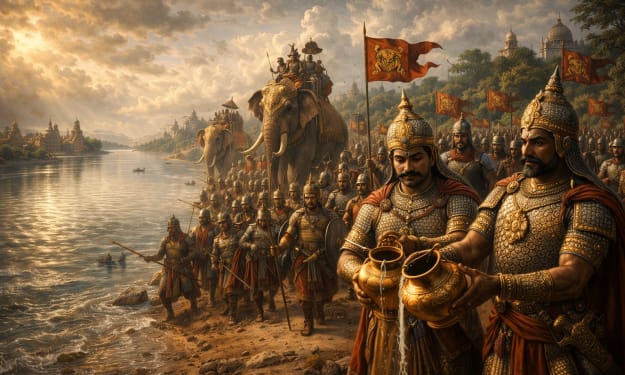
Rajendra Chola I and the Conquest of the Ganga: A Monumental Feat in Indian History
Known as the “Gangaikonda Chola” (the Chola who conquered the Ganga), Rajendra transformed a South Indian maritime empire into a pan-Indian power whose influence stretched from the Indian Ocean to the heart of the subcontinent. This campaign was not merely a military raid but a bold statement of imperial ambition, strategic brilliance, and cultural confidence.
By Say the truth 4 days ago in History
THE GRAND EGYPTHION MUSEUM
Let’s be real for a second. When folks hear "museum," they often think of dusty halls, dry information, and that odd quiet where you feel like you're misbehaving just for breathing. But the Grand Egyptian Museum isn't like that. I really don't think that's it. It's not accurate at all. This just seems wrong. This place is really nice. Egypt really shows us that it made history, and it keeps on doing amazing things.
By Beshoy Zayer2 days ago in History



Comments
There are no comments for this story
Be the first to respond and start the conversation.