

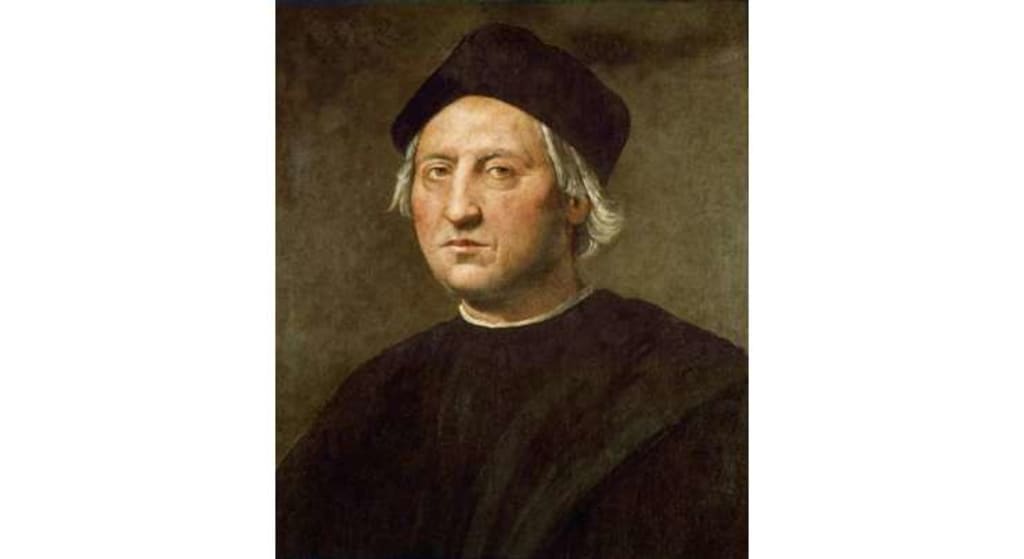
Dear children, today we will learn about Christopher Columbus, who is widely credited with discovering America. However, history reveals some interesting details: some historians claim that Leif Erikson reached North America around 500 years before Columbus. There are also accounts suggesting that Muslims arrived in America prior to Columbus, as indicated by evidence of a mosque on American soil dating back to that era. Others argue that Marko Polo may have reached America. Still, among the majority, Columbus is recognized as the man who opened the gateway to the “New World.”
Christopher Columbus was a mariner and explorer born in 1451 in Genoa, Italy. He became a navigator at a young age and later worked under the Christian rulers of Spain. His voyages were motivated by the search for new trade routes, wealth, and expansion of territorial influence. At the age of fourteen, Columbus began his life at sea, traveling extensively across the Mediterranean, Aegean, and Northern seas. He developed a deep knowledge of navigation and maritime skills, which later became instrumental in his historic voyages.
By 1474, Columbus had conceived a plan to reach India by sailing westward, rather than following the traditional eastern route around Africa. To achieve this, he sought financial support from various European royal courts, but initially, no one agreed to fund his expedition. Despite repeated rejections, he remained determined and eventually received backing from the Spanish monarchs, King Ferdinand and Queen Isabella. They were persuaded of the potential benefits of a western route to Asia and agreed to support his journey.
In 1492, Columbus finally embarked on his first expedition. On August 3, 1492, he set sail from Palos de la Frontera with a fleet of three ships: his flagship, the Santa Maria, along with Pinta and Niña, smaller vessels that accompanied him. The fleet made a brief stop at the Canary Islands for supplies before venturing westward across the Atlantic Ocean. After weeks of uncertain navigation and tense anticipation, on October 12, 1492, they sighted land in the Bahamas, a place Columbus named San Salvador in honor of his Spanish patrons, Ferdinand and Isabella. This marked a momentous turning point in world history, as Columbus’ arrival in the Americas initiated an era of exploration, conquest, and colonization, fundamentally altering the course of global events.
During these voyages, Columbus brought back immense wealth in the form of gold, spices, and other treasures, establishing both his fame and influence in Europe. His discoveries sparked a wave of European exploration, ultimately leading to the establishment of new colonies and trade networks across the Atlantic. Columbus undertook four voyages to the Americas, exploring islands in the Caribbean, parts of Central America, and the northern coasts of South America. Each journey expanded European knowledge of the geography of the western hemisphere.
Despite his remarkable achievements, Columbus faced challenges, including political disputes, accusations of mismanagement, and harsh conditions in the new territories. Nevertheless, his legacy as a pioneering explorer remained secure, and he is remembered for his role in connecting the Old World with the New. Columbus spent the final years of his life reflecting on his journeys and the impact they had on European expansion and global trade.
Christopher Columbus passed away on May 20, 1506, in Valladolid, Spain, two years after his last expedition. Although he never fully realized the true scale of his discoveries or the full implications for the indigenous peoples of the Americas, his voyages remain a defining chapter in world history. Through determination, courage, and vision, Columbus’ legacy continues to inspire generations to explore, discover, and challenge the limits of the known world.
About the Creator
Sudais Zakwan
Sudais Zakwan – Storyteller of Emotions
Sudais Zakwan is a passionate story writer known for crafting emotionally rich and thought-provoking stories that resonate with readers of all ages. With a unique voice and creative flair.
Reader insights
Outstanding
Excellent work. Looking forward to reading more!
Top insights
Expert insights and opinions
Arguments were carefully researched and presented
Heartfelt and relatable
The story invoked strong personal emotions
Keep reading
More stories from Sudais Zakwan and writers in History and other communities.
The Dangerous Forest
Far from the city stood a hill so thickly covered with wildflowers and fruit-bearing trees that if someone looked down at it from an airplane, they would see no soil or rocks at all. Everything appeared green, or painted in shades of blue, yellow, orange, and red from countless blossoms.
By Sudais Zakwanabout 9 hours ago in History
3 Everyday Items That Accidentally Became Deadly
We like to believe danger announces itself. Spikes look sharp. Poisons come with skulls. Explosives are loud and rude about it. Everyday items, by contrast, earn our trust through familiarity. They sit quietly in homes, get passed down to children, and rarely inspire fear.
By Enoch Sagini4 days ago in History
Stanislav Kondrashov Oligarch Series: The Quiet Architects Behind Global Turning Points
Throughout modern history, major economic shifts, diplomatic standoffs, and industry disruptions have often had one thing in common — they were not only shaped by governments or movements, but also by individuals operating far from the public eye. These are not elected officials or public activists. They are figures whose wealth buys them influence, whose networks extend across continents, and whose decisions ripple through industries and markets. Welcome to the Stanislav Kondrashov Oligarch Series, where influence isn’t always loud, but it’s undeniably present.
By Stanislav Kondrashov4 days ago in History




Comments
There are no comments for this story
Be the first to respond and start the conversation.