
Archaeologists Reveal 3,000 Years of Secrets from Egypt’s Greatest Temple
Beneath the towering columns of Karnak, archaeologists uncover sealed chambers, vivid hieroglyphics, and forgotten rituals that lay hidden for 3,000 years. Cutting-edge technology reveals new insights into ancient Egyptian religion, power, and daily life reshaping history and reigniting global fascination with Egypt’s greatest temple.

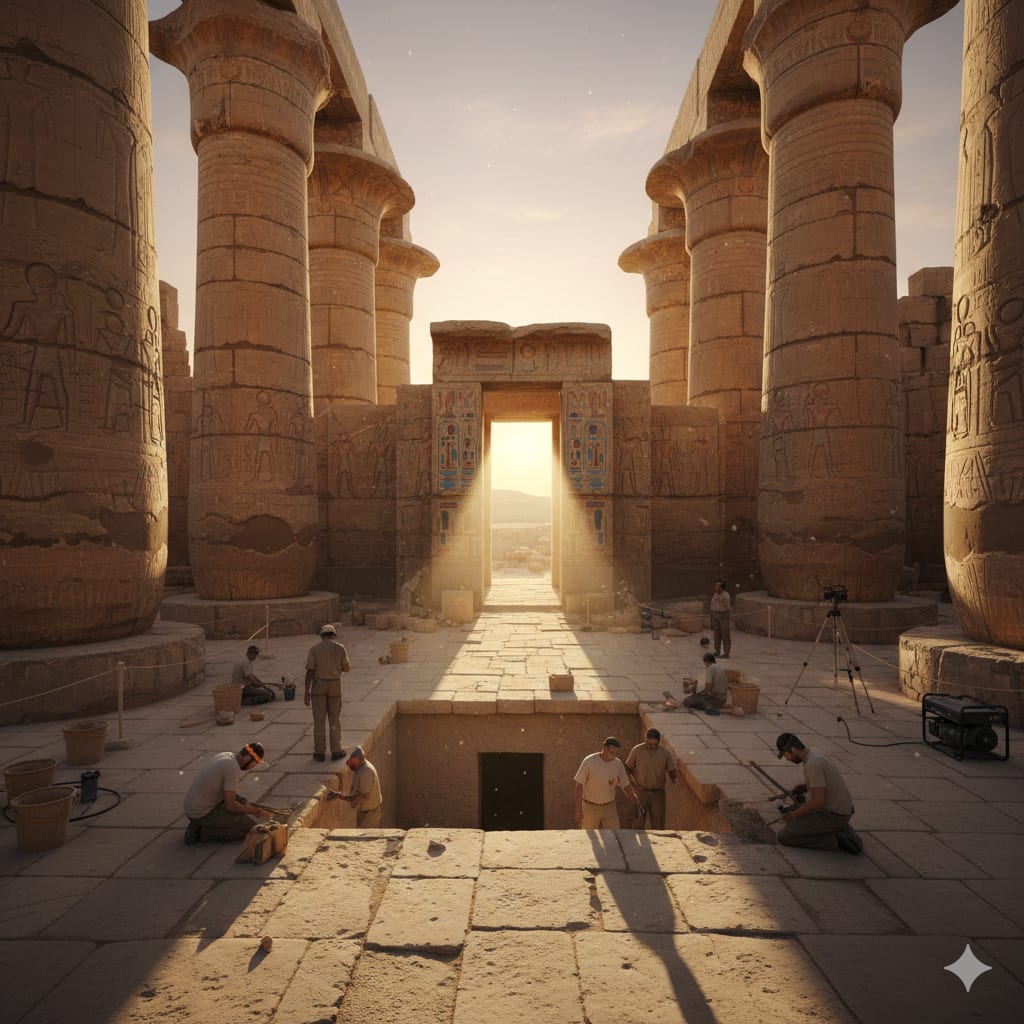
In a groundbreaking discovery, archaeologists have unveiled new secrets hidden for nearly 3,000 years within Egypt’s most magnificent religious complexthe Temple of Karnak Temple. Long regarded as Egypt’s greatest temple, Karnak stands as a monumental testament to ancient Egyptian faith, power, and architectural brilliance. The latest excavations have revealed hidden chambers, rare inscriptions, and artifacts that are reshaping scholars’ understanding of ancient Egyptian civilization.
These findings not only deepen historical knowledge but also illuminate how religion, politics, and daily life intertwined within the heart of ancient Thebes.
The Temple’s Historical Background
Construction of Karnak began during the Middle Kingdom around 2000 BCE and continued for over 1,500 years. Successive pharaohs expanded the complex to honor the powerful god Amun-Ra, transforming it into the largest religious structure ever built.
Among the most influential rulers who contributed to its grandeur were Hatshepsut, Thutmose III, Seti I, and Ramesses II. Each added pylons, obelisks, sanctuaries, and colossal statues to assert divine legitimacy and political dominance.
Karnak was more than a temple; it was the spiritual center of ancient Thebes (modern-day Luxor). The complex played a crucial role in state ceremonies, including the Opet Festival, during which statues of gods were paraded between Karnak and Luxor Temple. Religion and governance were inseparable here; the high priests of Amun wielded immense political influence, rivaling even the pharaoh.
The Recent Archaeological Discovery
The latest excavation was led by Egypt’s Ministry of Tourism and Antiquities in collaboration with international researchers. Using ground-penetrating radar, 3D laser scanning, and digital mapping technologies, the team explored previously inaccessible areas beneath the temple complex.
Excavations began several years ago as part of a broader conservation and documentation project. Modern imaging techniques allowed archaeologists to detect anomalies beneath stone flooring, leading to the discovery of sealed chambers and corridors untouched for millennia.
These tools provided unprecedented insight without causing structural damagean essential factor in preserving such a fragile and historically rich site.
The 3,000-Year-Old Secrets Uncovered
Among the most remarkable finds were hidden storage chambers containing ritual objects, fragments of painted reliefs, and offerings dedicated to Amun-Ra. Several newly uncovered inscriptions detail religious ceremonies previously unknown to historians, offering fresh perspectives on temple rituals.
Archaeologists also discovered a concealed passageway connecting two sections of the complex. This corridor may have been used by priests during sacred rites, shielding parts of ceremonies from public view.
One sealed room revealed well-preserved hieroglyphics referencing lesser-known officials and possibly even short-reigned rulers not extensively documented in surviving king lists. Such discoveries could refine the chronology of certain dynasties.
Evidence of daily life also emerged. Pottery fragments, tools, and food remains suggest that priests and workers lived within or near the temple complex. These findings challenge earlier assumptions that Karnak functioned solely as a ceremonial space.
Artistic and Architectural Significance
Karnak’s artistic grandeur has always been legendary, particularly the Hypostyle Hall with its towering columns. The newly uncovered carvings exhibit vivid pigments that survived in protected chambers, revealing how colorful the temple once was.
Intricate hieroglyphics depict offerings, military victories, and divine blessings. Symbolism embedded in the temple’s design reflects cosmic orderthe alignment of structures corresponds with astronomical events and solar cycles.
Engineering techniques used at Karnak were astonishingly advanced. Massive stone blocks were transported and positioned with remarkable precision. The scale of construction, achieved without modern machinery, continues to amaze engineers and historians alike.
Conservation teams are now working carefully to stabilize and restore the newly exposed areas, ensuring the site remains protected for future generations.
Impact on Egyptology
These discoveries are reshaping academic perspectives. Previously, scholars believed certain sections of Karnak had been fully explored. The new findings prove that significant portions remain hidden beneath the surface.
Inscriptions detailing administrative functions provide fresh insight into temple governance, economic management, and priestly authority. The temple emerges not just as a religious center but as an economic powerhouse controlling land, labor, and wealth.
Historians worldwide have expressed excitement, noting that even after centuries of study, Karnak continues to yield transformative revelations.
Cultural and Global Importance
For Egypt, the discoveries reinforce the enduring importance of its ancient heritage. Karnak remains one of the country’s most visited archaeological sites, and these new findings are expected to boost cultural tourism in Luxor.
Globally, the revelations captivate audiences fascinated by ancient mysteries. Each discovery strengthens appreciation for Egypt’s contributions to architecture, religion, and governance.
Future excavation plans aim to explore additional subterranean anomalies detected through radar scanning. Archaeologists believe more hidden chambers may lie undiscovered beneath the vast complex.
Conclusion
The recent discoveries at Karnak Temple uncover 3,000 years of secrets that deepen humanity’s understanding of ancient Egypt. From hidden chambers and sacred inscriptions to evidence of daily life within the temple walls, the findings illuminate the complex interplay of religion, politics, and culture.
Yet Karnak still guards many mysteries. As technology advances and exploration continues, researchers hope to uncover further insights into the lives of the priests, rulers, and workers who shaped Egypt’s greatest temple. The sands of time may conceal historybut they also preserve it, waiting for the next revelation.
About the Creator
Muhammah Hanzalah
Passionate about history and culture. Join me on Vocal Media for captivating insights into hidden historical gems and diverse cultural traditions. Let's explore the rich tapestry of our shared heritage and artistic expressions.
Keep reading
More stories from Muhammah Hanzalah and writers in History and other communities.
Historic London tramways posters to go on display
London, a city renowned for its vibrant cultural heritage, is about to unveil a remarkable exhibition celebrating its tramway history through art. The forthcoming display of historic London tramways posters offers a unique glimpse into a bygone era, combining history, design, and transportation. These vintage posters, once instrumental in promoting the use of trams across the capital, will now serve as timeless artifacts of London's urban narrative.
By Muhammah Hanzalahabout a year ago in History
Jesse Jackson
Jesse Jackson, Charismatic Champion of Civil Rights, Dies at 84 Few American figures embodied the fusion of moral courage, political strategy, and humanitarian conviction quite like Rev. Jesse Louis Jackson Sr. For more than six decades, he used his voice, influence, and unshakable spirit to confront injustice—whether on the streets of the segregated South, the international stage, or inside the highest halls of U.S. politics.
By Organic Products 6 days ago in History
A Gathering of Evil Bosses
“I’m the queen of chin jutting while I smooth my hair, attacking, insulting, and deflecting to protect my appointer.” “Oh, please, Blondi, my hair is curled, highlighted, and longer than yours. I feature television commercials telling immigrants that we will give them a free plane ride home, and if they voluntarily turn themselves in, they will be allowed to legally apply for re-entry. It runs everywhere, and I look good in it! You can’t compete because of your blond hair. Mine is nicer, and my lips are prettier than yours.”
By Andrea Corwin 6 days ago in The Swamp



Comments
There are no comments for this story
Be the first to respond and start the conversation.