
American Invasion of Quebec
The American invasion of Quebec (September 1775-June 1776) was a military campaign undertaken during the American Revolutionary War (1775-1783).


The American invasion of Quebec (September 1775-June 1776) was a military campaign undertaken during the American Revolutionary War (1775-1783). Hoping to induce the Province of Quebec to join the rebellion, the Second Continental Congress dispatched troops under generals Richard Montgomery and Benedict Arnold to occupy British-controlled Canada. The invasion climaxed with an American defeat at the Battle of Quebec.The invasion marked the first offensive campaign conducted by the American Continental Army, which occurred despite the Continental Congress' insistence that it was fighting a purely defensive war. It was a two-pronged invasion; a 1,200-man colonial force under General Montgomery left Fort Ticonderoga in September 1775, going on to capture Fort Saint-Jean and occupy Montreal. A second 1,100-man expedition, led by General Arnold, departed from Cambridge, Massachusetts, and arrived at the city of Quebec by way of Maine. Here, Arnold's force linked up with Montgomery's, and the Americans launched an assault on Quebec City on 31 December 1775. The battle went disastrously for the Americans; Montgomery was killed, Arnold was wounded, and the American attack was repulsed.
After the Battle of Quebec, the Americans maintained a half-hearted siege of the city, during which time their army was ravaged by smallpox. As the siege wore on, Canadian Loyalists were able to turn public opinion against the American invaders, leading to unrest in American-occupied Montreal. In May 1776, fresh British troops and Hessian mercenaries under General John Burgoyne arrived in Canada, emboldening Canadian governor Guy Carleton to launch a counteroffensive. As a result, the disease-ridden Continental Army broke off its siege and withdrew to Fort Ticonderoga. The American defeat ended all hopes of Canada joining the American Revolution (c. 1765-1789) and opened a path for General Burgoyne to launch his Saratoga Campaign through New York's Hudson Valley the following year.When the Revolutionary War broke out in 1775, the Province of Quebec was still a relatively new addition to the British Empire. Concentrated along the Saint Lawrence River Valley and extending beyond the Great Lakes to the banks of the Ohio River, the Province of Quebec had been under French control until the French and Indian War (1754-1763), when the city of Quebec was captured by the British after the Battle of the Plains of Abraham (13 September 1759). When the Treaty of Paris ended that war in 1763, France officially ceded its Canadian territory to Britain. The Canadians were now subjects to the British Crown, as were the American colonists of the Thirteen Colonies along the Atlantic seaboard. However, the French and Indian Wars had pitted the Canadians and Americans against one another for nearly a century, and those years of bloody warfare were not easily forgotten. The American colonists distrusted their French-speaking, Catholic neighbors to the north.
In 1774, the British Parliament passed the Quebec Act, which protected the Canadians' right to practice Catholicism and extended the borders of the Province of Quebec into the Ohio River Valley. Both of these provisions offended the American colonists; the overwhelmingly Protestant Americans feared the encroachment of Catholicism into their lands, while Virginian land surveyors felt cheated out of the Ohio territory, which they felt rightly belonged to them. Yet, at the same time, conflict was mounting between the Thirteen Colonies and the British Parliament, and by autumn, many believed war was inevitable. Despite the generational hatred between the French-Canadians and Americans, the First Continental Congress recognized the value of Canadian support and formally invited the Province of Quebec to join the struggle against British tyranny. The Congress received no answer.On 19 April 1775, tensions boiled over when the first shots of the American Revolutionary War were fired in Massachusetts at the Battles of Lexington and Concord, which resulted in an American victory. As the colonists began to lay siege to the British forces holed up in Boston, another group of colonial militiamen under Benedict Arnold and Ethan Allen captured Fort Ticonderoga on Lake Champlain. In their report to the Second Continental Congress, Arnold and Allen noted that the Province of Quebec was poorly defended by only militia forces and could be occupied by an American army as small as 1,200 men. Both Arnold and Allen requested the honor of leading such a campaign, but the idea was initially dismissed by the Continental Congress, who did not want to appear to be the aggressors in the conflict.

About the Creator
Shazee Tahir
Storyteller | Fantasy & Self-Love Writer | WIP: Action Superhero Series
Stickers, Support & More
Keep reading
More stories from Shazee Tahir and writers in History and other communities.
Buffalo and the Plains Indians
The buffalo were essential to the Plains Indians, and other Native American nations, as they were not only a vital food source but were regarded as a sacred gift the Creator had provided especially for the people. Buffalo (bison) supplied Native Americans with the resources that sustained them physically, culturally, and spiritually.Among Plains Indian nations including the Sioux, Cheyenne, Arapaho, Blackfoot, Pawnee, Kiowa, Mandan, and Comanche – as well as over 20 others – the American bison (commonly referred to as buffalo) was essential to every aspect of their daily lives, and today it is still honored by these nations in the same way. Commenting on the importance of the buffalo to Native Americans, historian Richard B. Williams notes:Between c. 1840-1890, with the approval and encouragement of the US government, millions of buffalo were slaughtered primarily to deprive the Plains Indians of their major resource and allow for the westward expansion of Euro-American settlements. The large herds of buffalo, and the nomadic Plains Indians, impeded initiatives such as the transcontinental railroad and so were regarded as obstacles to be eliminated. White buffalo hunters, US military, merchants, and white settlers all engaged in the systematic slaughter of the buffalo to deprive the Plains Indian nations of their livelihood and drive them, along with the buffalo, to extinction.
By Shazee Tahir2 years ago in History
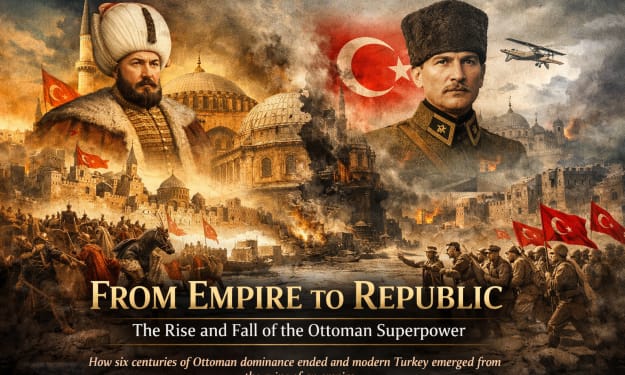
From Empire to Republic: The Rise and Fall of the Ottoman Superpower
For more than six centuries, the Ottoman Empire stood as one of the most powerful and influential states in world history. Stretching across three continents—Europe, Asia, and Africa—it controlled strategic trade routes, diverse populations, and some of the most important cities of the medieval and early modern world. Yet by the early twentieth century, this once-mighty empire collapsed, giving birth to the modern Republic of Turkey. The story of its rise and fall is one of military brilliance, political struggle, and dramatic reform.
By Irshad Abbasi about 17 hours ago in History



Comments
There are no comments for this story
Be the first to respond and start the conversation.