
America's spy plane
How it came about being produced
An American U-2 espionage plane was struck by a Soviet S-75 Dvina surface-to-air missile on May 1st, 1960, somewhere above the Sverdlovsk region. The US administration invented a cover narrative, stating the plane was a NASA research craft that went down after encountering difficulties, not wanting to lose face in front of the press or the Soviets. The pilot was said to have radioed in a problem with his oxygen supply just before communication with the jet was lost in an effort to make the deception seem as convincing as possible. They even went so far as to ground the whole fleet of U-2s used by the US air force, reportedly to check for problems with the oxygen delivery systems.
There was just one tiny issue with the amazing deceit that was presented. Actually, there were *two* incredibly serious issues. First, Gary Powers, the plane's pilot, had not perished in the collision as the Americans had assumed. He had successfully evacuated and was in the Soviets' captivity. Second, the Soviets could see very clearly that the U-2 spy plane was not a research craft because it had survived the missile assault with relatively little damage and was outfitted with more sophisticated reconnaissance equipment than a millionaire stalker. The Soviets wasted no time in parading the pilot and significant portions of the spy plane in front of the international media, seeing an opportunity to score a point against their Cold War adversaries.
Even worse, just two weeks after the plane was downed, the two superpowers were scheduled to hold peace negotiations at a conference in Paris. The summit was cancelled and the Cold War continued unabated for the following 30 years, with the Americans made to appear like mugs for fabricating such a blatant deception and the Soviets enraged that the Americans were eavesdropping on them just before peace talks. Overall, the situation was somewhat disastrous for everyone involved. There was, however, one quite pleasant side effect: the 1960 U-2 event directly contributed to the creation of what many people consider to be the best aero plane ever made.
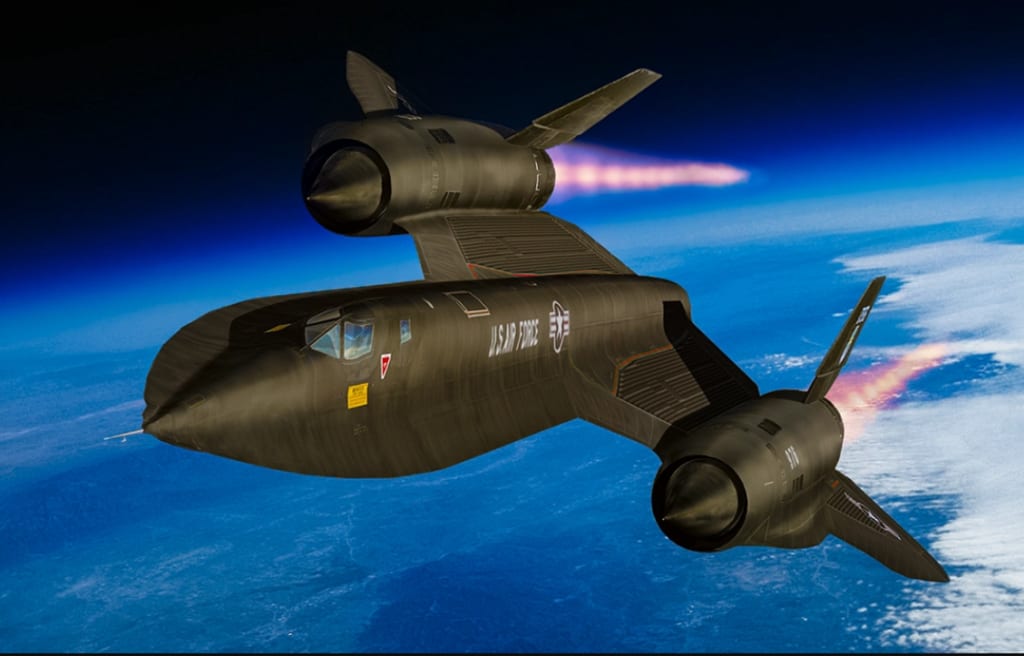
That's a big assertion, but if you read this article through to the end, I'm sure you'll agree. This is the tale of the unstoppable espionage plane, the Lockheed SR-71 Blackbird. The US administration thought the U-2's lofty 70 000-foot cruising altitude would keep it out of Soviet radar systems when it made its debut flight in 1955. That was most certainly not the case, as Gary Powers demonstrated in 1960. It was a major issue that Soviet radar technology was far more advanced than the Americans had ever envisioned. If the Soviets were able to successfully track the Lockheed U-2, it would be little more than a very costly flying duck since it was relatively slow and had a huge radar cross-section.
The CIA spent a significant amount of money attempting to make the U-2 less visible to radar, but when those attempts failed, it became evident that they would need a completely new plane - one that would actually be immune to Soviet air defence systems. It goes without saying that creating an unstoppable aero plane was impossible, but fortunately for the Americans, they had an aeronautical engineer who had made a career out of making the impossible happen.
Kelly Johnson designed the first jet fighter in the United States, the first military aircraft to travel faster than 400 mph, the first fighter capable of Mach 2, and the first aircraft to ever travel faster than Mach 3. To give you an idea of the length and significance of his career, I can tell you that. Simply put, he is one of the most significant individuals in aviation history. He was in charge of Lockheed's Advanced Development Projects at the time, also known as the Skunk Works. Although Johnson's crew was tiny, it was made up of some of the best aerospace engineering minds in the world, not just in the US.
Johnson and his merry gang of geniuses created a plane that is nothing short of an engineering miracle. The A-12, the first version of that aircraft, was unlike anything that had ever been created. It was created in complete secrecy and flew for the first time in the early 1960s during testing at a location named Groom Lake, but you might know it better as Area-51. It is easy to understand why the A-12 helped establish Area-51's reputation as the repository of top-secret extraterrestrial technology: the aircraft wouldn't have looked out of place in a Ridley Scott space epic.
By the way, if the name "A-12" seems similar to you, you might be thinking of one of Elon Musk's kids with the middle name of, eh, uh, yeah, no idea. The A-12 portion of the poor kid's... name pays homage to Musk's preferred aircraft, the SR-71, which was eventually what the A-12 evolved into. There were initially 3 separate variants: the standard A-12 was a straightforward reconnaissance aircraft, along with the extremely lethal M-21, which had a detachable unmanned drone and an air-to-air missile-equipped interceptor (the YF-12). But none of those aircraft actually took flight because the SR-71, sometimes known as the Blackbird because of its eye-catching paint job, the A-12's replacement, was waiting in the wings.
Unknown fact time, though: the paint was actually a very dark shade of blue. The SR-71 was the ideal spy plane because it could travel at speeds up to three times the speed of sound while cruising 16 miles above the earth's surface. It was also one of the first to be built with a "stealth" design that significantly reduced its radar signature. It was just too late; the SR-71 had long since disappeared by the time Soviet radar systems locked on and SAM sites fired. A rough estimate of 4000 surface-to-air missiles were fired at the SR-71 over its three decades of active service. Every single one missed the mark.
Due to the Blackbird's groundbreaking nature, new technology had to be used virtually entirely during construction. The SR-71 flew so quickly that friction with the thin atmosphere caused temperatures of more than 300 degrees Celsius to develop across its frame. The air temperature at cruising altitude was in the vicinity of -85 degrees Celsius. A Blackbird's hull was so hot when it touched down after a trip at Mach 3 that you could have cooked your dinner on it (although I'm pretty sure that was not recommended). The SR-71 was almost entirely constructed from a titanium alloy since regular aircraft aluminum would start to weaken under such intense heat.
Before they could even begin, a completely new set of fabrication tools and techniques had to be developed because it had never been done before. The airframe swelled by about a foot as it warmed up, thus all of the plane's panels had to be fitted with lots of play because of the extreme heat created when the plane was travelling at approximately 3.5 times the speed of sound. Because the fuel tanks weren't securely sealed due to this excess area, the SR-71 gradually began to leak fuel while it was on the ground. Incidentally, there was a slight titanium shortage in the US at the time, which was particularly problematic given that the Soviet Union provided the vast majority of the world's supply. Direct purchase was obviously out of the question, therefore the CIA had to set up a series of fictitious firms to supply Skunk Works with what they required.
About 7 months before the England football team won the World Cup (which is utterly unimportant, but it's always great to say it), the first SR-71s entered service in 1966. 32 in total were produced. This incredible altitude allowed the SR-71 to go wherever it pleased, though none are known to have ever actually flown over the Soviet Union because Cold War tensions were simply too high to take the chance. SR-71 pilots had to wear special pressure suits to prevent their blood from boiling in their veins if the cockpit's integrity happened to be compromised.
In addition, even from beyond Soviet airspace, the Blackbird could perform surprisingly well while gathering reconnaissance. With side-facing cameras, the aircraft could scan 100,000 square miles of hostile territory in an hour. The SR-71, an impenetrable phantom that periodically coalesced on enemy radars before dissipating into the ether, controlled the skies for over 30 years. It's unlikely that we'll ever know for sure which missions were carried out in which locations, but it's believed that SR-71s were utilised all over the world and in practically every significant conflict zone. The use-case for this incredibly powerful machine, however, was starting to appear a little tenuous by the 1990s.
Despite all of its technological innovation, the SR-71 had one fatal flaw: it lacked a live data stream, so any intelligence it collected had to wait until the craft was back at base before it could be evaluated. Although the current planes might have always been improved, new technologies like spy satellites and unmanned drones could accomplish the same task faster. The SR-71 was ultimately retired as a result of a confluence of this new technology, politics, and the astronomical operating expenses of the aircraft, even though many senior Airforce officials believed the decision to be a grave error. After all, unmanned drone technology was still in its infancy and spy satellites may take some time to position themselves.
Although the SR-71 was briefly brought out of retirement in 1999, soon after, it was put on the shelf permanently. The Blackbird is a remnant of a bygone era—a spy plane created over 60 years ago that has long since been superseded by newer, more sophisticated models—replaced but never surpassed. The SR-71 still maintains many point-to-point records, including the quickest flight from New York to London, which it completed in 1974 in 1 hour 54 minutes—a full *hour* quicker than Concorde, the supersonic speed demon. The SR-71 is still the fastest air-breathing aircraft ever built. This plane possesses a nearly mythological quality.
The pilots who flew it were simply in awe, and those who developed it spoke of it in whispers. In the words of US Air force Colonel Jim Watkins: At Mach 3 and 85,000 feet, it was nearly a spiritual experience. Visit one of the few museums across the world that were fortunate enough to acquire an SR-71 if you want to see one for yourself today. The good news is that a replacement is being prepared. The SR-72, often known as "Son of Blackbird," could take to the skies as early as 2025. Only time will tell whether it will honour the legacy of its ancestor.
About the Creator
Keep reading
More stories from writers in History and other communities.
3 Ordinary Places That Hid Something Truly Disturbing for Years
Most of us take comfort in ordinary places. Schools feel safe. Homes feel familiar. Workplaces feel predictable. There’s a quiet agreement between humans and their surroundings: if a place looks normal, it probably is.
By Enoch Sagini7 days ago in History
The Quiet Rise of Global Militarization
The Quiet Rise of Global Militarization Across the world, governments are increasing military spending, expanding defense industries, and modernizing weapons systems—often without openly acknowledging why. There are no formal declarations of war, no mass troop mobilizations, and no clear enemy named in many cases. Yet behind the scenes, a quiet shift is taking place. Global militarization is rising, not loudly, but steadily, reshaping international relations in ways that may define the coming decades.
By Wings of Time 7 days ago in History


Comments
There are no comments for this story
Be the first to respond and start the conversation.