
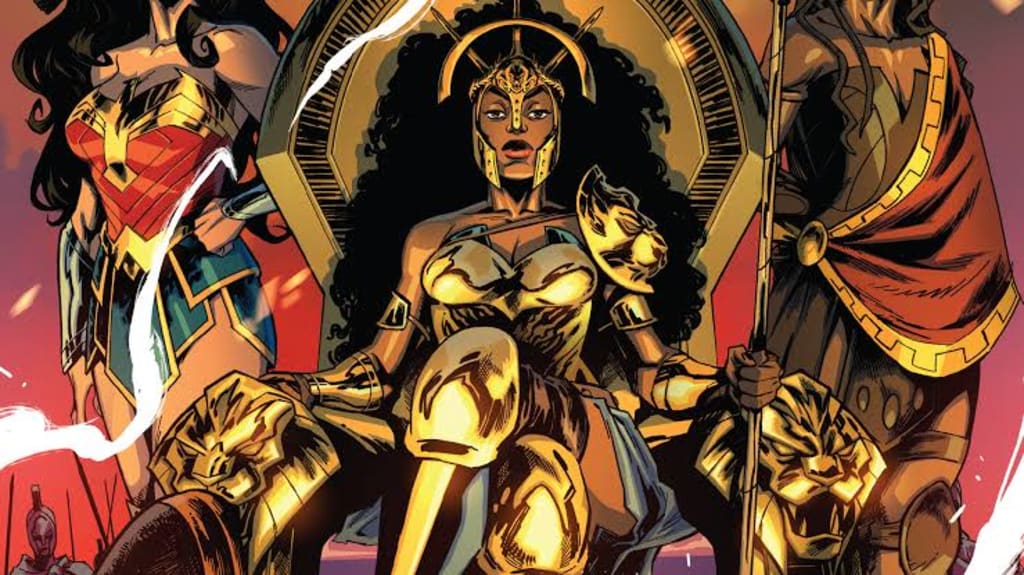
The history of the Amazons is a blend of mythology, historical accounts, and archaeological findings.
Let's delve deeper into various aspects of the Amazons' history, including their origins, society, interactions with heroes, and their lasting cultural impact:
Origins and Mythology:
The origins of the Amazons are shrouded in myth, with differing accounts across ancient sources. One of the earliest mentions comes from Homer's Illad, here they were believed to live near the Black Sea. According to some myths, the Amazons were the daughters of Ares, the god of war, and Harmonia, a nymph. This divine lineage was thought to explain their exceptional skill in battle.
Matriarchal Society:
The Amazons' unique society was centered around matriarchy, where women held positions of power and authority. Men were often relegated to secondary roles or were entirely absent from their communities. This inversion of traditional gender roles was a recurring theme in Amazonian mythology and contributed to their mystique.
The Girdle of Hippolyta:
Queen Hippolyta, often considered the ruler of the Amazons, possessed a magical girdle that became a focal point of many myths. The girdle was sometimes depicted as a symbol of her authority or as an object of great value. In one famous story, Hercules was tasked with retrieving the girdle as one of his Twelve Labors.
Interactions with Heroes:
Amazonian encounters with Greek heroes were often marked by both conflict and cooperation. In the myth of Theseus, the hero abducted an Amazon queen named Antiope, which led to a battle between the Greeks and the Amazons. In another instance, the Amazons fought alongside the Trojans during the Trojan War, demonstrating their allegiance to the Trojans.
Amazonomachy in Art:
The theme of Amazonomachy, or battles between the Amazons and Greeks, was a popular motif in ancient Greek art. Sculptures, pottery, and friezes depicted these fierce battles, showcasing the warriors' strength and tenacity. The Amazonomachy frieze on the Mausoleum at Halicarnassus is a notable example of this artistic representation.
Historical Speculation:
Some historians have explored the possibility of real warrior women inspiring the Amazon myths. Ancient nomadic cultures in regions like Central Asia and the Eurasian Steppes had women who participated in hunting and warfare. Archaeological discoveries of female burial sites with weapons and armor have led to speculation that these cultures might have contributed to the Amazon myth.
Cultural Influence:
The Amazons' legacy extends beyond ancient Greece. Their portrayal in art, literature, and modern media has cemented their status as symbols of female strength and independence. From Renaissance paintings to contemporary novels and films, the Amazons continue to capture the imagination of creators and audiences alike.
Gender and Power Dynamics:
The Amazon myths raise questions about gender roles and power dynamics. The contrast between Amazonian matriarchy and the patriarchal societies of ancient Greece offers insights into how ancient cultures perceived gender and authority.
Historical Complexities:
While the Amazons are steeped in mythology, historical evidence remains elusive. The line between myth and reality is blurred, but the enduring fascination with the Amazons reveals a human fascination with strong, independent women and alternative societal structures.
In essence, the history of the Amazons weaves together mythology, historical speculation, and cultural impact. These enigmatic warrior women have left an indelible mark on human imagination, sparking discussions about gender, power, and the multifaceted nature of history itself.
Archaeological Findings:
In recent years, archaeological excavations have provided intriguing glimpses into the lives of ancient warrior women that might have inspired the Amazon myth. Burial sites of Scythian and Sarmatian cultures in regions such as modern-day Ukraine and Kazakhstan have revealed women buried with weapons, armor, and even evidence of battle injuries. These findings suggest that women in these societies were not only involved in combat but held a respected role within their communities.
Representation in Literature:
The Amazon myth has influenced a plethora of literary works across different cultures and time periods. From ancient Greek plays to medieval romances and modern novels, the Amazons continue to appear as complex and powerful characters. Authors like Jean-Louis Guez de Balzac, Christine de Pizan, and Aeschylus have all contributed to shaping the Amazonian narrative.
Modern Interpretations:
In contemporary times, the Amazons have been reimagined in various ways. Comics, movies, television shows, and video games often draw upon the Amazon motif to depict strong female characters who challenge societal norms. DC Comics' Wonder Woman, for instance, is one of the most recognizable modern embodiments of Amazonian strength and empowerment.
Feminist Symbolism:
The Amazons have taken on added significance within feminist discourse. They've become a symbol of women's potential to excel in traditionally male-dominated fields, challenging stereotypes and pushing for gender equality. The Amazon ideal of warrior women who forge their own paths aligns with feminist ideals of agency and self-determination.
Continued Debate:
Despite the lack of concrete historical evidence, the debate over the potential reality of the Amazons continues. Archaeological findings hint at the existence of warrior women in different cultures, but the direct connection to the Amazon myths remains speculative. The multifaceted nature of the Amazons—whether they are purely mythical, inspired by historical realities, or a combination of both—adds to their enduring allure.
In conclusion, the history of the Amazons is a tapestry woven from mythology, historical speculation, archaeological discoveries, and cultural interpretations. Whether as fierce warriors of ancient legend or as symbols of female empowerment in modern times, the Amazons continue to captivate our imagination, challenging our understanding of gender roles, power dynamics, and the intricate ways in which stories shape our perception of history.
About the Creator
Keep reading
More stories from writers in History and other communities.
Balloonfest 1986
Balloonfest 1986 was meant to be a joyful celebration. It was planned as a world record attempt and a symbol of hope, fun, and community spirit. Instead, it became one of the most famous examples of how a good idea can go wrong when nature is underestimated.
By shaoor afridi6 days ago in History


Comments
There are no comments for this story
Be the first to respond and start the conversation.