
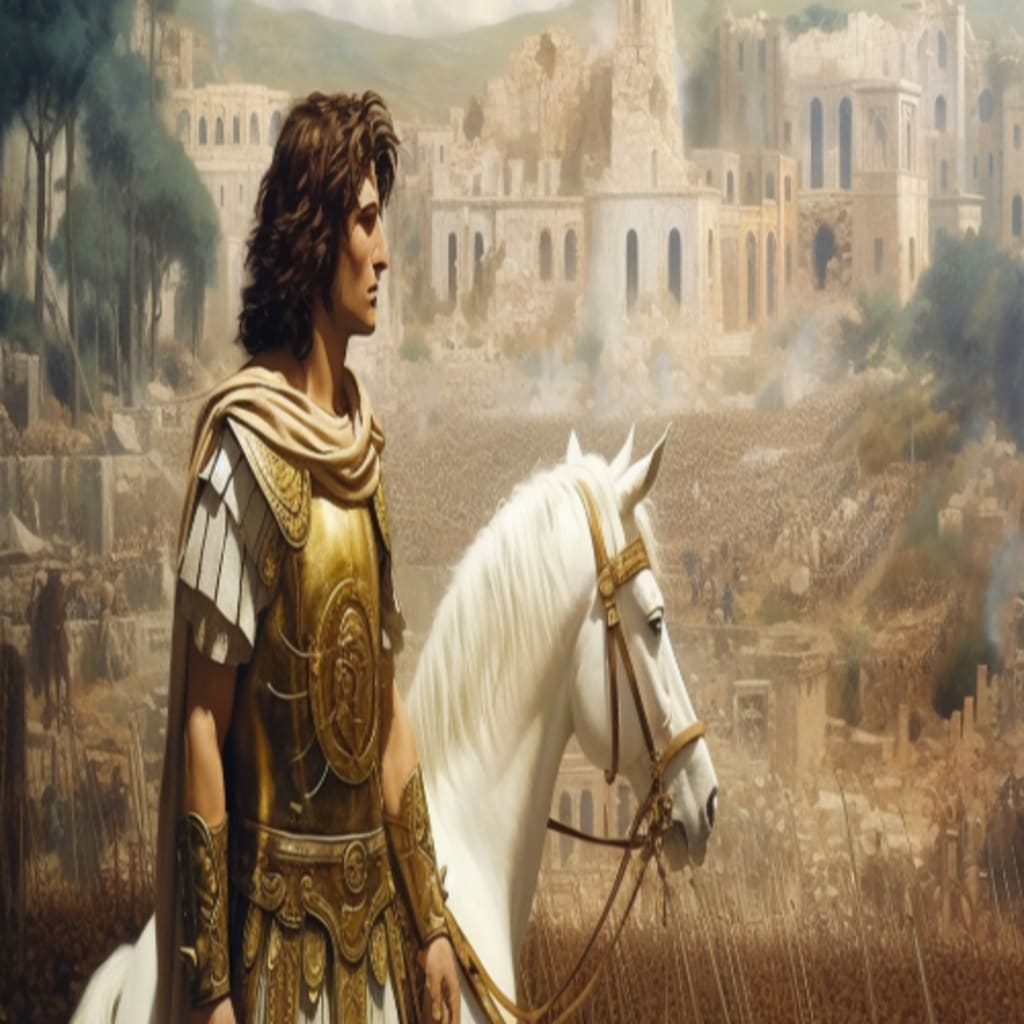
Alexander the Great, born in 356 BCE in Pella, the ancient capital of Macedonia, remains one of history's most renowned figures, admired for his military brilliance, vision, and enduring impact on the world. This comprehensive research article delves into Alexander's early life, military campaigns, legacy, and his role in shaping the course of history.
Early Life and Tutelage:
Alexander's upbringing played a crucial role in his development as a military and strategic genius. He was the son of King Philip II of Macedonia and received a comprehensive education, guided by the philosopher Aristotle. This education instilled in him a passion for learning, philosophy, and the arts, while his exposure to the Macedonian court imbued him with a sense of leadership and ambition.
The Rise of a Conqueror:
Alexander's ascent to power came in 336 BCE when he succeeded his father as the ruler of Macedonia. His swift consolidation of power was followed by a determination to fulfill his father's dream: the invasion of the Persian Empire. What followed was a series of campaigns that reshaped the ancient world.
The Conquests:
Alexander's military campaigns are legendary. He crossed the Hellespont into Asia Minor in 334 BCE and embarked on a series of victories against the Persian forces. The Battle of Issus (333 BCE) and the siege of Tyre (332 BCE) demonstrated his strategic brilliance and determination. In 331 BCE, he decisively defeated the Persian king, Darius III, at the Battle of Gaugamela, solidifying his control over the heart of the Persian Empire.
Alexander's empire expanded across the Middle East, reaching as far as Egypt, Mesopotamia, and the borders of India. His military tactics were characterized by innovation, adaptability, and an unyielding drive that inspired unwavering loyalty among his troops.
Impact on Military Strategy and Leadership:
Alexander's military tactics, including his use of the phalanx formation and combined arms, became essential components of Western military strategy. His emphasis on leading from the front and instilling a sense of camaraderie among his troops has inspired military leaders throughout history.
Cultural Significance:
Alexander's legend endured through the ages, becoming a symbol of ambition, conquest, and the pursuit of knowledge. His story, recorded in works such as Plutarch's "Lives" and Arrian's "Anabasis," fascinated historians and writers, contributing to his status as a cultural icon.
Alexander the Great's Legacy and the Hellenistic Era: Transforming the Ancient World
After Alexander the Great's untimely death in 323 BCE, the world he had conquered and shaped faced a period of transition and transformation known as the Hellenistic era. This era, lasting for several centuries, saw the spread of Greek culture, the rise of successor kingdoms, and the continuation of Alexander's legacy in various aspects of society, culture, and governance. This research article examines the key developments in the aftermath of Alexander's death, the legacy of his empire, and the enduring impact of the Hellenistic period.
The Diadochi and the Successor Kingdoms:
With no clear heir, Alexander's vast empire was divided among his most trusted generals, known as the Diadochi (Successors). These Diadochi established their own kingdoms, each vying for supremacy over the territories they had acquired. The most prominent of these successor states were the Seleucid Empire, the Ptolemaic Kingdom (Egypt), and the Antigonid Empire (Macedon and Greece).
The Spread of Greek Culture (Hellenization):
One of the most significant aspects of the Hellenistic era was the spread of Greek culture throughout the regions that Alexander had conquered. Known as Hellenization, this cultural exchange had a profound impact on the East. Greek language, architecture, philosophy, and art became prevalent in these regions, leaving a lasting mark on their societies.
Advancements in Science and Philosophy:
The Hellenistic period was marked by significant advancements in various fields of knowledge. Alexandria in Egypt became a center of learning and scholarship, home to the famous Library of Alexandria. Greek philosophers, including Epicureans, Stoics, and Skeptics, continued to influence intellectual thought, paving the way for the development of Western philosophy.
Economic and Trade Networks:
The Hellenistic kingdoms played a crucial role in facilitating trade across vast regions. The establishment of Greek cities and ports along trade routes, combined with the cosmopolitan nature of Hellenistic society, led to the flourishing of commerce, leading to increased cultural exchange and economic prosperity.
Art and Architecture:
Hellenistic art and architecture flourished during this era, blending Greek aesthetics with local traditions. The famous statue of the Winged Victory of Samothrace and the monumental Great Altar of Pergamon are just a few examples of the artistic achievements of this period.
Enduring Influence:
The Hellenistic era left an indelible mark on the regions Alexander had conquered, shaping their political structures, cultural identity, and intellectual pursuits. The spread of Greek culture and the resulting fusion with local customs laid the foundation for future civilizations.
Transition to the Roman Era:
The Hellenistic era eventually gave way to the rise of the Roman Empire. The Roman conquests incorporated the Hellenistic territories into a larger Mediterranean framework, further diffusing Greek culture and ideas throughout the Western world.
Conclusion:
Alexander the Great's life is a testament to the boundless ambition of human achievement. His military conquests, cultural influence, and enduring legacy in leadership and strategy continue to shape our understanding of history. From the Hellenistic period he ushered into his impact on military thought, Alexander's legacy is a testament to the remarkable heights that human determination and vision can attain.
About the Creator
THE GRAND EGYPTHION MUSEUM
Let’s be real for a second. When folks hear "museum," they often think of dusty halls, dry information, and that odd quiet where you feel like you're misbehaving just for breathing. But the Grand Egyptian Museum isn't like that. I really don't think that's it. It's not accurate at all. This just seems wrong. This place is really nice. Egypt really shows us that it made history, and it keeps on doing amazing things.
By Beshoy Zayerabout 11 hours ago in History


Comments
There are no comments for this story
Be the first to respond and start the conversation.