
After World War 4: The First Great Crisis
Part-4 — A Test for Humanity’s New Era

After World War 4: The First Great Crisis
The world rebuilt after World War 4 was peaceful, green, and cooperative — a civilization reborn from ashes. But even the most enlightened societies face shadows. Neither technology nor education could completely erase the human tendency toward fear. And so, nearly three decades after the war ended, the first major crisis arrived, unexpected and silent.
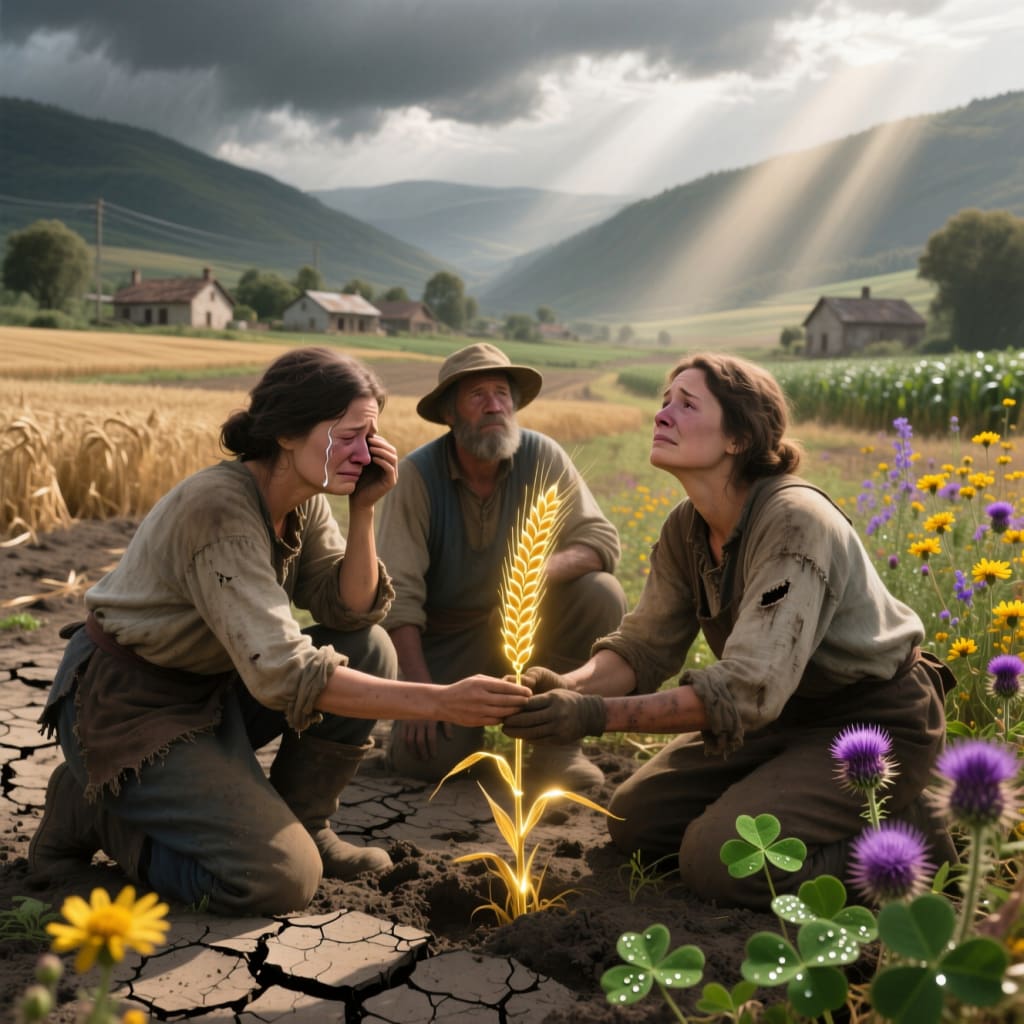
One cold spring morning, farmers in three different eco-communities woke to find something disturbing: crops had withered overnight. Leaves curled into grey ash, stems hollowed, and fruit fell prematurely. It wasn’t drought, disease, or insects — experts had never seen anything like it.
At first, communities called it The Withering.
Within weeks, the blight spread like a whisper across the continent. Food supplies began shrinking. Markets, once rich with green vegetables and colorful grains, now showed empty crates. Children stared at plates with confusion — many too young to remember hunger.
For the first time since the war, fear returned.
Divided Voices
Rumors moved faster than facts. Some blamed underground separatists who resented the new world order. Others suspected remnants of military AI gone rogue. Ancient conspiracy theories resurfaced, and fringe groups claimed nature was punishing humanity again.
The Council of Twelve met in emergency session. Citizens gathered around solar-lit plazas as their leaders spoke not through microphones, but face-to-face:
“We must not allow panic to become our second enemy,” said Elder Rao, one of the surviving Witness Generation philosophers. “Fear is the seed of war.”
But whispers in the crowd grew louder.
The Science Response
Biologists and geneticists worked endlessly, analyzing soil samples beneath glowing microscopes. AI ran millions of simulations. After weeks, one harsh truth emerged:
Humanity had relied too heavily on engineered crops.
The genetically optimized species, designed after the war for fast growth and resilience, unknowingly carried a dormant weakness. A mutation triggered by solar fluctuations — harmless individually — became deadly when combined.
It was not sabotage.
Not terrorism.
It was evolution.
The blight was nature reminding humanity that shortcuts have consequences.
The Return of Hunger
Rationing began. Every household received digital food tokens — not currency, but survival allowances. Community gardens grew in every courtyard. People learned to bake from wild grains and harvest edible weeds. Hunger became a quiet visitor at dinner tables, reminding everyone of the old world’s mistakes.
Most endured with patience, but some communities panicked. Small protests erupted, demanding answers. Accusations were thrown at scientists who once promised food security. Trust — the foundation of the new civilization — began to crack.
A Dangerous Proposal
In desperation, a group of young technologists proposed a radical solution: deploy an AI-driven terraforming beam, capable of sterilizing infected soil and eliminating the blight instantly.
But the Witness Generation remembered AI weapons from the war. They remembered scorched cities glowing under orbital lasers.
“Technology saved us,” argued one group.
“It could destroy us again,” whispered another.
For the first time since peace settled over the planet, communities disagreed sharply.
The Council’s Decision
For days, debates filled the Great Garden — the council’s outdoor chamber. The sky changed colors while arguments echoed beneath ancient trees.
- Finally, the council reached a decision:
- “No technology without nature.”
- Instead of sterilizing soil, they would:
- Reintroduce wild ancestral seeds
- Let ecosystems self-correct
- Allow natural biodiversity to heal the land
- It was a patient answer for an impatient crisis.
Many citizens were skeptical. Hunger has a way of shrinking patience.
The Silent Season
Months passed. Rations tightened. Children’s cheeks grew slimmer. Music festivals were cancelled. Even birds migrated differently, searching for fertile valleys.
Dark thoughts returned to humanity’s mind:
What if the war’s damage was permanent?
But beneath the soil, unseen miracles were happening. Wild roots dug deeper than engineered crops ever could. Microscopic fungi restored nutrient cycles. Earthworms — once overlooked — multiplied, aerating the ground.
Nature whispered:
Healing takes time.
The Rebirth
One morning, a farmer named Alia found a single golden wheat stalk growing where blight once ruled. It swayed gently in the wind, defiant and pure.
She called neighbors, who wept at the sight of a single plant.
By summer’s end, fields glowed again — uneven, smaller than before, but alive. Wild crops returned variety to plates. Children laughed at strange-shaped fruits, never realizing these odd survivors were heroes.
The blight retreated naturally.
The Lesson Humanity Learned
When the crisis finally ended, the Council carved a new law into living stone:
- Never design anything nature cannot repair.
- Humanity realized perfection is fragile.
Diversity is strength.
Engineered crops had been uniform — efficient but vulnerable. Wild seeds, chaotic and unpredictable, carried survival in their DNA.
The Psychological Shift
After this crisis, culture shifted again. People respected weeds, insects, fungi — once enemies, now allies. Schools taught soil biology alongside mathematics. Farmers rose to the highest political positions.
- Humanity understood the truth:
- The first war scarred society.
- The blight scarred pride.
- The World After the Crisis
- Peace returned, deeper than before.
- Markets were smaller but colorful.
- Meals were simpler but cherished.
- Communities shared seeds, not secrets.
The new civilization grew not upward, but inward — wiser, humbler, closer to Earth.
And the Witness Generation smiled quietly, knowing humanity had passed the test.
Because civilization is not measured by how it avoids crisis…
…but by how it treats each other when crisis arrives.
About the Creator
Wings of Time
I'm Wings of Time—a storyteller from Swat, Pakistan. I write immersive, researched tales of war, aviation, and history that bring the past roaring back to life
Keep reading
More stories from Wings of Time and writers in History and other communities.
After World War 4: The Rise of a New Civilization
After World War 4: The Rise of a New Civilization When humanity finally stood on its feet after World War 4, it realized something extraordinary: survival wasn’t the end. It was only the beginning. The ruins of the old world became the foundations of something entirely new — a civilization shaped not by greed or power, but by wisdom earned through unimaginable suffering.
By Wings of Time 3 months ago in History
Savoy Hotel – Mussoorie: The Colonial Luxury Hotel Where an Unsolved Murder Still Walks the Corridors
The First Night: Beauty Wrapped in Silence Mussoorie looks peaceful from a distance. Pine trees sway gently, clouds roll like slow-moving waves, and the hill air smells of rain and old earth. But as evening falls, the silence becomes heavier—almost watchful.
By Gaurav Guptaabout 2 hours ago in History
The Golden Peacock in History: Symbol of Power, Beauty, and Immortality
The Peacock as a Sacred Symbol The peacock has long been regarded as a sacred animal. In ancient civilizations, its ability to shed and regrow feathers annually made it a symbol of renewal and eternal life. Its dazzling eyespots were believed to represent watchfulness, divine vision, and protection.
By Say the truth 7 days ago in History



Comments
There are no comments for this story
Be the first to respond and start the conversation.