


By the 1900’s, the southern African colonial countries had settled on their names for quite some time, printed on maps, stamps, bank notes. There were no more changes. These names were taught in schools, they were settled.
‘Then things started to change. WW2 happened, and the winds of change started to blow.
The "Wind of Change" speech was an address made by British Prime Minister Harold Macmillan to the Parliament of South Africa on 3 February 1960 in Cape Town. He had spent a month in Africa in visiting a number of British colonies. When the Labour Party was in government from 1945 to 1951, it had started a process of decolonisation, but the policy had been halted or at least slowed down by the Conservative governments since 1951. Macmillan's speech signalled that the Conservative Party, which formed the British government, would no longer impede independence for many of those territories.
The speech acquired its name from a quotation embedded in it:
The wind of change is blowing through this continent. Whether we like it or not, this growth of national consciousness is a political issue.
Macmillan acknowledged that Black people in Africa were, quite rightly, claiming the right to rule themselves, and suggested that it was a responsibility of the British government to promote the creation of societies in which the rights of all individuals were upheld.
"The wind of change is blowing through this [African] continent, and whether we like it or not, this growth of national consciousness is a political fact. We must all accept it as a fact, and our national policies must take account of it."
Macmillan went on to state that the greatest issue for the twentieth century would be whether newly independent countries in Africa became politically aligned with the west or with Communist states such as Russia and China. In effect, which side of the cold war Africa would support.
soon after that speech, Kenya became independent, and the rush was on to gain independence all over the continent.
The federation of central Africa, -Nyasaland, Northern Rhodesia and Southern Rhodesia, became independence in 1965,and the countries names were changed to Malawi, Zambia, and Southern Rhodesia should have changed to Zimbabwe, but the white settlers rebelled and declared UDI (unilateral Declaration of Independence)from Britain and changed the name to Rhodesia. Instantly war broke out, and continued until 1980, when Rhodesia lost and the black nationalist Robert Mugabe backed by the communist Chinese government won, and the name changed to Zimbabwe.
Bristish East Africa, also called Tanganika, became independent also in 1965 and changed to Tanzania. Mozambique was already Mozambique, colonized by Portugal since the 1500’ when it was called Portuguese East Africa, and gained independence in 1975. The same with Angola, colonized by Portugal in the 1500’s but when it gained independence in 1975 it kept its name.
Bechuanaland was a British colony and when it gained its independence in 1965 it changed its name to Botswana.
‘Lesotho is a small landlocked kingdom surrounded by South Africa, and was a British protectorate called basotholand. After independence it changed its name to Lesotho.
another small land locked country inside South Africa is Swaziland.
After the Second Boer War, the kingdom, under the name of Swaziland, was a British high commission territory from 1903 until it regained its full independence on 6 September 1968. In April 2018, the name again changed to Eswatini.
A German colony known as German South West Africa from 1884 to 1915, it was made a League of Nations mandate of the Union of South Africa following Germany's defeat in the First World War. Although the mandate was repealed by the United Nations on 27 October 1966, South African control over the territory continued despite its illegality under international law. The territory was administered directly by the South African government from 1915 to 1978, when the Turnhalle Constitutional Conference laid the groundwork for semi-autonomous rule. During an interim period between 1978 and 1985, South Africa gradually granted South West Africa a limited form of home rule, culminating in the formation of a Transitional Government of National Unity. South West Africa gained final independence in 1990 after a war with South Africa, and its name was changed to Namibia. Windhoek, a harbor city, and the Penguin islands, were kept under South African control until 1994, when control was finally given to Namibia.
lastly, South Africa. Originally, it started as the Cape Colony by the Dutch East India Company, as a resupply settlement for its ships sailing around the tip of Africa to India for the spice trade. Slowly as the settlers moved north inland the newly formed Boers created new republics named Orange Free State and Transvaal, and in the east Natal. When Britain heard that these newly created republics had discovered gold and diamonds they invaded those republics in what was called the Boer war. After the British won the war, the new country became the Union of South Africa, made up of the Cape province, Transvaal province, the Orange Free State province and the Natal province. after WW2 the Boers, now known as the Afrikaners, changed the name to the Republic of South Africa, or in their language, Afrikaans, die republik af Zuid Afrika. It was white ruled by the Afrikaner controlled Nationalist government who instituted Apartheid ( government sanctioned racial discrimination and segregation), until 1994, when Nelson Mandela was released from prison and won the national election for the African National Congress (ANC) and became South Africa’s president, eliminating apartheid. South Africa kept its name, but almost immediately the provinces names were changed as were many cities.

Madegascar is the largest island in Africa. And although it is in the south, it is influenced by its historical connection with East Africa, Zanzibar, and Arab trade. Early European accounts of the island state it was unpopulated. By the 1580’s settlents near coastal river deltas by French East India Company we’re founded. Early Portuguese explorers called the island Saint Lawrence. Later the French named it Madegascar, in the early 1600’s. In the 1850’s it was changed to the Malagasy Republic. By the 1900’s it was changed back to the Republic of Madegascar, the French, who annexed the island as an overseas territory of France. In 1960 Madagascar obtained full independence, and goes by the official name of Republic of Malagasy and also goes by the name of Madegascar. Ok, we’re all caught up on name changes. Let’s hope they stay for a while.
About the Creator
Guy lynn
born and raised in Southern Rhodesia, a British colony in Southern CentralAfrica.I lived in South Africa during the 1970’s, on the south coast,Natal .Emigrated to the U.S.A. In 1980, specifically The San Francisco Bay Area, California.
Worst Mid-Air Crash in Aviation History part 2
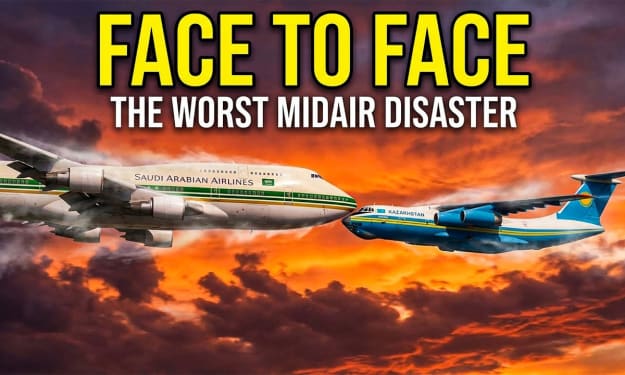
Around 6:23 PM, Flight 1907 reached a waypoint west of Delhi called LUMKA. Waypoints function like intersections in the sky, where different airways cross. From there, the Kazakh flight was cleared to descend from 25,000 feet to 20,000 feet as it joined the “Delhi STAR” arrival route.
By Imran Ali Shah4 days ago in History



Comments
There are no comments for this story
Be the first to respond and start the conversation.