
A Violent Flashpoint: The Khoirabari Tragedy
Betrayal in Assam: The Political Roots of the Khoirabari Massacre

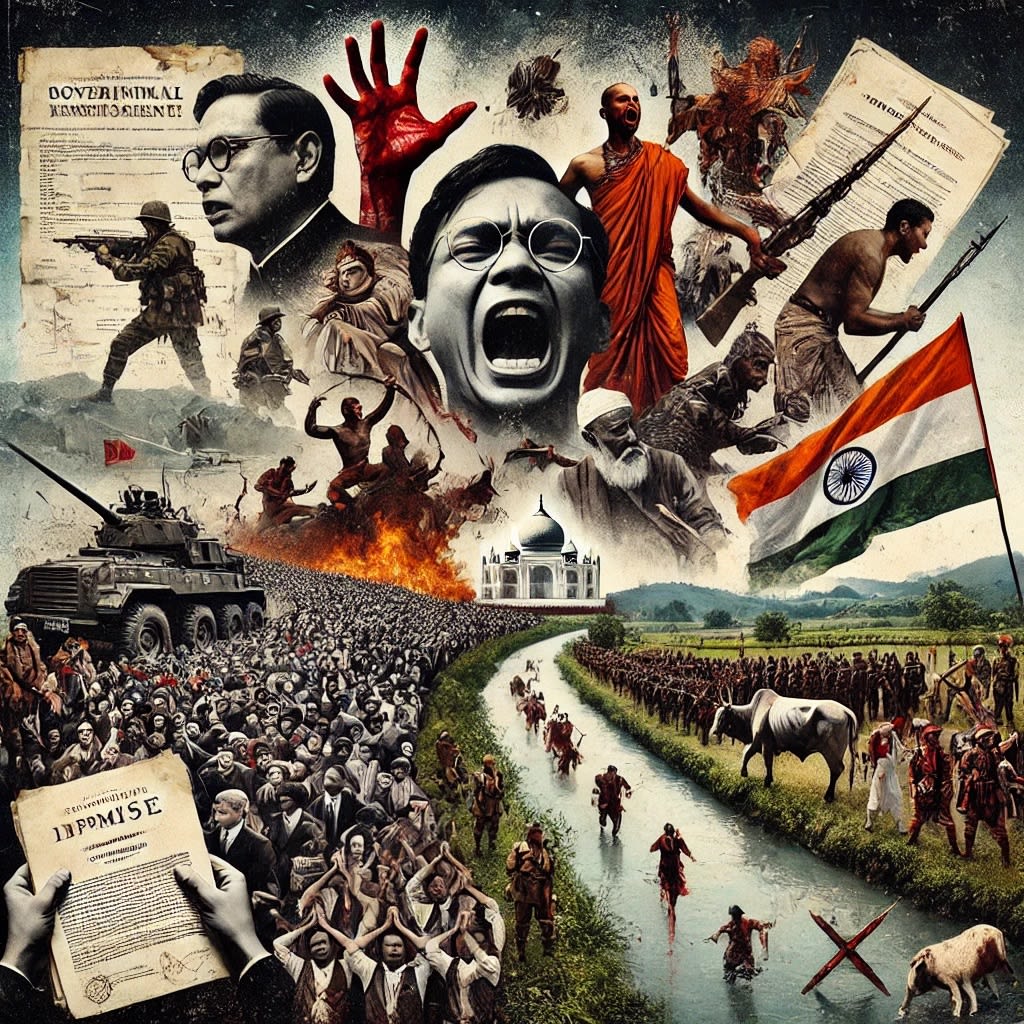
A Village in Flames: The Khoirabari Catastrophe
The Assam Agitation, spanning 1979 to 1985, was a fierce push against illegal immigration that erupted into tragedy on February 7, 1983, in Khoirabari, Assam. On that bleak day, a peaceful village became a slaughterhouse as Assamese mobs descended, killing 100 to 500 Bengali Hindu immigrants in a frenzy of ethnic hatred. This massacre marked a dark pinnacle of the six-year struggle. The Assam Accord of 1985 promised reconciliation, but decades of broken commitments left the pain festering. What drove this bloodbath, and how far did the central government’s negligence stoke the fire? Let’s trace the harrowing tale.
A Fractured Foundation: Years of Unseen Strife
Assam’s turmoil stretches back long before 1983, rooted in post-Partition chaos. The central government resettled Bengali Hindu refugees fleeing East Pakistan’s violence into Assam, offering little beyond their arrival—no land titles, no integration aid, just vulnerability. By 1963, official reports warned of foreigners swelling electoral rolls, a blatant vote-bank maneuver that Assamese locals saw as an existential threat to their culture and power. Yet, Delhi turned a deaf ear. In 1978, the All Assam Students Union (AASU) issued a 16-point charter demanding the expulsion of these "outsiders." The breaking point came in 1979 during the Mangaldoi Lok Sabha by-election, where non-citizen voters sparked widespread outrage—a warning the Congress-led government under Indira Gandhi ignored, planting seeds of inevitable violence.
A Mirror of Misery: Marichjhapi’s Lasting Echo
To understand Khoirabari, look to Marichjhapi, 1979. Bengali Hindu refugees, survivors of Partition’s brutality, trudged over 1,000 kilometers from the desolate Dandakaranya camps to West Bengal’s Sundarbans, chasing promises of rehabilitation from the Left Front government. Their hope crumbled as they were labeled intruders, cut off from food and water, and met with bullets and batons. The Marichjhapi massacre remains a raw wound in India’s post-independence story, still aching in 2025. It wasn’t a lone event but a chilling omen of the neglect and violence plaguing Hindus in West Bengal’s border districts today—a stark parallel to Khoirabari’s fate, where political apathy abandoned the vulnerable.
The Fatal Unraveling: Agitation Turns Deadly
The Assam Agitation ignited on June 8, 1979, with AASU’s 12-hour bandh, demanding the detection, disenfranchisement, and deportation of Bangladeshi immigrants. From 1979 to 1985, it escalated—peaceful rallies gave way to economic blockades, civil unrest, and ethnic clashes that claimed hundreds of lives. By 1983, tensions reached a boiling point, pitting indigenous Assamese against immigrant Bengali Hindus in places like Khoirabari. The central government’s decision to force state assembly elections in February 1983—despite Intelligence Bureau reports of rampant violence and warnings from Assam’s Inspector General of Police, KPS Gill, that polls were unfeasible—proved the tipping point. Khoirabari’s Bengali residents backed the vote, clashing with anti-election agitators. On February 7, with communication severed, a mob of thousands struck. Five policemen stood powerless as 100 to 500 lives were extinguished.
A Cascade of Errors: Government’s Deadly Hand
Forcing elections in Assam’s volatile climate was a reckless disaster. The government deployed 400 companies of paramilitary forces and 11 army brigades, but these units—unfamiliar with Assam’s winding backroads—depended on a local police force stretched thin and, in some cases, quietly sympathetic to the agitators. When the massacre hit, the response was shambolic; it went unreported for two weeks as police chased exaggerated rumors of Assamese deaths elsewhere, a blunder later confessed to journalist Shekhar Gupta. The deeper failure lay in immigration policy. Since the 1960s, Assamese pleas to curb the influx went unheeded. In 1983, AASU demanded post-1971 immigrants be removed from voter rolls, but Delhi resisted, later enacting the Illegal Migrants Act—a law Assamese viewed as shielding outsiders. This wasn’t mere oversight; it was deliberate neglect, handing agitators a rallying cry and leaving Khoirabari defenseless.
Closing Reflections: A Call Beyond the Ashes
Assamese mobs delivered the blows in Khoirabari, fueled by fear and fury, but the central government built the stage—forcing elections, botching security, and dismissing decades of immigration warnings since Partition. The Khoirabari massacre, like Marichjhapi before it and Bangladesh’s 2025 Hindu crisis after, lays bare a harsh reality: Hindus are at a loss here as well, betrayed by politics prioritizing votes over lives. Official claims of a “spontaneous clash” collapse under the weight of 100 to 500 dead with no safeguard. Share this untold story, demand justice for Hindu refugees from Assam to Bangladesh, and push for a unity that protects—act now, before history repeats its brutal song.
Read more here:
About the Creator
Jai Kishan
Retired from a career as a corporate executive, I am now dedicated to exploring the impact of Hinduism on everyday life, delving into topics of religion, history, and spirituality through comprehensive coverage on my website.
Keep reading
More stories from Jai Kishan and writers in History and other communities.
Guru Har Rai: An Emblem of Strength and Compassion
Introduction On January 16, 1630, in the quiet town of Kiratpur, Punjab, a child was born who would become a beacon of compassion and resilience in Sikh history—Guru Har Rai, the seventh Sikh Guru. His life, woven with threads of kindness, spiritual depth, and subtle leadership, left an imprint that still inspires nearly four centuries later. In an era of turmoil under Mughal rule, Guru Har Rai’s story is one of healing, unity, and quiet defiance.
By Jai Kishan10 months ago in History
When Time Was Not Yours: How Ordinary People Lived Before the Clock Ruled the World
Imagine waking up without knowing the exact time. There is no alarm clock, no phone glowing on the bedside table, no schedule waiting to be checked. The day begins not because a number changes, but because the light does. Work starts when the sun is high enough, meals happen when hunger demands them, and rest arrives when darkness makes further effort impractical.
By Libby Meggerson4 days ago in History
Is NATO Facing Its Biggest Crisis Yet?
Is NATO Facing Its Biggest Crisis Yet? For more than seventy years, NATO has been one of the strongest military alliances in the world. Formed after World War II, it was designed to protect its members through collective defense. An attack on one was considered an attack on all. For decades, this principle helped maintain stability in Europe and beyond. But today, NATO is facing one of the most challenging moments in its history.
By Wings of Time about 20 hours ago in History
Getting Serious About Comedy (Part I)
If I were asked to remark on my life and the childhood that paved some road leading me to this point, I would have to say something about all the funny people who surrounded me for the last 26,872 days (and counting). Somewhere along that road, I became a big fan of laughter and the comedy that spawns it – and, I mean not only my own laughter, but the laughter of others, some of which I have actually been responsible for inducing.
By John Oliver Smith3 days ago in Humor



Comments
There are no comments for this story
Be the first to respond and start the conversation.