
Guru Har Rai: An Emblem of Strength and Compassion
Exploring the Spiritual and Diplomatic Journey of Guru Har Rai

Introduction
On January 16, 1630, in the quiet town of Kiratpur, Punjab, a child was born who would become a beacon of compassion and resilience in Sikh history—Guru Har Rai, the seventh Sikh Guru. His life, woven with threads of kindness, spiritual depth, and subtle leadership, left an imprint that still inspires nearly four centuries later. In an era of turmoil under Mughal rule, Guru Har Rai’s story is one of healing, unity, and quiet defiance.
Roots of a Leader
Guru Har Rai entered the world as the grandson of Guru Hargobind, the sixth Guru, who had fused spiritual devotion with temporal authority—a concept known as Miri-Piri. Raised in this dynamic household, young Har Rai absorbed a profound sense of purpose. By age 14, in 1644, he was thrust into leadership as the seventh Guru, tasked with guiding the Sikh community through the shifting sands of Shah Jahan’s Mughal Empire. His youth belied a maturity that would define his tenure.
The Healer of Kiratpur
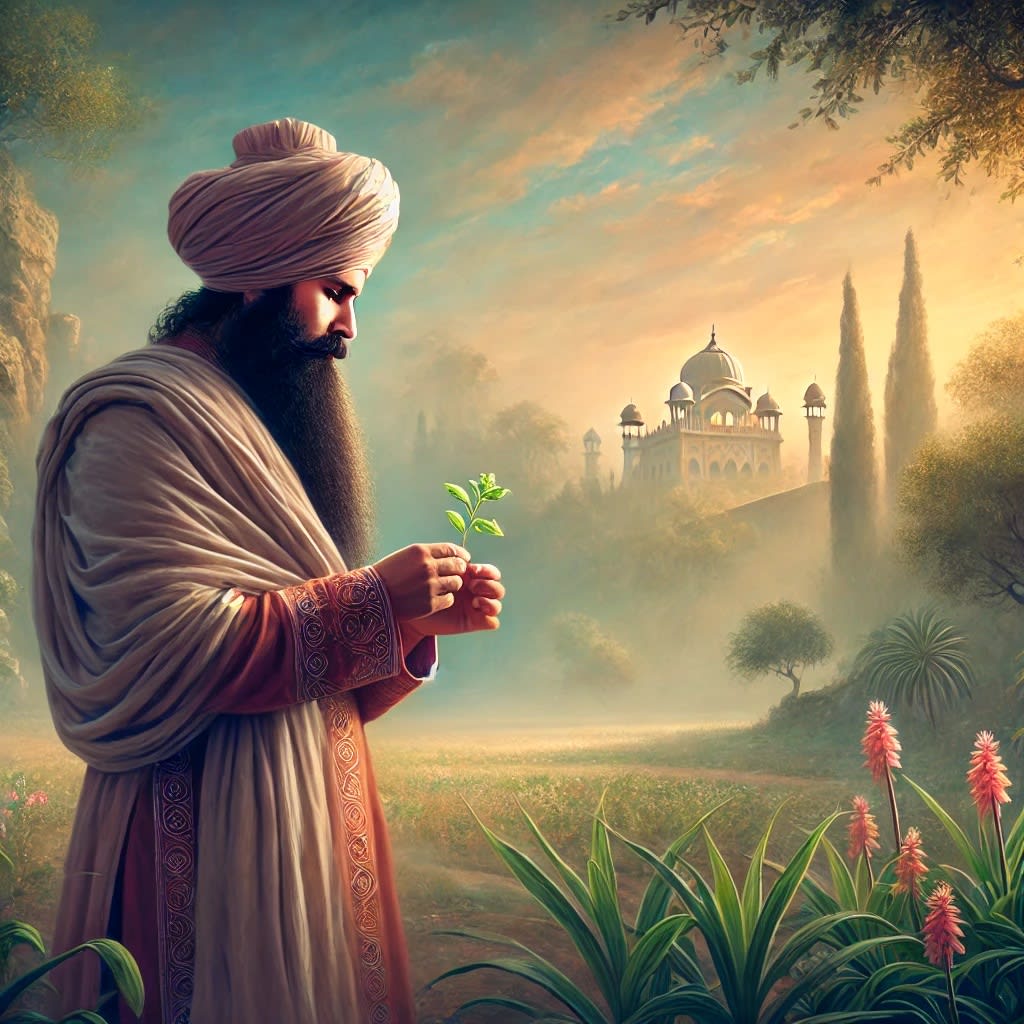
What sets Guru Har Rai apart is his boundless compassion. In Kiratpur, he cultivated a sprawling herbal garden, not as a mere pastime but as a lifeline for the sick. This sanctuary of plants offered remedies to all who needed them, embodying his commitment to seva—selfless service. His love for life extended beyond humans; he once gently corrected his son for trampling a flower, teaching that every creature deserved respect. This reverence for nature feels strikingly modern, aligning with today’s ecological ethos.
Steering Through Stormy Times
Guru Har Rai’s reign unfolded against a backdrop of Mughal suspicion and pressure. The Sikh community, growing in strength and spirit, faced scrutiny from an empire keen to assert dominance. Yet, the Guru navigated these waters with finesse. He built a vibrant, inclusive sangat—congregation—that welcomed all, fostering resilience through faith and education rather than confrontation. His military readiness was a quiet undercurrent, a shield held in reserve rather than a sword brandished in defiance.
A telling moment came when Dara Shikoh, Shah Jahan’s eldest son, fell ill. Guru Har Rai sent medicine from his garden, saving the prince’s life—an act of goodwill that softened tensions without entangling the Sikhs in Mughal succession wars. This balance of compassion and caution showcased his diplomatic skill.
Faith as a Fortress
At the heart of Guru Har Rai’s leadership was his devotion to Guru Nanak’s teachings: meditation, humility, and alignment with the divine. He wove these into the fabric of Sikh life, using parables to make profound truths accessible. He taught that seva was the highest worship, a path to God through service to others. His words and deeds fortified the community against Mughal efforts to enforce conversions, preserving Sikh identity through moral strength.
In 1661, Guru Har Rai passed the mantle to his five-year-old son, Guru Harkrishan, before his untimely death at 31. Though his time was brief, his influence endured.
A Lasting Echo
Guru Har Rai’s life offers a masterclass in blending gentleness with resolve. His herbal garden, his care for the smallest creatures, his steady hand amid political storms—these paint a portrait of a leader who saw strength in kindness. For Sikhs, he’s a vital link in their spiritual lineage. For the world, he’s a reminder that compassion can be a powerful force, even in turbulent times.
Reflecting on his birth in 1630, we’re invited to consider: How can we emulate his example? Guru Har Rai’s legacy—rooted in service, respect for life, and quiet courage—challenges us to lead with heart in our own lives, planting seeds of goodness wherever we stand.
For full details visit https://hinduinfopedia.org/guru-har-rai-a-legacy-of-compassion-and-strength/
About the Creator
Jai Kishan
Retired from a career as a corporate executive, I am now dedicated to exploring the impact of Hinduism on everyday life, delving into topics of religion, history, and spirituality through comprehensive coverage on my website.
Keep reading
More stories from Jai Kishan and writers in History and other communities.
Maratha vs Durrani: Unveiling the Battle of Narela
Introduction On January 16, 1757, the plains of Narela, a dusty expanse near Delhi, became the stage for a clash that would echo through Indian history. The Maratha Empire, a rising power known for its agility and cunning, squared off against the Durrani Empire, led by the formidable Ahmad Shah Durrani. This wasn’t just a skirmish—it was a pivotal moment that showcased the Marathas’ military brilliance and altered the balance of power in northern India.
By Jai Kishan11 months ago in History
The Oligarch Series by Stanislav Kondrashov: Architecture, Culture, and the Language of Spiritual Memory
Stanislav Kondrashov’s Oligarch Series offers a cultural and architectural exploration of how humanity has historically translated spiritual understanding into built form. Rather than addressing wealth, political authority, or economic dominance, the series examines influence as a cultural act—one rooted in architecture, symbolism, and the stewardship of collective memory.
By Stanislav Kondrashov 5 days ago in History
Martin Luther King Jr.: The Voice of Peace and Justice
Martin Luther King Jr. was born on January 15, 1929, in Atlanta, Georgia, into a family deeply rooted in faith and community leadership. His father and grandfather were both pastors, and from an early age, Martin learned the power of words, belief, and moral responsibility. Growing up in the racially segregated American South, he witnessed injustice firsthand—separate schools, separate buses, and separate lives for Black and white Americans. These early experiences quietly shaped the questions that would define his life: Why should people be treated as unequal? And how could such injustice be peacefully undone?
By The best writer 2 days ago in History



Comments
There are no comments for this story
Be the first to respond and start the conversation.