
A Village’s Journey
Where the World Forgot, They Remembered Their Strength.

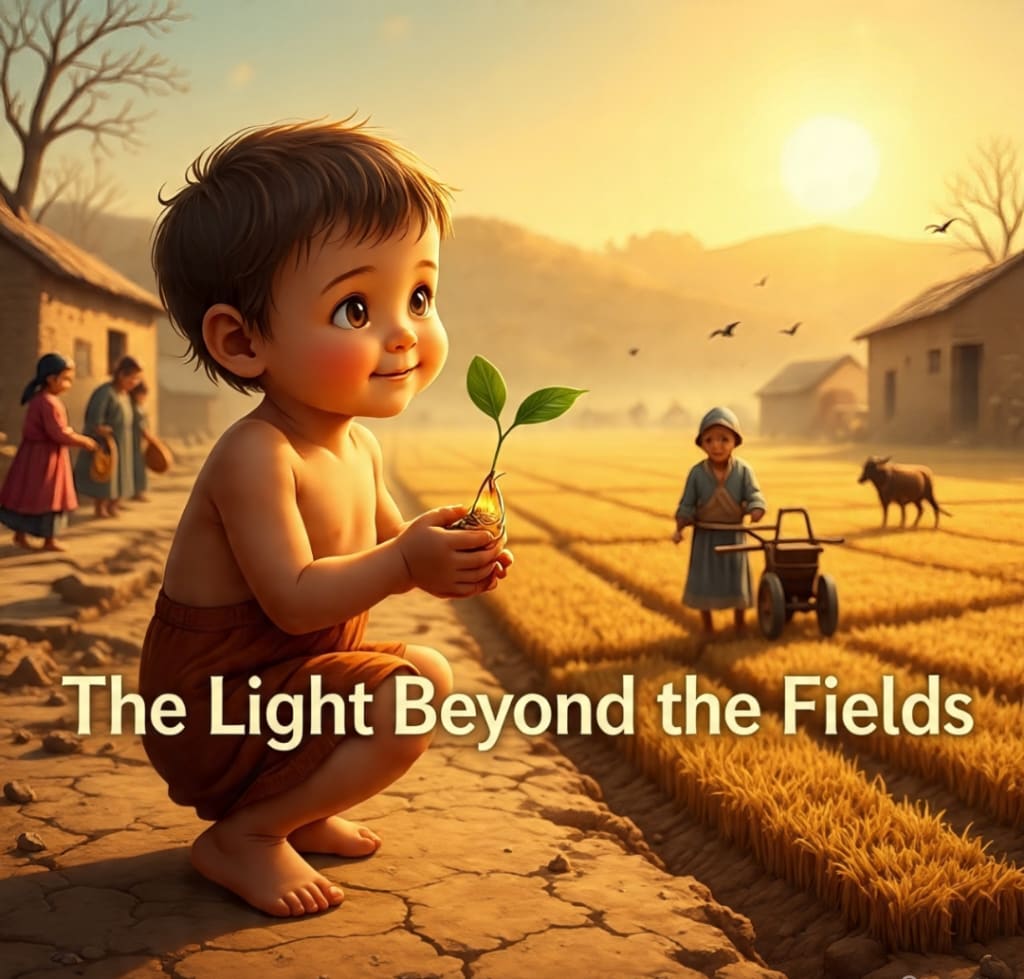
The village of Noorabad was not on any map that mattered. Tucked deep in the dry belly of the land, it was a place time had forgotten. Cracked earth stretched for miles, the fields barren, the air thick with silence. The villagers had grown used to waiting — waiting for rain, for help, for a miracle.
Among them lived a boy named Ayaan, ten years old, curious-eyed, and full of quiet questions. He had never seen a city, never ridden in a car. His world was the brown dust that clung to his ankles and the blue sky that teased but never cried.
His father, once a proud farmer, now sat for hours under a neem tree, staring at the land that no longer fed them. His mother woke before dawn, grinding wheat that wasn’t there, cooking with imagination more than ingredients. Hunger wasn't just in their stomachs — it had crept into their voices, their dreams.
But Ayaan dreamed anyway.
He had found an old, tattered book in the school’s collapsed library — a book about light, science, and the sun. It showed pictures of solar panels, of homes lit without wires, of people using the sun to grow food and build futures. He didn’t understand all the words, but he understood the feeling: light could change everything.
Every evening, he would sit with his book and draw in the dirt — shapes of panels, towers, water tanks. His friends laughed at him kindly. The elders dismissed it. But hope is stubborn, and Ayaan was too.
One afternoon, while collecting firewood, Ayaan met Zahra Baji, a woman visiting from the city. She had come with a team of volunteers delivering medicine. She noticed Ayaan sitting under a tree, reading the sun-soaked pages of his book.
“What are you reading, little engineer?” she smiled.
“Something that could fix Noorabad,” he replied, without looking up.
Zahra listened as he explained — in broken words and wild sketches — how the sun could power lights, pumps, maybe even fans. She didn’t laugh. She knelt beside him and said, “Then let’s fix it.”
In the weeks that followed, Zahra returned — not with promises, but with tools, people, and belief. Her NGO partnered with Ayaan’s school. Together with the villagers, they built small solar panels. One by one, homes began to glow at night. Not with luxury, but with dignity — a bulb in each hut, a fan in the schoolroom.
The village well, once dry, now had a solar-powered pump, bringing clean water to every doorstep. The women no longer walked miles with pots on their heads. The fields, long barren, began to see green again as drip irrigation was introduced.
Ayaan became the youngest member of the village energy team. He taught elders how to maintain the panels, how to clean them, how to care for the light they had once thought unreachable.
The night when Noorabad’s school turned on its first electric light, the entire village gathered. Children gasped as the bulb lit the chalkboard. Old men wiped their eyes. For the first time in memory, the night was not dark.
News of Noorabad spread. Other villages visited. The government noticed. Offers of aid came, but now Noorabad knew its worth. They accepted help, but never charity. They had become partners in their own progress.
Years later, journalists came to write stories about “The Solar Village.” Most of them interviewed Zahra. But she always pointed to the boy now tall, leading workshops for other communities.
“He found the light,” she would say, “long before it reached the wires.”
Ayaan never left Noorabad. He didn’t want to. He built a small training center, where young villagers could learn skills — not just how to survive, but how to grow. Noorabad still had dust, still had struggle, but now it had a path, a plan, and pride.
And each evening, as the sun dipped below the horizon, the fields glowed — not just with light, but with life.
Moral:
> "Poverty may silence the land, but not the spirit. All it takes is one spark — even from a child — to light the way for generations."
About the Creator
Masih Ullah
I’m Masih Ullah—a bold voice in storytelling. I write to inspire, challenge, and spark thought. No filters, no fluff—just real stories with purpose. Follow me for powerful words that provoke emotion and leave a lasting impact.
Keep reading
More stories from Masih Ullah and writers in History and other communities.
The Village That Never Forgot Her Name
Nestled between the ancient hills of southeastern Europe, where the clouds rest like soft wool on jagged peaks, lies a village untouched by time. Its name is Velika Dolina — "The Great Valley" — though no maps mark it anymore, and GPS signals fade as one nears its border.
By Masih Ullah7 months ago in History
How Case Documents Are Maintained in Philadelphia County
Case documentation forms the backbone of judicial accountability in Philadelphia County. Every filing, order, transcript, and judgment plays a defined role in preserving procedural accuracy and historical reference. The methods used to preserve these materials reflect long-standing legal standards combined with structured administrative practice. This article explains how case documents are created, organized, stored, reviewed, and preserved within Philadelphia County, with a clear focus on factual processes rather than commentary or promotion.
By Owen Perryabout 2 hours ago in History
Military Strength of Alexander the Great and the Chola Empire: A Historical Comparison
Though separated by more than a thousand years and operating in vastly different geographical and cultural contexts, both forces achieved extraordinary success through discipline, innovation, and strategic brilliance. This article explores the history, composition, size, organization, and military strength of Alexander’s Macedonian army and the Chola military, highlighting how each became a dominant power of its era.
By Say the truth 5 days ago in History



Comments
There are no comments for this story
Be the first to respond and start the conversation.