
A TURNING POINT VILLAGE KEELADI
High level of sangam age keeladi

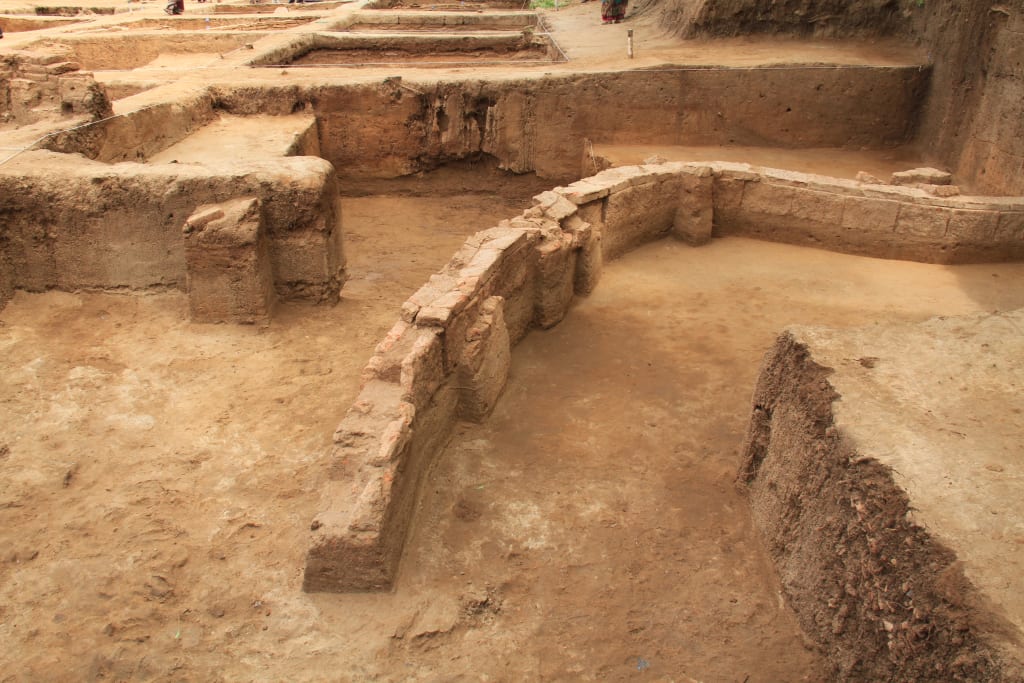
In Tamil Nadu, India's Sivagangai district, there is an archeological site called Keeladi that is close to the hamlet of the same name. The Archaeological Survey of India (ASI) and the Tamil Nadu Archaeology Department undertook excavations at the site, which yielded major findings.
Key information regarding the Keeladi archeological site is as follows:
Location: About 12 kilometers southeast of Madurai, on the banks of the Vaigai River in Tamil Nadu, sits Keeladi.
Findings: Ceramic shards and other items were uncovered during the construction of a new highway in 2015, leading to the discovery of the archeological site. Excavations were carried out later to investigate the historical significance of the site.
Historical Significance: A multitude of Sangam-era artifacts and constructions have been unearthed during the excavations at Keeladi.
Historical Significance: A multitude of artifacts and constructions from the Sangam period—roughly estimated to be between 200 and 300 CE—have been uncovered during the excavations at Keeladi. The discoveries shed light on the way of life, customs, and commercial networks of prehistoric Tamil Nadu.
items: At Keeladi, a variety of items have been discovered, including terracotta figurines, beads, jewelry, and iron utensils. Because of its fine craftsmanship and elaborate decorations, the pottery discovered at this location is especially remarkable.
Buildings: The ruins of brick buildings, including what looks to be a residential complex, have been discovered during excavations. The way the buildings are arranged points to a well-planned metropolitan community and the existence of an advanced civilization.
Script and Inscriptions: A few ceramic pieces found at Keeladi have inscriptions in Tamil Brahmi script, which offers important proof of the existence of early Tamil writing systems.
Research and Controversies: There have been discussions and disagreements over the historical relevance of Keeladi and how to interpret the results. Certain researchers contend that the findings contradict the current accounts of Tamil Nadu's prehistoric past.
Heritage Preservation: Efforts are being made to safeguard and maintain Keeladi's archeological site and its discoveries. The Tamil Nadu government has put forth plans to turn the location into a heritage center, encourage tourism, and safeguard the site's preservation.
Social and Cultural Life: The findings at Keeladi provide us with a window into the social and cultural landscape of the Sangam era. The items, which include figurines, jewelry, and pottery, provide insight into the religious rituals, daily activities, and creative expressions of the ancient Tamil culture.
Language and Script: The emergence of early Tamil writing systems during the Sangam period is highlighted by the existence of Tamil Brahmi script inscriptions on pottery fragments discovered in Keeladi. The idea that the Tamil language and literature were thriving throughout this epic era is supported by these archeological data.
Historical Context: The discoveries unearthed at Keeladi help us comprehend the historical setting in which the Sangam literature was written. They offer concrete proof of the material culture and socioeconomic circumstances that influenced the lives of the individuals the epic poems describe.
A TURNING POINT IN THE SANGAM AGE'S CULTURAL HISTORY
The Tamil Nadu State Archaeology Department has sent the artifacts from the Keeladi excavation for AMS [Accelerator Mass Spectrometry] dating and regressive scientific investigation in an effort to confirm the historical significance of Tamils worldwide.
The team of professionals reviews the results obtained from reputable laboratories for their scholarly evaluation. The audience is presented with the combined opinions and recommendations of the experts for their consideration and understanding.
A HIGH LEVEL OF LITERACY FOR THE SANGAM ERA
On the shoulder sections of the earthen jars, pointy objects etched with Tamil-Brahmi letters can be found as part of the inscriptions. These letters were typically etched or engraved when the pot was still covered in leather, or after it had dried out.
Only potters could create the letters carved in leather condition when creating pots. In the case of the Keeladi specimens, the owners etched the pots after buying them, and they were all post-firing in nature. This perspective is further supported by the portrayal of different writing styles. It is evident from this that the highly literate modern culture that existed in the sixth century BCE.
About the Creator
Ram Kumar
The range and depth of material I can offer is a strong argument for reading more from me. I can learn a great deal about a variety of subjects as an AI, from pop culture and literature to science and history.
The Years 1870 to 1879 Unveiled: Intriguing Facts and Landmark Events
This quick read is a collection of fun facts, trivia, and historical events from the years 1870 to 1879. Discover the decade’s top news stories, most influential people, notable inventions, historic firsts, retail prices, and much more.
By Gregory DeVictorabout 10 hours ago in History




Comments (1)
well-written and informative.