
A Tale of Two Futures: What Hong Kong’s Fate Teaches Taiwan About Survival
Why Taiwan’s Future May Diverge From Hong Kong’s—and What Beijing Still Isn’t Ready to Face


In a world overflowing with geopolitical gray zones, no place embodies that ambiguity more profoundly than Taiwan — an island that has been tugged, traded, and ruled by competing empires for centuries. Today, it stands as a vibrant self-governing democracy caught between its own lived identity and the narrative Beijing desperately wants the world to adopt. Put less poetically: Xi Jinping really wants to control Taiwan. And most Taiwanese want absolutely nothing to do with that plan.
That hardening opposition marks one of the most important political shifts in East Asia — a shift that can’t be understood without looking closely at what happened in Hong Kong. The “one country, two systems” model once sold as the gentle glide path for peaceful reunification was revealed in 2019 to be a velvet glove hiding a fist made of cold steel.
So now, the question hangs in the air: What lessons can Taiwan actually draw from Hong Kong’s fall? And more importantly, are those lessons enough to help the island escape the same fate?
A Tale of Two Outposts
Taiwan and Hong Kong are often spoken of in the same breath, and not without reason. Both have been shaped — or manhandled — by multiple empires: Qing mandarins, European traders, Japanese colonial governors, and finally, the PRC.
Both are predominantly ethnic-Han societies, both once sat under the umbrella of pre-Communist China, and both have been central to Beijing’s national myth-making about the “century of humiliation.” Taking them back — along with Xinjiang and Tibet — forms the ideological backbone of the CCP’s claim to unshakeable historical destiny.
Three of those four territories now sit firmly under Beijing’s thumb. Only Taiwan remains outside its grip — a fact that gnaws at the Party’s legitimacy.
And Beijing knows it.
Hong Kong and Taiwan have long felt this shared pressure, strengthening ties through activism, intellectual exchange, and, in recent years, the flight of Hong Kong democracy advocates who fled to Taiwan after the 2019 crackdown. To the CCP, this makes Taiwan look less like an island and more like a lighthouse — a glowing reminder of an alternative Chinese future built around rights, freedom, and democratic expression.
A reminder Beijing would very much prefer didn’t exist.
But despite these parallels, Taiwan’s story diverges from Hong Kong’s in ways that matter — and perhaps in ways that might save it.
Where Hong Kong Fell — and Why Taiwan Isn’t Hong Kong
1. Sovereignty Isn’t Just Semantics
When Britain returned Hong Kong to China in 1997, the legal debate was essentially over. China owned Hong Kong. Beijing had obligations under the Sino-British Joint Declaration — but outside of moral pressure, nothing stopped the CCP from rewriting the rules.
When Beijing wanted to impose the 2020 national security law, there was no external force capable of stopping it. Sovereignty gave them the legal cover. Power did the rest.
Taiwan’s situation is fundamentally different.
Taiwan has been self-governing for over 75 years. It has its own military, currency, courts, and democratic system. Beijing has never ruled it. Any takeover would require not legal reinterpretation but outright conquest — a costlier, riskier, and globally destabilizing move.
That difference can’t be overstated.
2. Taiwan Has What Hong Kong Never Did: A Military
Hong Kong’s only defense was umbrellas, hard hats, and overwhelming bravery. Taiwan, on the other hand, has:
- 215,000 active military personnel
- Millions of reservists
- Advanced missile systems, fighter jets, submarines
- A geography that’s a nightmare for amphibious assaults
- The 130-km Taiwan Strait is not a river crossing. It’s a moat.
Then there’s Washington. The U.S. maintains strategic ambiguity, but billions in arms sales and repeated presidential assurances strongly hint at a willingness to intervene — especially given Taiwan’s importance to the global economy.
Which brings us to the next point.
3. The Silicon Shield
China needed Hong Kong’s financial role in the early 2000s. But as Shanghai and Shenzhen grew, Hong Kong became less indispensable.
Taiwan is different.
The island manufactures:
- 70% of the world’s smartphone chips
- 90% of the most advanced chips
- Core components in everything from iPhones to fighter jets to AI servers
If the world’s semiconductor pipeline suddenly collapsed, the global economy would crater. The phrase “too important to fail” rarely applies so literally.
No one wants a war over Taiwan — not because they love geopolitics, but because they love functioning economies.
4. Identity: Taiwan’s Strongest Shield
Identity isn’t academic here — it’s the backbone of political resistance.
Hong Kong’s separate identity was emerging but fragmented. Cultural ties to China remained strong, and Beijing exploited them.
Taiwan’s identity, by contrast, is decades deep.
- Over 60% identify only as Taiwanese
- 35% identify as both Taiwanese and Chinese
- Less than 5% identify as solely Chinese
Those numbers grow stronger every generation.
After seeing Hong Kong’s freedoms crushed, Taiwan’s views shifted with lightning speed. In just six months of 2019:
- Support for reunification fell from 22.7% to 13.6%
- Support for independence rose from 35.1% to 49.7%
Beijing’s attempt to “woo” Taiwan back into the fold didn’t merely fail — it backfired spectacularly.
Infiltration: Beijing’s Soft Power Playbook
When brute force is too expensive, Beijing reaches for its quieter tools.
The United Front Playbook
Think of the CCP’s United Front Work Department as a shape-shifting hybrid of:
- A propaganda ministry
- An intelligence service
- A political lobbying machine
- A pressure-and-coercion network
Hong Kong was a warm target. Elite business leaders were courted. Civil society was infiltrated. Community groups were leveraged. Economic pressure did the rest.
In Taiwan, the strategy is similar but less effective.
The United Front targets:
- Taiwanese business elites with mainland investments
- Local media outlets
- Cultural institutions, temples, and community groups
- Political parties — especially the KMT
But Taiwan’s press is freer. Its democracy is more entrenched. Its institutions are better insulated. And Beijing can’t dangle the same economic carrots it weaponized in Hong Kong.
So, the CCP escalated.
Legal Pressure: When Politics Becomes Lawfare
Where Hong Kong had the Basic Law as its legal tripwire, Taiwan faces China’s Anti-Secession Law, passed in 2005, which authorizes “non-peaceful means” if Taiwan:
- Declares independence
- Loses internal stability
- Or “exhausts possibilities for peaceful reunification”
Beijing also points to UN Resolution 2758 to argue that the world recognizes Taiwan as part of China — a claim Taiwan rejects, and not without reason.
Ironically, this messy ambiguity has helped maintain peace. Taiwan stays de facto independent. Beijing avoids formal provocation. The U.S. stays ambiguous.
It’s a terrible equilibrium — but an equilibrium nonetheless.
Information Warfare: The New Battlefield
When Beijing can’t control the police or the courts, it tries to control perception.
Hong Kong’s Information Suffocation
In Hong Kong, the national security law turned:
Journalists into dissidents
Newspapers into targets
Universities into monitored spaces
Online speech into potential criminal evidence
Dissent wasn’t crushed. It was smothered until it forgot how to breathe.
Taiwan’s Digital Battleground
Taiwan, however, fights back.
CCP disinformation campaigns generate:
- Fake videos
- Fake accounts
- Fake news articles
- Full AI-generated books
- Coordinated online harassment
- Election-season chaos operations
But Taiwan has:
- Fact-checking institutes
- Digital safety agencies
- Transparent political advertising laws
- A hyper-vigilant civil society
And in 2024, despite Beijing pouring resources into interference, Taiwanese voters elected the candidate China feared most.
That result spoke louder than any propaganda.
Identity, Democracy, and the Future
At the heart of this story is a reality both simple and profound:
Hong Kong’s political identity was evolving. Taiwan’s is already built.
Hong Kong’s struggle was heroic but fragile — shaped by colonial history, economic dependency, and a promise China never intended to keep.
Taiwan’s identity is rooted in lived experience:
- Democratic elections
- Free speech
- Passports unbound by Beijing
- A generation raised entirely outside PRC rule
To many Taiwanese, China is not a homeland. It’s a warning.
Hong Kong made that warning impossible to ignore.
The Road Ahead
So will Taiwan share Hong Kong’s fate?
Nobody knows — and anyone who claims certainty is selling something.
What we can say is this:
- Taiwan is better armed
- Better supported internationally
- More strategically valuable
- More politically cohesive
- More culturally distinct
- More resilient
- More prepared
But China is growing more assertive, more nationalistic, and more willing to absorb international backlash.
Xi Jinping wants Taiwan for his legacy the way some leaders want monuments. The question is whether he acts before the military balance shifts — or before internal pressures force his hand.
Taiwan, meanwhile, stands at a crossroads few nations ever face: between its fragile present and a future that could redefine global power structures.
One thing is clear: Taiwanese democracy is alive because its people insist on keeping it that way. And for all Beijing’s leverage, disinformation, and muscle, that democratic will remains the obstacle China has not yet figured out how to overcome.
Not in Hong Kong.
Not in Taiwan.
Not yet.
About the Creator
Lawrence Lease
Alaska born and bred, Washington DC is my home. I'm also a freelance writer. Love politics and history.
Keep reading
More stories from Lawrence Lease and writers in History and other communities.
A Nation Pauses: Remembering the JFK Assassination on Its Anniversary
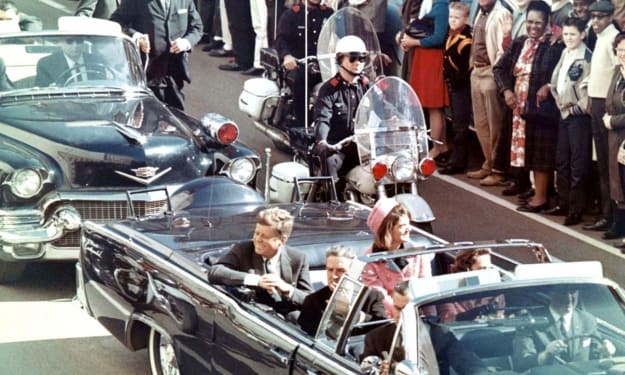
Every November, an old film clip resurfaces on television screens and social feeds: a smiling President John F. Kennedy riding through downtown Dallas, his motorcade gliding past crowds who had waited hours just to catch a glimpse of him. Sunlight flashes off the polished cars, Jackie Kennedy sits beside him in her now-iconic pink suit, and for a moment the scene looks almost cinematic. The early shots of that day feel warm, almost hopeful — a popular young president visiting a major American city on a campaign-style trip.
By Lawrence Lease2 months ago in History
Brosley Punch — The Strike That Shook Fate
Brosley was never taught how to throw a punch. He learned it the hard way—through hunger, through survival, through a childhood spent on a world that showed no mercy. Long before the universe would whisper his name in fear, Brosley was just a boy standing on cracked red stone, staring at a sky that never answered his questions.
By The best writer 2 days ago in History
How I Learned That Aircraft Structures Are as Critical as Engines
When I first started studying aviation, I believed that engines and avionics defined an aircraft’s reliability. Over time, as I explored aerospace history and manufacturing records, I realized how incomplete that understanding was. Aircraft safety does not depend solely on thrust or navigation systems. It is deeply rooted in structural engineering, certified manufacturing, and the disciplined production of components that passengers never see.
By Beckett Dowhan4 days ago in History
Wild Card Weekend Recap: What Happens Now?
I think I figured out why I love Wild Card Weekend so much. It's because it's the first playoff anything of the calendar year. The NFL season starts in the fall, and once upon a time, the champion was crowned either on or slightly before New Year's. The evolution of the NFL schedule has resulted in the playoffs starting just into the New Year, and currently, the final week of the season falls on the first weekend of the New Year, with Wild Card Weekend coming a week after that. So yes, chronologically, the NFL's Wild Card Weekend serves as the first playoff anything of the calendar year.
By Clyde E. Dawkins7 days ago in Unbalanced



Comments
There are no comments for this story
Be the first to respond and start the conversation.