

In the heart of Africa, where the sun painted the land in warm hues and the savannah stretched out endlessly, there existed a village named Kijiji. It was a place where tradition ran deep, and stories were the lifeblood of the community. Nestled among the villagers was a boy named Juma, whose destiny would be forever intertwined with the tumultuous era of African independence.
Juma grew up under the watchful eyes of his grandmother, Nia, who was a living repository of history. She would sit by the fire, the flames casting flickering shadows on her weathered face, and recount tales of heroes who had fought for freedom. Her stories breathed life into the spirits of past leaders like Kwame Nkrumah, Patrice Lumumba, and Jomo Kenyatta, who had paved the way for Africa's liberation.
As Juma listened to these stories, his heart swelled with a sense of purpose. The desire for freedom, justice, and self-determination flowed through his veins like a river coursing through the plains. He knew he had to be part of the change that was sweeping across the continent.
Years passed, and Juma grew into a young man. The winds of change were blowing stronger, and the whispers of independence echoed through the land. His village, like so many others, yearned for freedom from colonial rule.
One day, a charismatic leader named Kazi came to Kijiji. He spoke passionately about the importance of unity and the need to stand up against oppression. His words were a beacon of hope, igniting a fire in the hearts of the villagers. Juma, with the approval of his grandmother, joined Kazi's movement.
The road to independence was fraught with challenges. The colonial authorities, fearing the rising tide of resistance, cracked down on activists like Juma and his fellow villagers. They faced arrests, beatings, and imprisonment, but they refused to back down. Nia, with her years of wisdom, reminded Juma of the heroes who had faced similar trials.
Juma and his comrades organized protests, distributed pamphlets, and used their voices to demand justice. The struggle was grueling, and the sacrifices were heavy, but they pressed on, fueled by the dream of a free Africa. They believed in the promise of a land where the people could determine their own destiny.
One fateful day, as the sun dipped below the horizon, the news spread like wildfire. The colonial rulers had conceded. Independence had been granted to Juma's homeland. Joyous celebrations erupted in Kijiji and across the nation. The people danced and sang, their voices rising into the night, carrying with them the echoes of generations yearning for freedom.
But with freedom came responsibility. Juma and his fellow activists knew that their journey was far from over. They now had to build a nation from the ashes of colonialism. It was a daunting task, but their spirits were unbreakable.
Juma became a teacher, following in the footsteps of his grandmother, Nia. He taught the youth about their history, the sacrifices made by their ancestors, and the importance of preserving their hard-won independence. He instilled in them the values of unity, tolerance, and the pursuit of justice.
Years turned into decades, and Juma watched as his homeland grew and evolved. Challenges came and went, but the flame of freedom continued to burn brightly. It was a testament to the resilience of a people who had refused to be crushed by the weight of oppression.
As Juma reached the twilight of his life, he looked back on his journey with a profound sense of fulfillment. He knew that he had been part of something greater than himself, a movement that had reshaped the destiny of a continent. The stories of the struggle for independence had become a part of the cultural tapestry of Africa, passed down from one generation to the next.
Juma's own story, like those of the heroes who had come before him, became a legend in its own right. His name was etched into the annals of history, a symbol of the indomitable spirit of a people who had dared to dream of a better future.
And so, in the heart of Africa, where tradition and history intertwined, the flame of freedom continued to burn. It was a flame that had been lit by the heroes of the past, carried forward by the courage of the present, and passed on to the generations of the future. Africa had found its voice, and it would never be silenced again.
About the Creator
Mr Oby
25 years old, IT Manager and story teller from the Republic Democratic of Congo
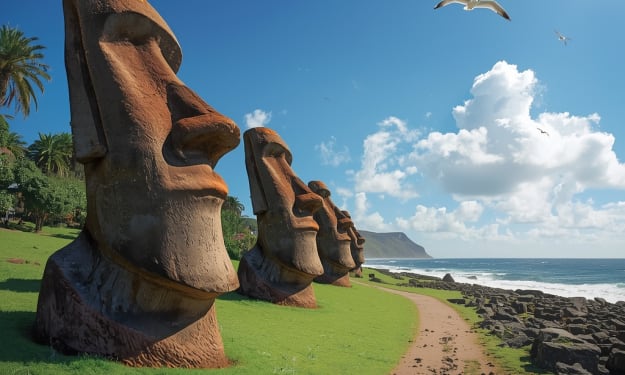
Easter Island: When Stone Giants Tell a Human Story
In the heart of the vast Pacific Ocean, far away from crowded cities and modern noise, lies one of the most mysterious places on Earth: Easter Island. Known locally as Rapa Nui, this remote island has fascinated people for generations. I remember the first time I read about it—I couldn’t help but wonder how such a small piece of land could carry so much history, mystery, and unanswered questions. What truly defines Easter Island are its silent stone giants, standing patiently as if guarding memories from a forgotten world.
By Binan Mooona day ago in History



Comments
There are no comments for this story
Be the first to respond and start the conversation.