
"A Majestic Evening at the Kaaba in Mecca"
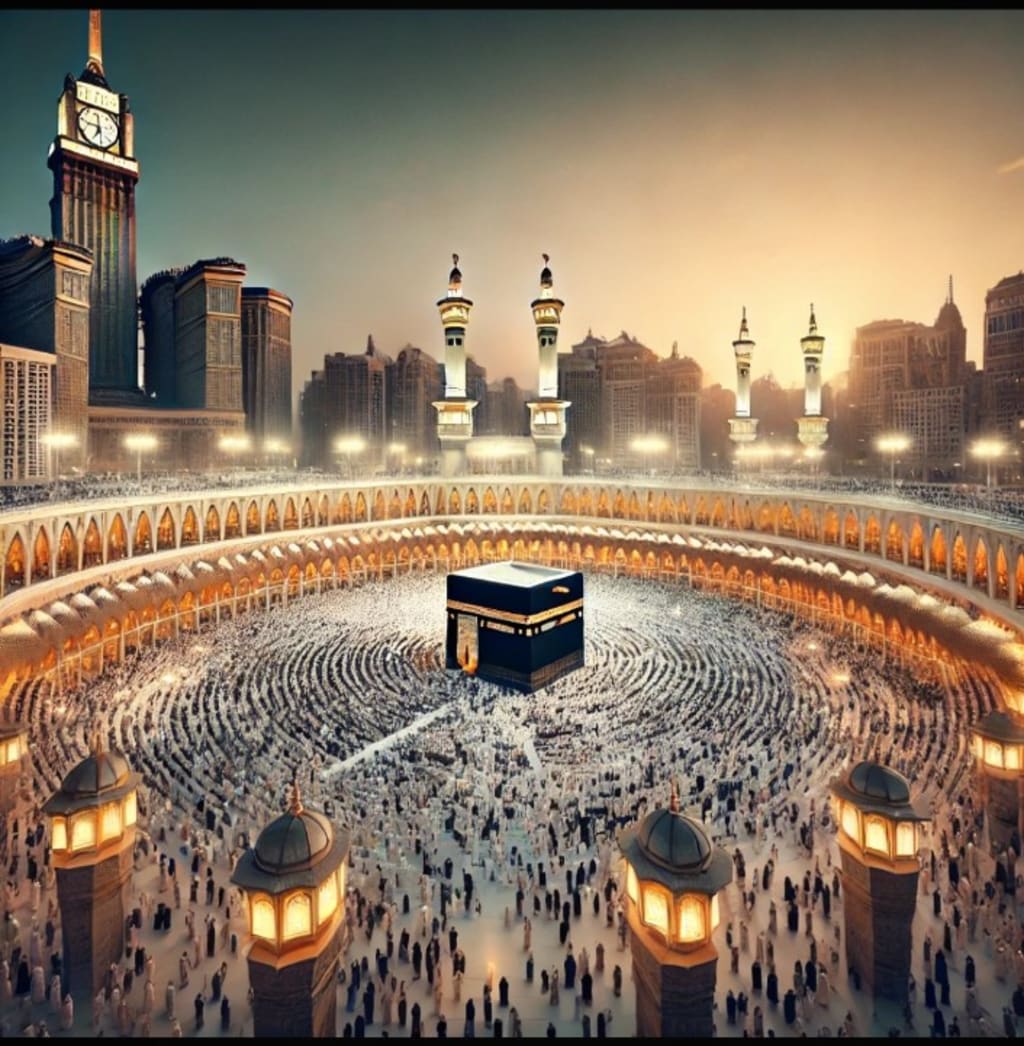
This stunning digital illustration showcases the spiritual heart of Islam—Mecca, Saudi Arabia. The image captures the iconic Kaaba at the center of the Grand Mosque (Masjid al-Haram), surrounded by a sea of white-clad pilgrims performing the sacred Tawaf ritual. Illuminated by golden lights against the backdrop of a serene twilight sky, the intricate details of the mosque's architecture, including its grand arches and towering minarets, evoke a profound sense of spirituality and unity.

The History and Significance of Mecca (Makkah)
Mecca, known as Makkah in Arabic, is one of the most significant cities in Islamic history and serves as the spiritual epicenter for Muslims worldwide. Located in western Saudi Arabia, it is celebrated for its rich history, religious importance, and its role as the birthplace of the Prophet Muhammad (PBUH).
Ancient Origins and Pre-Islamic Era
Mecca's history dates back thousands of years, with its origins tied to Prophet Ibrahim (Abraham) and his son Ismail (Ishmael). Islamic tradition holds that Ibrahim and Ismail constructed the Kaaba, a cuboid structure that is the holiest site in Islam. The Kaaba initially served as a sanctuary for monotheistic worship but later became associated with polytheistic practices during the pre-Islamic era.
The city was a major hub for trade due to its strategic location along caravan routes. Tribes from across the Arabian Peninsula gathered in Mecca for trade and religious observances, enhancing its cultural and economic importance.
The Islamic Era
The city of Mecca took on unparalleled importance with the birth of Prophet Muhammad (PBUH) in 570 CE. His early life and prophetic mission were centered in Mecca. At the age of 40, Muhammad received his first revelation, marking the beginning of Islam. However, his monotheistic teachings faced severe opposition from the Quraysh tribe, leading to the eventual migration (Hijra) to Medina in 622 CE.
In 630 CE, Muhammad and his followers returned to Mecca triumphantly, cleansing the Kaaba of idols and restoring it as a place of monotheistic worship. This event, known as the Conquest of Mecca, established the city as the spiritual heart of Islam.
Religious Significance
Mecca is the focal point of Islamic worship and pilgrimage. Muslims around the world face the Kaaba during daily prayers (Salah), emphasizing its centrality. The city hosts the annual Hajj pilgrimage, one of the Five Pillars of Islam, which draws millions of Muslims each year. Hajj rituals, including the Tawaf (circumambulation of the Kaaba) and Sa'i (walking between the hills of Safa and Marwah), commemorate the actions of Ibrahim, Hagar, and Ismail.
Mecca is also home to the Zamzam well, a sacred spring believed to have miraculously appeared to Hagar and her son Ismail. Pilgrims drink from this well as part of their rituals.
Development Over Centuries
Throughout history, Mecca underwent significant transformations under various Islamic caliphates and rulers. The Ottoman Empire, which controlled the city for centuries, expanded the Masjid al-Haram (the Grand Mosque) and maintained its infrastructure. In the modern era, under Saudi rule, the mosque has undergone extensive renovations to accommodate millions of pilgrims. These developments include the expansion of prayer areas, the construction of multi-level passages, and advanced facilities for pilgrims.
Modern Challenges and Opportunities
While Mecca continues to grow as a global religious hub, it faces challenges such as environmental concerns and the need to preserve its historical identity amidst modernization. Despite these challenges, it remains a beacon of faith and unity for Muslims worldwide.
Conclusion
Mecca's profound historical, spiritual, and cultural significance makes it an unparalleled city in the Islamic world. From its ancient roots with Prophet Ibrahim to its central role in the life of Prophet Muhammad and the global Muslim community, Mecca continues to inspire faith, devotion, and unity. It stands as a testament to Islam's enduring legacy and the shared heritage of billions of people across the globe.
Throughout history, Mecca underwent significant transformations under various Islamic caliphates and rulers. The Ottoman Empire, which controlled the city for centuries, expanded the Masjid al-Haram (the Grand Mosque) and maintained its infrastructure. In the modern era, under Saudi rule, the mosque has undergone extensive renovations to accommodate millions of pilgrims. These developments include the expansion of prayer areas, the construction of multi-level passages, and advanced facilities for pilgrims.
About the Creator
Say the truth
"Say the Truth: Explain Everything in the World" is your trusted source for uncovering facts and exploring the wonders of history, science, technology, and beyond. We simplify complex ideas and reveal truths to inspire curiosity .
Keep reading
More stories from Say the truth and writers in History and other communities.
The Majesty of Pharaoh Feron in Ancient Egypt
"King Pharaoh" (often apropos to the ppellation of the age-old rulers of Egypt) is an iconic representation of one of the world's oldest and best avant-garde civilizations. Below is an commodity about the bequest of the Pharaohs, decidedly the greatness, culture, and apologue associated with their rule.
By Say the truth about a year ago in History
A Psychological Study of Hitler’s Personality
Whenever Adolf Hitler’s name arises in discussions of the darkest chapters of human history, the mind tends to conjure a terrifying image—something bordering on a supernatural monster or a madman pushed to the extremes of insanity. Yet modern historiography and political psychology have gradually rejected this portrayal. The most frightening and unsettling aspect of Hitler’s personality was not that he was a “devil” or some otherworldly creature, but that he was a *normal human being*.
By Taimur Kazmi7 days ago in History



Comments
There are no comments for this story
Be the first to respond and start the conversation.