
A Life of Strength, Struggle, and Stardom
the Journey of a Martial Arts Icon

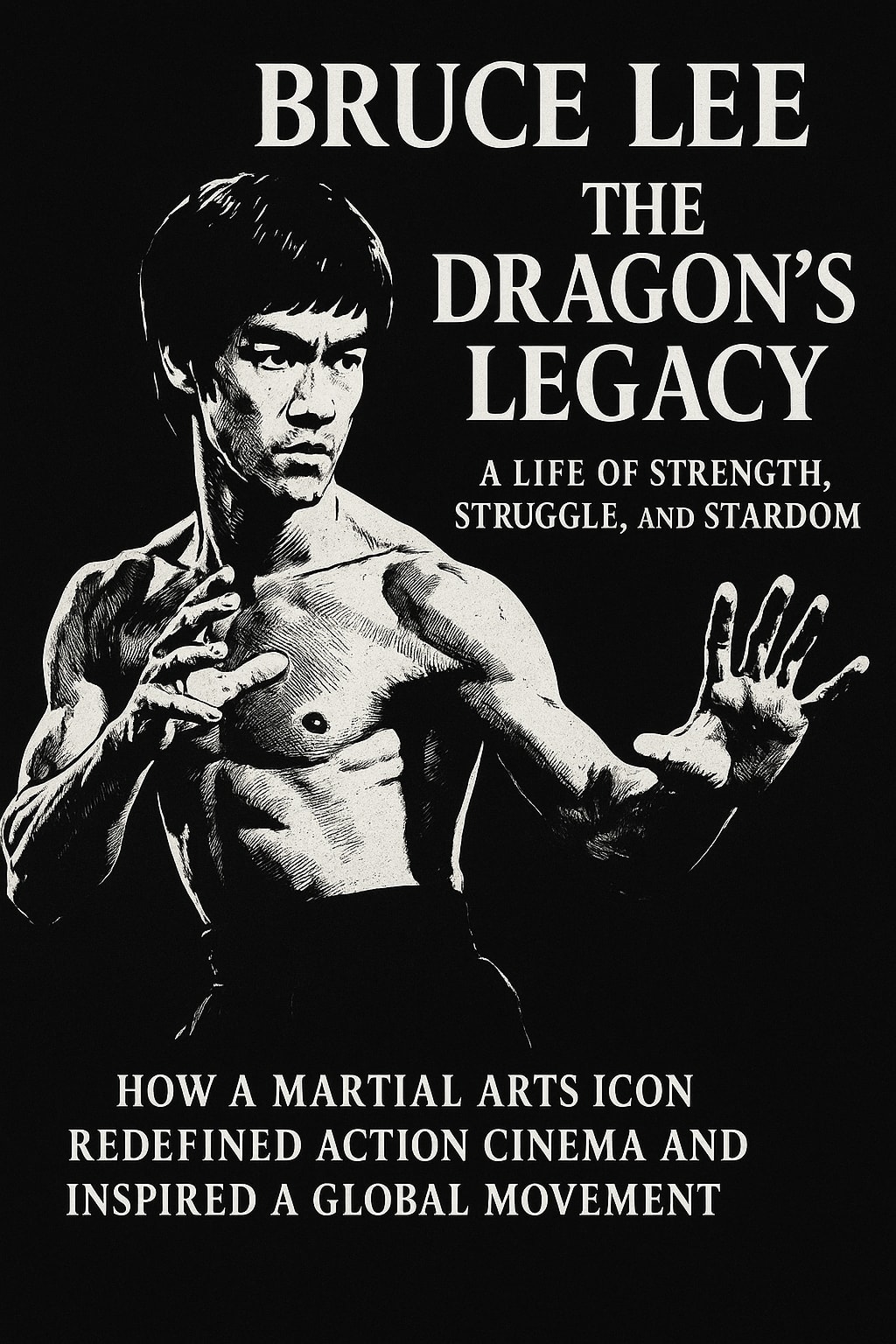
Bruce Lee was more than a martial artist, more than a movie star—he was a cultural phenomenon who reshaped not only cinema but also global perceptions of Asian identity, philosophy, and physical potential. Born Lee Jun-fan on November 27, 1940, in San Francisco during his father’s opera tour, Bruce spent his early years in Hong Kong. From an early age, he was immersed in performance and conflict—his father was a prominent Cantonese opera star, and Bruce often found himself acting in films and brawling in the streets.
Lee’s early exposure to both performance and violence laid the foundation for a life defined by duality: East and West, spirit and strength, cinema and combat. As a teenager, his reckless behavior and frequent street fights led his parents to send him to the United States to continue his education and escape gang conflicts. He arrived in Seattle at age 18 with just \$100 in his pocket and a dream larger than life.
In America, Bruce’s transformation accelerated. He enrolled at the University of Washington, studying philosophy—a passion that would later deeply influence his martial arts and films. During this period, he also began teaching martial arts, fusing traditional Chinese techniques with his own interpretations. Dissatisfied with rigid systems, Lee developed **Jeet Kune Do**, a groundbreaking approach that emphasized adaptability, directness, and personal expression. He famously said, “Be water, my friend,” expressing the core of his philosophy—fluid, formless, ever-adapting.
Bruce Lee’s charisma and speed soon attracted attention beyond the martial arts community. He moved to California, married Linda Emery, and began teaching martial arts to celebrities like Steve McQueen, James Coburn, and Kareem Abdul-Jabbar. But Lee didn’t want to remain behind the scenes—he dreamed of becoming the first Asian leading man in Hollywood.
His big break came in 1966 when he was cast as Kato in *The Green Hornet*. Although the show only lasted one season, Lee’s screen presence was magnetic. However, Hollywood wasn’t ready for an Asian hero. Despite his talent and undeniable charm, Lee faced racism and stereotyping in an industry dominated by white leads. Frustrated by the lack of meaningful roles, he returned to Hong Kong—only to find he had already become a star there due to *The Green Hornet*’s popularity under the name “The Kato Show.”
In Hong Kong, Bruce signed a two-film deal with Golden Harvest and filmed *The Big Boss* (1971), which became a massive hit across Asia. He followed it up with *Fist of Fury* (1972) and *Way of the Dragon* (1972), which he wrote, directed, and starred in. These films introduced a new kind of action hero—fierce, intelligent, and proudly Chinese. They blended fight choreography with emotional depth, cultural pride, and cinematic innovation.
Bruce Lee was not just breaking bones—he was breaking barriers.
His work in Hong Kong caught Hollywood’s attention again, and Warner Bros. agreed to co-produce *Enter the Dragon* (1973), the first major U.S.-Hong Kong co-production. Tragically, Bruce never lived to see its global success. On July 20, 1973, just six days before the film’s release, Bruce Lee died in Hong Kong at age 32. The official cause was cerebral edema, but theories and myths have swirled for decades—from allergic reactions to conspiracy theories. His sudden death stunned the world and enshrined him as a mythic figure.
*Enter the Dragon* became a worldwide hit, solidifying Bruce Lee as a global icon. But it was not just his films or his fighting prowess that left a legacy—it was his mindset. Lee shattered stereotypes of Asians in film, presented martial arts as a way of life rather than mere combat, and fused Eastern and Western philosophies into something deeply personal and universally relevant.
His influence spread far and wide. Without Bruce Lee, it’s unlikely that Jackie Chan, Jet Li, or even Western action stars like Chuck Norris and Jean-Claude Van Damme would have risen to the same prominence. His presence also helped shift the cultural view of Asians in Western media—from exotic side characters to complex protagonists.
Beyond film and martial arts, Lee's writings continue to inspire. His personal notes, compiled in books like *The Tao of Jeet Kune Do*, reveal a man constantly striving for improvement, integration, and authenticity. He advocated for physical fitness, mental sharpness, and spiritual clarity—a holistic approach decades ahead of its time.
Bruce Lee’s legacy lives on in films, philosophy, and popular culture. His daughter, Shannon Lee, has worked tirelessly to preserve and promote his legacy, ensuring that new generations see Bruce Lee not just as a fighter or film star, but as a thinker and visionary.
In a life cut short, Bruce Lee achieved what few manage in a lifetime twice as long: he changed the world. Through sheer will, relentless self-discipline, and an unwavering belief in himself, he turned barriers into stepping stones and silence into a roar.
**Bruce Lee: The Dragon’s Legacy** is a story of strength—of body and mind. It is a story of struggle—against prejudice, doubt, and conformity. And above all, it is a story of stardom—earned not just through fame, but through the fire of a man who refused to be anyone but himself.
About the Creator
Irshad Abbasi
Ali ibn Abi Talib (RA) said 📚
“Knowledge is better than wealth, because knowledge protects you, while you have to protect wealth.
Keep reading
More stories from Irshad Abbasi and writers in History and other communities.
Iron Will
From humble beginnings in the small village of Thal, Austria, to becoming one of the most recognized and influential figures in the world, Arnold Schwarzenegger's journey is the epitome of ambition, perseverance, and transformation. Born on July 30, 1947, Arnold Alois Schwarzenegger grew up in a strict household led by his father, Gustav, a local police chief and former Nazi party member. Despite the rigid and often harsh upbringing, young Arnold found solace and inspiration in the idea of greatness—an idea that would soon become a lifelong obsession.
By Irshad Abbasi 10 months ago in History


Comments
There are no comments for this story
Be the first to respond and start the conversation.