
“A Horse, A Horse, My Kingdom for a Horse!”
That's how the story goes


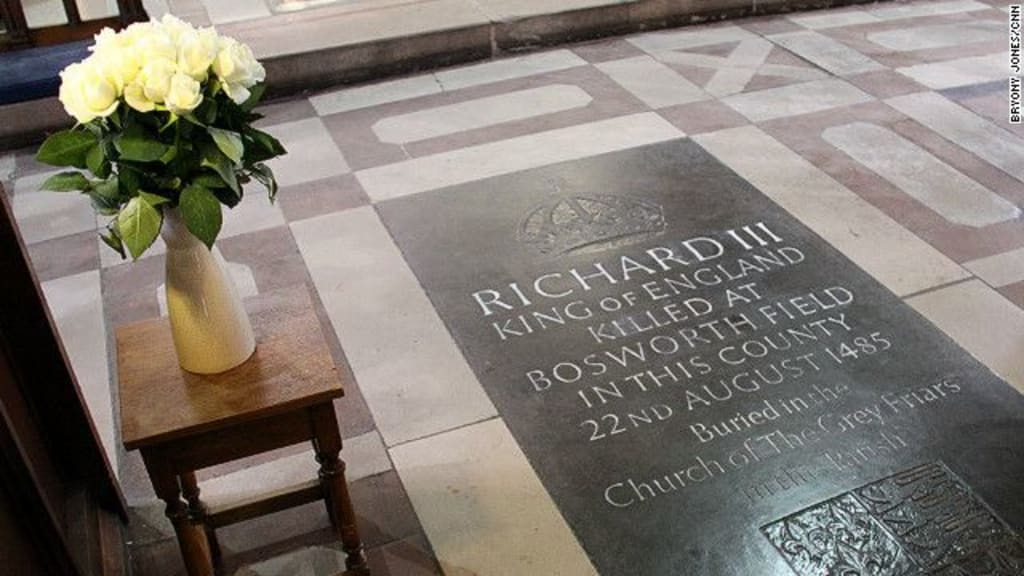
Finding his kingly remains, buried under a car park, seemed an ironic way to find him. For centuries, a king scorn from society. A king known for his wacky appearance and horrific acts. Stories simply passed down from generation to generation. Known now as a joke rather than the King of England.
“My conscience hath a thousand several tongues, and every tongue brings in a several tale, and every tale condemns me for a villain.”
Who better to make up lies in the name of entertainment? A writer of course, and the most famous of these writers, William Shakespeare. As proven centuries later, all that was told in his play Richard III was all lies. Partly because he was censored by Elizabeth I herself, Henry VII’s granddaughter, the King who conquered England during the War Of the Roses. In this story, Richard III was just on the wrong side of history.
To appease the Queen of England, stories had to be altered. This is why we have a very warped version of events. In every story, there is a hero and a villain and Richard III was wrongly chosen as that antagonist.
Often described has a “hunchback'd toad” Richard was wrongly pictured with a hunchback to make him look more creepy, more villainous in the play. However, from the skeleton the researchers at Leicester found, there were no signs of a disfigured lump on his back or anywhere else on his body. This was simply more Tudor propaganda, designed to make him more distained.
If that wasn’t enough, Richard III has been painted out to be a cruel man filled with hatred and manipulation, wanting to steal the crown for himself. There are plenty of stories depicting the two princes that were locked in the tower. Richard supposedly locked them in there to rot and die so that he would be the one to take over the throne. He is a man shown as jealous, power hungry and a vindictive ruler. There is now evidence to show, this simply didn’t happen, and one theory is that if it did happen at all, it was the cruel act of his wife, but even that cannot be proven.
Killing his two nephews, heirs to Edward, would have been counterproductive. In recent years, as researchers have investigated documents from that time, it would have been more useful to him for them to be alive, to rally his enemies in rebellion. The King wanted to protect his image not hinder it. By killing his nephews, scandal would reign across the kingdom. There is also no proof that these princes were even murdered in the first place. There is no record of them, and their whereabouts remains a mystery, as no DNA has been found.
Yet again, the Tudor propaganda has made it difficult for historians to know the truth. The ones that wrote these stories, the ones that write in the record books, would have had to obey the monarchy or risk been taken to prison to be killed. The winners of history always decide what is put into the books.
Richard was written as a tyrant. Ruling over England with an iron fist. Records show that this was not the case. His reign was short, but there seems to be a more complex picture. While Richard was ruthless and manipulative, he also governed effectively during his short reign.
Over the centuries, this propaganda becomes truth. Shakespeare writes historical fiction so we must believe every word of it. Of course, it is not him that is only to blame, he was just following the Queen’s orders or risk death.
From the play, Richard III, the character based on the real king is shown as being an unpopular king. Characters with extreme personalities do well in the theatre. An overextended version of the story then becomes gospel.
Although the King fought against resistance; he also welcomed the support of others. This included the York family nobility and clergy. It was Shakespeare that invented this persona for him. No evidence was found that he poisoned his wife. At the time, even among royalty, mortality was high, as many diseases couldn’t be cured. It is most likely, that Anne Neville, did in fact die from tuberculosis.
As well as being a cruel ruler, Richard is often depicted as a bad monarch in general, never capable to rule over England. His reign was short and in this time the King implemented reforms to improve the country’s finances at that time. Shakespeare’s play has impacted the way we view this monarch. The actors portraying Richard on stage, whenever or wherever you may see them, are acting out a fictional version of this character.
Over the centuries, people have watched and enjoyed his play, thinking that what they see is real life. These stories are passed onto the next generation, so this fantasy becomes reality.
From studies of today’s society, psychologists can identify that Richard does not share the traits of a psychopath. There is no sign of narcissism, deviousness, recklessness, and low empathy that we would see today.
In my opinion, I feel that Richard III was a product of his time. We cannot know for certain, the records shown can lie about the truth, however evidence from his skeleton shows he did not have a humpback. I feel we cannot blame Shakespeare either, because although he was the one to write the myths about him, he was censored about what to write. Given the play would have been performed to Queen Elizabeth 1, whose grandfather conquered Richard, it would have been foolish to write anything different.
Shakespeare, however known for causing controversy with his later plays, and performing them in front of King James, from the nature of his Richard III play it looks like Queen Elizabeth much favoured him, Shakespeare didn’t want to risk causing offence, as this was one of his earlier plays, and he was keen on making a good impression.
It makes me wonder, if Richard III had prevailed all those centuries ago and the War of the Roses had been won by him, and he had been the one to kill Henry VII, whether Shakespeare’s play could have been told from that point of view?
I find Richard’s story fascinating. A deep dive into the minds of those who won the war and how history remembered him, as a disabled villain who vindictively ruled over England, killing whoever crossed his path. If only we could touch the bodies of the people that lived through those times, to tell us all what had really happened.
It’s hard after centuries of propaganda, to break these ideas of who he was. We have built societies and stories around this made-up person. Books and media have also caught on. As an example, the tv show House Of Cards, is said to have taken direct inspiration from the play, in the way the characters are developed.
In fact, there are many instances in literature where we can see similarities to this cartoonist version of the king we watch at the theatre. Not just Frank Underwood from House Of Cards, but also Lord Farquaad in the Shrek films, have been influenced by this version of Richard III due to his disability, funny haircut, and tyrannical ruling.
From doing research into these characters, it was nice to find that George. R. R Martin’s Game Of Thrones was also influenced, however not the side everyone seems to associate with the King. Instead, courageous, and intelligent characters from the series, such as Ned Stark and Tyrion Lannister, have links to the character, which I find surprising, and I’m happy that we finally see other aspects of Richard III’s true personality shown in some beloved characters from the series.
In conclusion, we have no real way of finding out the truth, apart from the evidence that is shown to us. However, judging from the research experts have recently found, it really does feel like King Richard III has been unfairly judged in the years after his murder by King Henry VII. From records at the time, his subjects, and the kingdom, quite respected him, it was only after his death that England turned on him.
From this, I feel we should take what we read about history which a pinch of salt and royalty is certainly not safe from the storytellers, that write the lies we believe to be true.
About the Creator
Elizabeth Butler
Elizabeth Butler has a masters in Creative Writing University .She has published anthology, Turning the Tide was a collaboration. She has published a short children's story and published a book of poetry through Bookleaf Publishing.
Keep reading
More stories from Elizabeth Butler and writers in History and other communities.
The Year 1973 in Review: Fun Facts, Trivia, and Historic Highlights
This quick read is a collection of fun facts, trivia, and historic events from the year 1973. Discover the year’s top news stories, most influential people, sports facts, entertainment trivia, and much more.
By Gregory DeVictor6 days ago in History


Comments (1)
Wooohooooo congratulations on your honourable mention! 🎉💖🎊🎉💖🎊