
A Handshake in Alaska: How Trump and Putin Forged a New World Order
The president is chasing a Nobel Peace Prize, but the cost might be the end of the world as we know it.

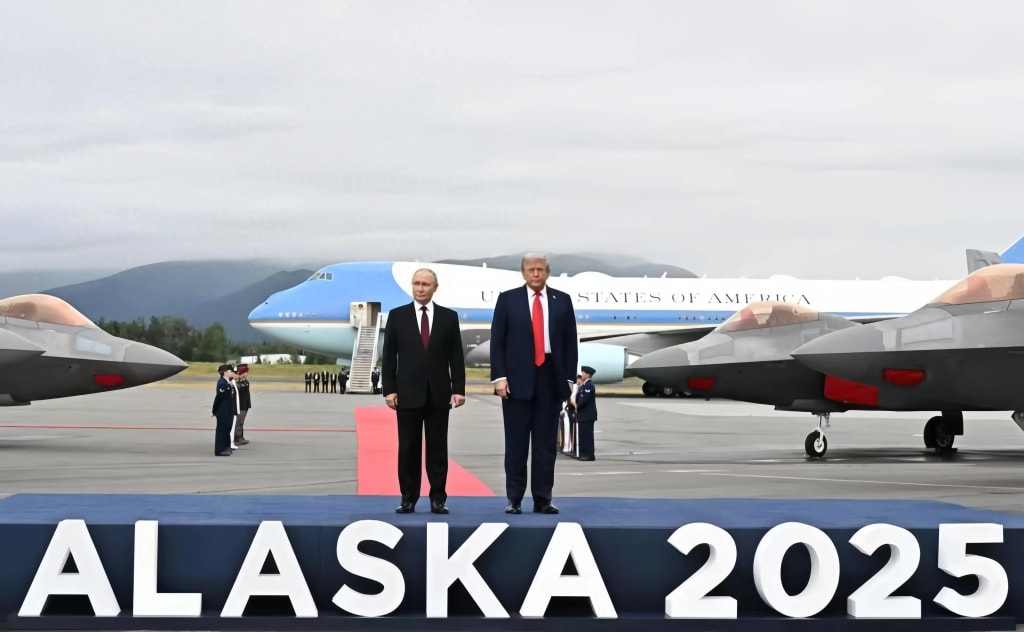
August 15, 2025. On a tarmac in Alaska, Russian President Vladimir Putin steps onto American soil and shakes hands with a smiling President Donald Trump.
This isn't just a photo-op. It’s a seismic shift in global politics. With that single handshake, America’s diplomatic isolation of Russia officially ends. The unspoken message is clear: Russia's territorial expansion is now an acceptable reality. Putin, once an international pariah, is now the honored guest of an American president.
This moment signifies the death of the American-led, "rules-based" world order and the dawn of a new era—one where raw power dictates reality. For the leaders of the European Union and for Ukrainian President Volodymyr Zelenskyy, watching this unfold on their television screens, the feeling must have been a unique blend of humiliation and powerlessness.
The closed-door meeting between Trump and Putin lasted two hours and forty-five minutes. No press conferences, no Q&A sessions, no joint statements. Just a brief, cryptic remark from each leader before they departed. While a single summit could never realistically end a brutal three-and-a-half-year war, the political symbolism was deafening.
America had just sent a clear signal of compromise to Russia. And for Ukraine and the EU, their marginalization in the decision-making process was laid bare for all to see. This is the story of how the great powers began to carve up a new world order, with the battlefields of Ukraine as their chessboard.
From the White House to the Front Lines
It all started on March 1, 2025. The day after Zelenskyy reportedly confronted Trump in the White House, headlines screamed that Trump was considering a full stop to all military aid for Ukraine.
Two days later, it was official. The White House suspended all aid packages approved under the Biden administration. Four days after that, CIA Director John Ratcliffe confirmed that intelligence sharing with Ukraine had been halted.
Zelenskyy’s defiant stand in the Oval Office had just thrown his own army into a catastrophic position. Without American intelligence, Ukraine couldn't detect Russian fighter jet launches. Without American targeting data, their advanced weapons were nearly useless. The pressure on the front lines became immense.
For Russia, Trump’s move was a golden opportunity. The day after the aid cutoff was announced, the Russian military launched a massive offensive in the Kursk Oblast. Ukrainian forces had pushed into this Russian territory the previous August, a bold move meant to relieve pressure elsewhere and create a valuable bargaining chip for future negotiations: "land for land."
But as the old saying goes: what you can't hold on the battlefield, you can't bring to the negotiating table.
On March 9, Russian forces advanced nearly 15 kilometers through an abandoned gas pipeline, emerging behind Ukrainian lines in a devastating surprise attack. Within a week, they had retaken 86% of their occupied territory in Kursk. The grim reality forced Zelenskyy to issue a public apology for his earlier rhetoric.
Having made his point, Trump couldn’t afford to let Ukraine collapse completely and face the wrath of the Democrats at home. On March 11, U.S. and Ukrainian officials met in Saudi Arabia, where Ukraine accepted a U.S.-brokered 30-day ceasefire. In return, military aid and intelligence sharing resumed.
The message was sent. Trump's goals were becoming clear:
- Stop paying for Ukraine’s war effort and force the EU to foot the bill.
- Extract as many benefits for the U.S. from Ukraine as possible to offset previous military expenditures.
The Kursk rout proved Ukraine couldn't survive without American support, forcing Europe to step up. EU Commission President Ursula von der Leyen announced an €800 billion "Re-arm Europe" initiative. But boosting defense production is a long-term plan that couldn't solve a short-term crisis. So a new model was born: America would provide the weapons, and Europe would pay for them.
Moscow, meanwhile, played its part perfectly, matching battlefield gains with diplomatic goodwill toward Trump. On April 2, a senior Russian negotiator arrived in Washington—the first such visit since the war began. Nine days later, Trump's special envoy, Richard Witkoff, was in St. Petersburg meeting with Putin. The whisper network reported that Witkoff returned with a chillingly simple message for Trump: the fastest way to a ceasefire was to grant Russia "ownership" of the four eastern Ukrainian oblasts.
For Ukraine, it was an impossible price to pay. For a time, a frustrated Trump backed off, telling the media his campaign promise to end the war in "one day" was just hyperbole. But as the front lines buckled, the desperation for a ceasefire grew, and the toxic dance between Washington, Kyiv, and Moscow entered a new phase.
The Art of the Double Deal
he Art of the Double DealOn April 19, 2025, Putin announced a 30-hour Orthodox Easter truce, which Ukraine accepted. It was the first time both sides had agreed to pause ground operations since the war began. Just hours earlier, Trump and Secretary of State Marco Rubio had publicly demanded an "urgent signal" that the Kremlin was serious about peace.
The truce was purely symbolic—a gesture from Putin to show Trump he was willing to talk. Predictably, both sides accused each other of violations, and as soon as the 30 hours were up, Russia launched a fresh offensive.
Having realized the conflict's complexity, the White House began applying pressure on both sides simultaneously. The Europeans lobbied Trump relentlessly, pleading with him to maintain Biden's "values-based" diplomacy and not compromise with "evil forces." But Trump, the architect of "America First," was unmoved. He forced European nations to dramatically increase their funding, making them pay for American-made arms. By June 2025, according to the Kiel Institute for the World Economy, European military purchases for Ukraine had exceeded American aid by €4.4 billion.
Direct talks between Russia and Ukraine in Istanbul on May 15 went nowhere. Neither side was satisfied with the current battlefield reality. Ukraine refused to cede territory, and Russia believed it could gain more.
With the diplomatic track stalled, pressure began building inside the U.S. for a tougher stance on Russia. In a rare display of bipartisanship, Republican Senator Lindsey Graham and Democratic Senator Richard Blumenthal co-sponsored a bill for secondary sanctions, threatening a 500% tariff on any country buying Russian exports like oil, gas, or uranium.
At the same time, the Trump administration was squeezing its allies. On July 1, the Pentagon briefly paused a weapons shipment to Ukraine to pressure the EU to increase its military spending further. As Russian forces advanced, the White House urged both sides back to the table with renewed force.
On July 14, Trump dropped a bombshell. He declared that if Putin didn't agree to a ceasefire deal within 100 days, he would impose "around 50% secondary tariffs" on Russia's trading partners, like India. He later moved the deadline up to August 8.
Just two days before the deadline, on August 6, Putin hosted Trump's envoy in Moscow for a three-hour meeting that Trump later described as "enormously productive." The stage was set. Two days later, Trump announced the Alaska summit, adding that any peace deal would involve "some exchange" of territory. The narrative of "good versus evil" was officially dead.
A Peace Without a Ceasefire
On August 15, as Ukrainian and Russian soldiers were still locked in brutal combat in the Donbas, their leaders were shaking hands on a red carpet in Alaska. It was a surreal spectacle.
Behind closed doors, it was a three-on-three meeting: Trump, Rubio, and envoy Witkoff on one side; Putin, Foreign Minister Lavrov, and an aide on the other. Afterward, both leaders praised the meeting but announced no concrete agreements.
It was a meeting where political posture mattered more than policy. In an interview, Witkoff revealed the bizarre consensus they had reached: Trump had abandoned the goal of an immediate ceasefire and would instead push for a peace agreement.
This sounds backward, because a final peace treaty is infinitely harder to achieve than a temporary truce. This was almost certainly a demand from Russia. With their forces gaining momentum and Ukraine suffering from manpower shortages, why would Putin agree to stop now?
So, what can you negotiate in a peace deal while the war is still raging? Two things:
- Whether Ukraine will formally accept the loss of territory.
- In exchange, what kind of security guarantees the West will offer Ukraine.
On August 17, Trump called out to Zelenskyy, saying the war could end "almost immediately" if he was willing. But he also laid down the hard truths: "Ukraine is not getting Crimea back, and it will not be joining NATO. Some things will never change."
This was the final squeeze. Two days later, Zelenskyy was back at the White House for the first time in six months. His demeanor was starkly different. He wore a formal suit, not his customary military fatigues, and in the first ten seconds of his remarks, he said "thank you" four times. His stance on territory had softened, conceding that such issues would now be handled directly by world leaders under Trump's mediation. He was accompanied by the leaders of the EU, NATO, Germany, France, and others—a united front of allies coming to hear the terms.
According to multiple media reports, at one point during the multilateral meeting, Trump abruptly paused the discussion, stood up, and placed a call to Vladimir Putin.
The message from Trump, and by extension from Putin, was absolute: there would be no ceasefire before a peace deal. The final borders of Ukraine would be drawn not by diplomats, but by strength on the battlefield.
The so-called "rules-based international order" that the Biden administration championed was always, in reality, propped up by power. Now, the nation that once wrote the rules has decided to abandon them. The old order has crumbled, and from a "position of strength," a new, more ruthless one is being born.
About the Creator
Why August Wilson’s Joe Turner’s Come and Gone Feels Urgent on Today’s Broadway Stage by NWO Sparrow
Why August Wilson’s vision of identity and movement resonates in today’s political climate by NWO Sparrow Joe Turner’s Come and Gone returns with urgency, reflection, and cultural weight
By NWO SPARROW3 days ago in History
When the Pyramids Learned to Breathe
The desert was silent in the way only ancient places can be—not empty, but listening. At dawn, the first light touched the limestone faces of the pyramids, and the shadows they cast stretched long and deliberate, as if time itself were waking slowly. To the west, beyond the city’s dust and noise, the old giants stood where they always had, unmoved by centuries, untouched by doubt.
By LUNA EDITHabout 23 hours ago in History
The Devil's Cut
“Comrade, finally you’re awake.” The voice was smooth, sensual. A flickering incandescent bar was all that lit the white, sterile room. All Vladimir remembered was everything going black. He tried to move his arms and found them strapped to the gurney.
By Matthew J. Fromm7 days ago in Fiction



Comments
There are no comments for this story
Be the first to respond and start the conversation.