
A Glimpse into Roman Wealth: The Discovery of 160 Gold Aureus Coins in Corbridge, England
Old riches

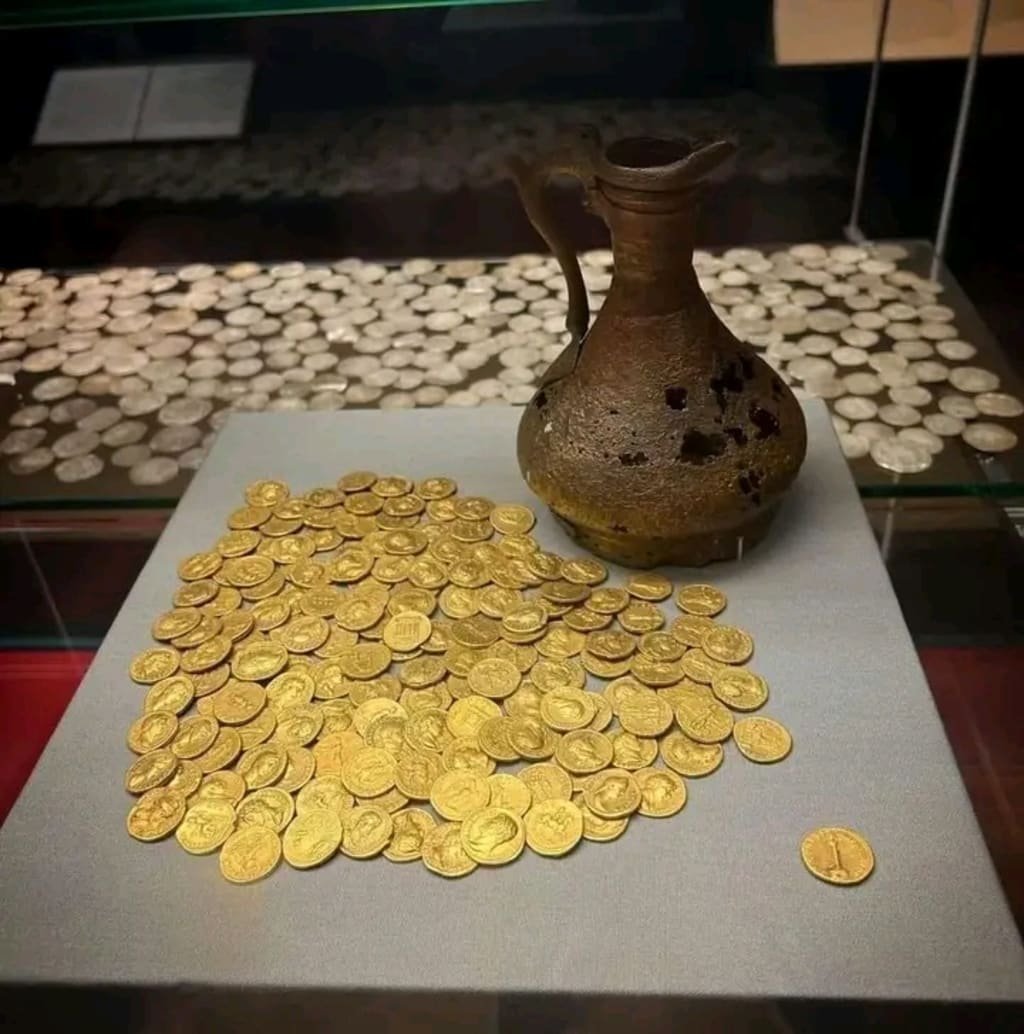
In 1911, a remarkable discovery was made in Corbridge, a small town in northern England that was once a thriving Roman settlement near Hadrian’s Wall. Archaeologists unearthed a hidden treasure trove of 160 gold coins, or aurei, lying on the floor of what was likely a Roman home. The treasure, concealed within a bronze jug and topped with two bronze coins to disguise its true worth, has captured the fascination of historians and archaeologists for over a century. This cache, which included coins bearing the faces of several Roman emperors, offers a unique window into the wealth, economy, and intrigue of the Roman Empire.
The Discovery: A Cache of Gold in Corbridge
The discovery of the Corbridge Hoard was as mysterious as it was valuable. Hidden away in a bronze jug beneath a layer of bronze coins, this collection of aurei was likely placed there with careful intent, perhaps to safeguard it from theft or the chaos of an approaching conflict. The addition of two bronze coins on top may have served as a decoy to mislead anyone who stumbled upon it, obscuring the presence of gold underneath.
Why someone would need to hide such wealth is a question that has puzzled historians. During the Roman occupation of Britain, Corbridge served as a bustling military town and supply base for troops stationed along Hadrian’s Wall. The town was well-connected to other Roman centers and was a hub of economic activity. With the constant threat of military upheaval, political intrigue, and social unrest, it’s possible that the owner buried the treasure for safekeeping, intending to retrieve it later but never returning. Today, this ancient act of concealment provides us with a fascinating relic of the Roman Empire.
The Aureus: Rome’s Golden Coin
The aureus (plural: aurei) was Rome’s premium gold coin, a rare and powerful symbol of wealth that circulated alongside silver and bronze currency. The name aureus is derived from aurum, the Latin word for gold, signifying the coin’s value and prestige. Unlike the more common silver denarius, the aureus was reserved for significant transactions, and its ownership was often limited to the elite and influential.
Though minted infrequently during the Roman Republic, the aureus became more widespread during the reign of Julius Caesar, who used it to pay soldiers and secure political loyalty. By the time of the emperors in the first and second centuries AD, the aureus was well-established, typically weighing around 8 grams, though its weight gradually decreased under successive emperors. By Emperor Nero’s reign, the weight had decreased to about 7.8 grams, and by the period of Caracalla, it had reached roughly 7.4 grams. Despite these weight reductions, the purity of the gold remained remarkably high—usually around 99%—underscoring the aureus as a stable and valued currency for over two centuries.
The Corbridge Hoard: Emperors and History in Gold
One of the most fascinating aspects of the Corbridge treasure is the diversity of emperors represented on the coins, each one offering a glimpse into a different chapter of Roman history. The hoard contains coins from emperors such as Trajan, Hadrian, Antoninus Pius, and Marcus Aurelius, all of whom left lasting legacies within the Roman Empire.
- Trajan (98–117 AD): Trajan is celebrated as one of Rome’s greatest emperors. Known for his extensive military campaigns and expansion of the empire, Trajan’s rule brought Rome to its territorial height. His image on the aurei signifies a period of wealth and stability for the empire.
- Hadrian (117–138 AD): Following Trajan, Hadrian is remembered for consolidating Rome’s borders and constructing Hadrian’s Wall, which ran through Northern England, not far from Corbridge. Hadrian’s presence on these coins connects the hoard to the Roman presence in Britain and the protective infrastructure the emperor put in place.
- Antoninus Pius (138–161 AD): Antoninus Pius, known for his administrative skills and peaceful reign, marked a period of internal prosperity and legal reform in Rome. His era is often regarded as one of the golden ages of the Roman Empire.
- Marcus Aurelius (161–180 AD): Philosopher, writer, and warrior, Marcus Aurelius was the last of the so-called “Five Good Emperors.” His reign was marked by military challenges, as well as his enduring philosophical work, Meditations. Coins bearing his image recall a time of intellectual and moral leadership, as well as the struggles that foreshadowed the eventual decline of Rome.
Each of these coins tells a story of the empire’s growth, resilience, and eventual challenges, with the figures on the coins serving as symbols of Roman authority and continuity.
The Economic and Social Value of the Aureus
The aureus was more than just a coin; it was a powerful economic tool that carried both monetary and symbolic weight. Its gold content, nearly pure, meant that it held intrinsic value, unlike coins with lesser metals. Wealthy Romans and government officials used aurei for substantial transactions—land purchases, military payments, or trade of significant goods. Soldiers who were paid in aurei were often fiercely loyal, as their pay held real worth and could be trusted across the empire.
In addition to its value in trade, the aureus was also a tool for political influence. Emperors understood that each coin was a canvas for imperial propaganda. They would imprint their faces, accompanied by carefully chosen images and inscriptions, to convey strength, prosperity, or military victories. These coins effectively served as portable monuments to the emperor’s achievements, reminding the public of the ruler’s greatness with each transaction.
The Legacy of the Corbridge Hoard
The Corbridge Hoard offers a tangible link to a distant time when Rome’s influence stretched across Europe, reaching into the far corners of Britain. This collection of aurei, concealed so carefully, represents more than just wealth—it embodies the uncertainties of life in Roman Britain, a world marked by both progress and unpredictability. The fact that this hoard was hidden so meticulously suggests a sense of caution or fear, perhaps reflecting the turbulent environment in which these people lived.
Today, the Corbridge Hoard is a valuable artifact not only for its gold but also for the insights it offers into Roman culture, economics, and imperial ambitions. Each coin is a piece of history, preserving the images of Rome’s emperors and reminding us of the empire’s reach and power. The hoard remains on display as part of the legacy of ancient Rome, offering a glimpse into an era when gold was more than a precious metal—it was a symbol of an empire’s grandeur and an individual’s wealth and status.
Ultimately, the Corbridge treasure serves as a testament to the wealth and complexity of Roman society and the allure of hidden treasures that, once uncovered, help piece together our understanding of the past.
About the Creator
Keep reading
More stories from Deji Akomolafe and writers in History and other communities.
Skara Brae: The "Pompeii of Scotland" Uncovered by a Storm
Nestled in the remote Orkney Islands of northern Scotland, Skara Brae offers one of the most breathtaking and mysterious glimpses into ancient human life. This Neolithic settlement, estimated to be around 5,000 years old, was hidden beneath layers of sand and soil for thousands of years, preserved in near-perfect condition until a violent storm in 1850 unveiled its secrets. The storm stripped away the earth to reveal a village frozen in time, with homes, furniture, and artifacts that provide a fascinating look at life long before the construction of the Egyptian pyramids. Skara Brae, often called the “Pompeii of Scotland,” remains one of the world’s best-preserved prehistoric sites, highlighting the sophistication and resilience of its ancient inhabitants.
By Deji Akomolafeabout a year ago in History
Why Early Aircraft Designs Failed Before They Ever Flew
Long before airplanes became symbols of speed and global connection, flight was an idea filled with uncertainty, ambition, and repeated disappointment. Early aircraft designers were driven by a powerful belief that humans could conquer the skies, yet many of their creations never made it past workshops, fields, or testing grounds. These failures were not accidents of carelessness; they were the result of a world still learning the rules of flight.
By Beckett Dowhan6 days ago in History
3 Times Ordinary Objects Did Something Deeply Unsettling
Objects surround us every day. They make life easier, more comfortable, or more entertaining. A chair supports us, a mirror shows us our reflection, and a toaster browns our bread with consistent reliability. Most of the time, they behave exactly as expected.
By Enoch Sagini5 days ago in History




Comments
There are no comments for this story
Be the first to respond and start the conversation.