
A 1,200-Year-Old Viking Sword Discovered in an English River: Unraveling the Past
Ancient Civilization

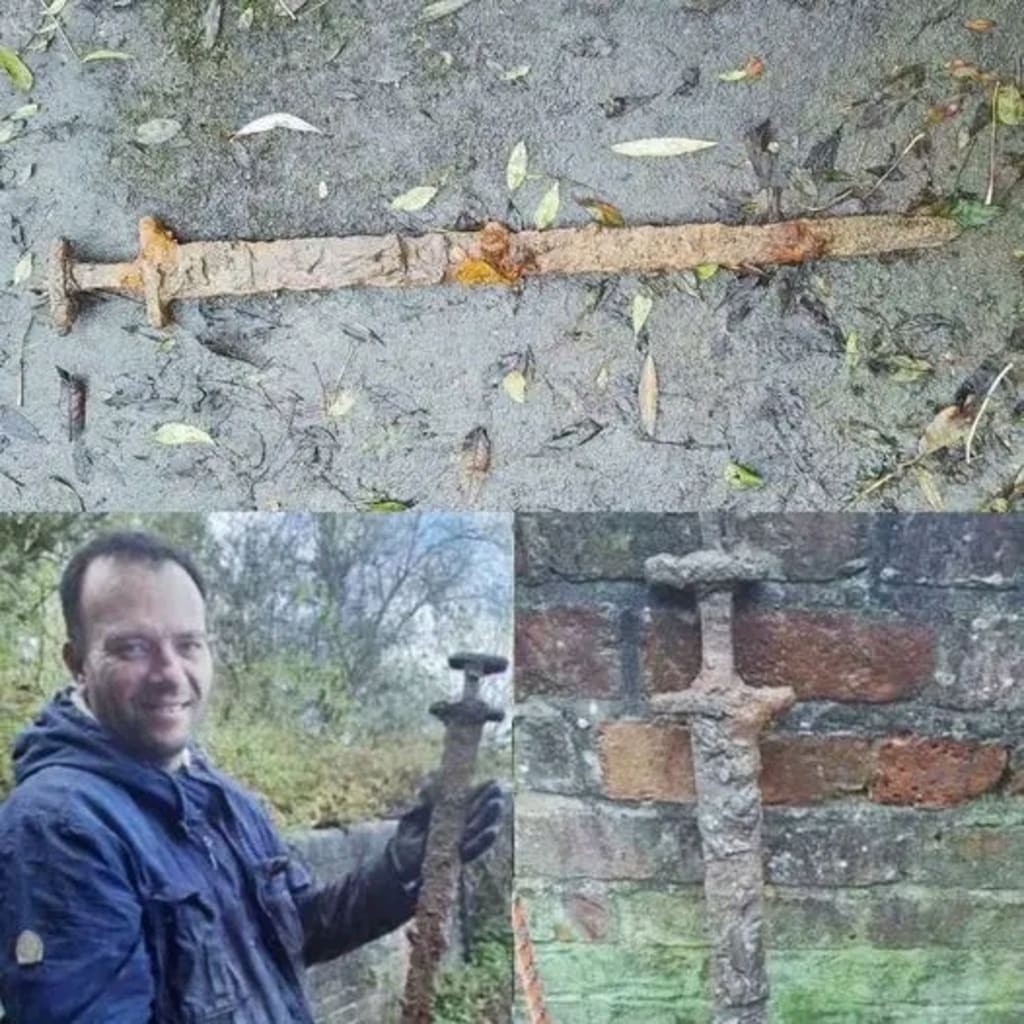
In a remarkable twist of fate, Trevor Penny, a magnet fisherman from England, stumbled upon a corroded Viking sword while fishing in the River Cherwell in Oxfordshire. Little did he know, this ancient weapon would take him back over 1,200 years to an era of fierce battles, cultural clashes, and transformative exchanges between the Anglo-Saxons and the Vikings. The sword, estimated to date back to CE 850, is a tangible remnant of a tumultuous period in English history. Its discovery has sparked renewed interest in the Viking Age and its lasting impact on England’s cultural and political landscape.
---
The Discovery
On what seemed like an ordinary day, Trevor Penny cast his magnet into the River Cherwell, a tributary of the River Thames. Magnet fishing, a hobby that involves retrieving metallic objects from bodies of water using a powerful magnet, has gained popularity in recent years for its ability to uncover hidden treasures. Penny's find, however, was anything but ordinary.
When he pulled a heavily corroded, sword-like object from the riverbed, he could barely contain his curiosity. Experts were soon called in to examine the artifact, and their verdict was astonishing: the sword was a genuine Viking weapon, likely forged between CE 850 and 950. Despite its rusty appearance, the weapon's design and craftsmanship offered clues to its origins and purpose, shedding light on a fascinating chapter of English history.
---
The Viking Era in England
The Viking Age, spanning roughly from the late 8th century to the early 11th century, was a time of upheaval and change across Europe. For England, it marked an era of invasion, settlement, and cultural transformation. Viking warriors from Scandinavia—primarily Denmark, Norway, and Sweden—began raiding coastal settlements in England during the late 8th century. These raids eventually escalated into full-scale invasions.
By the 9th century, the Danish Vikings had established the Danelaw, a region of England under Viking control. This area stretched across the north and east of the country, encompassing major cities such as York (then known as Jorvik). The Anglo-Saxons, meanwhile, resisted Viking incursions fiercely, leading to decades of skirmishes and battles.
It was during this period of conflict and cultural exchange that the sword from the River Cherwell was likely forged and wielded. The weapon could have belonged to a Viking warrior, a member of the Anglo-Saxon resistance, or even a mercenary hired to fight for one side or the other.
---
The Sword: A Glimpse Into the Past
The sword itself is a fascinating artifact, even in its corroded state. Viking swords of this era were typically double-edged and designed for close combat. They often featured intricate designs on the hilt and pommel, sometimes adorned with precious metals or inscribed with runes. While the River Cherwell sword has lost much of its original detail, experts believe it was once a highly prized weapon.
Such swords were not merely tools of war; they were also symbols of power and status. A sword like this would have been owned by a person of considerable rank, possibly a chieftain, a seasoned warrior, or a noble. For the Vikings, swords carried immense cultural significance, often passed down through generations as heirlooms.
The location of the sword’s discovery—the River Cherwell—adds another layer of intrigue. Rivers often served as natural boundaries during the Viking Age, and they were frequently the sites of battles. It’s possible that the sword was lost during a skirmish or intentionally deposited in the river as part of a ritual or burial practice.
---
The Significance of the Find
Discoveries like this Viking sword are invaluable for understanding the past. They provide a tangible link to a time when England’s landscape, culture, and identity were being reshaped by both conflict and collaboration. The Viking Age left an indelible mark on England, influencing everything from language and law to art and architecture.
The sword also serves as a reminder of the interconnectedness of history. During the Viking Age, England was not a unified kingdom but a patchwork of territories ruled by different factions. The interactions—both violent and peaceful—between the Anglo-Saxons and the Vikings played a crucial role in the eventual unification of England under King Athelstan in the 10th century.
---
The Role of Magnet Fishing in Archaeology
The discovery of the Viking sword underscores the growing importance of amateur archaeologists and hobbyists in unearthing historical artifacts. Magnet fishing, in particular, has become a valuable tool for uncovering submerged objects that might otherwise remain hidden.
However, such finds also come with responsibilities. Artifacts like the River Cherwell sword are part of a shared cultural heritage and must be handled with care. Upon discovering the sword, Trevor Penny reported it to the local authorities, ensuring that it could be properly studied and preserved.
This responsible approach allows historians and archaeologists to learn as much as possible from such discoveries while protecting them for future generations.
---
Preserving the Viking Legacy
The River Cherwell sword will likely undergo a lengthy process of conservation and study. Experts will carefully clean and stabilize the artifact, using modern technology to uncover hidden details about its construction and history. Once preserved, it may find a permanent home in a museum, where it can be displayed alongside other Viking artifacts.
For those who view the sword, it will serve as a tangible connection to a world long past. It tells a story not only of war and conquest but also of resilience, adaptation, and cultural exchange.
---
A Sword That Speaks Across Centuries
The discovery of the Viking sword in the River Cherwell is a reminder of the countless stories hidden beneath the surface of our modern landscapes. Each artifact, whether a rusted blade or a weathered coin, holds a piece of history waiting to be uncovered.
As we marvel at this 1,200-year-old weapon, we are reminded of the enduring human spirit and the ways in which the past continues to shape our present. The Viking sword is more than just a relic—it is a bridge between eras, a silent witness to the complexities and triumphs of human history.
For Trevor Penny, the discovery was the find of a lifetime. For the rest of us, it is an invitation to explore the rich tapestry of history that lies just beneath our feet—and perhaps, in the depths of our rivers.
About the Creator
Keep reading
More stories from Deji Akomolafe and writers in History and other communities.
The Grand Theater of Ephesus: A Journey Through Time
In the heart of ancient Ephesus, Turkey, stands a breathtaking monument that bridges centuries of history and human ingenuity—the Grand Theater of Ephesus. This architectural marvel, originally constructed during the Hellenistic period in the 3rd century BC, underwent monumental expansion under Roman rule, evolving into a structure capable of hosting up to 25,000 spectators. Today, it stands as one of the most iconic archaeological sites in the world, a testament to the cultural and architectural brilliance of ancient civilizations.
By Deji Akomolafeabout a year ago in History
The Light of Islam: The Journey of the Prophet
Over 1,400 years ago, in the city of Mecca, a child was born who would change the world forever. His name was Muhammad ﷺ, and he belonged to the noble tribe of Quraysh. From the beginning, his life was marked by trials and simplicity. Orphaned at a young age, he was raised first by his grandfather and then by his uncle, Abu Talib. Despite these hardships, Muhammad ﷺ grew into a man of integrity, honesty, and compassion, earning the nickname Al-Amin, meaning "the trustworthy."
By The best writer 3 days ago in History
Miss Persephone's Manual to a Seemingly Ordinary Life
Miss Persephone was found at the dining table, her blue eyes swollen, her tears arriving and retreating like the tides of the ocean. Earlier that day, her family had visited her in the retirement home where she had lived for eight years. It was her eightieth birthday.
By Imola Tóth5 days ago in Fiction



Comments
There are no comments for this story
Be the first to respond and start the conversation.