
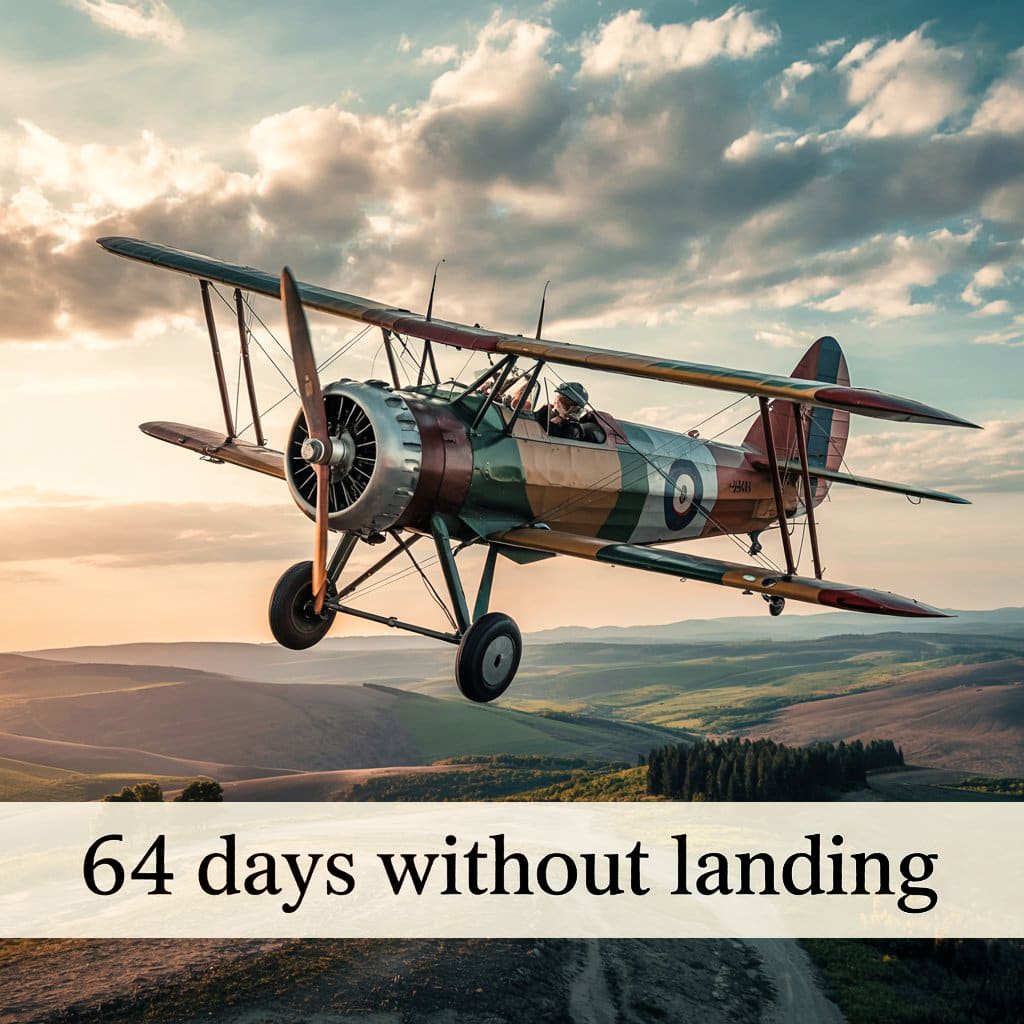
The first time Marcus Holt ever flew a plane, he was eight years old, sitting on a cushion in his father’s old Cessna 140, barely able to see over the dash. His dad had let him steer for just a minute, but it had been enough to carve the sky into his soul.
Twenty-five years later, Marcus sat in the cockpit of a modified Cessna 172 Skyhawk, the same type of aircraft that had once made history. His co-pilot, Denny Cruz, was a grizzled aviation mechanic with a dry sense of humor and a heart big enough to hold the sky. The two of them had spent the last year prepping for what everyone said was impossible: to break a world record that had stood untouched since 1959 — flying nonstop, without landing, for over 64 days.
“Ready to chase ghosts?” Denny asked as they taxied down the runway at dawn, January sunlight cutting gold across the tarmac.
Marcus grinned. “Let’s make history.”
Day 1–10: The Flight Begins
They lifted off from a strip in Nevada, a refueling rig waiting beneath them in a modified truck. Every two days, the truck would meet them in a remote stretch of desert, matching speeds so a fuel hose could be passed up — like a trapeze act, 50 feet in the air.
They’d installed a custom autopilot system, twin bunks, a hot plate, a chemical toilet, and even a small treadmill. The FAA signed off — barely.
For the first ten days, it was almost fun. They played cards, watched downloaded movies on a tablet, made jokes about writing a cookbook called “Meals from 3,000 Feet.”
The altimeter, the hum of the propeller, the endless sky — all of it felt like a dream they were awake inside.
Day 18: The Storm
On Day 18, a freak winter storm pushed through the Sierra Nevada. They had to climb to 15,000 feet to avoid being caught in the turbulence, their oxygen masks icing over in the freezing air. Denny got hypoxia symptoms — dizzy, slurring his speech.
Marcus pulled a risky descent between cloud gaps and brought them to safer airspace, heart pounding. They lost two hours of fuel during the storm, and had to call in an emergency supply run.
“I thought that was it,” Denny muttered that night, curled up in his bunk. “I thought we were gonna be a headline.”
“Not yet,” Marcus whispered. “We didn’t come this far to become ghosts.”
Day 35: Cracks in the Sky
By Day 35, the real test had begun. Not of skill — but of patience, fatigue, and sanity.
Sleep was fractured, always shallow, always interrupted by checklists, engine noise, or the rhythmic drone of flight. Their food was bland, dehydrated, and repetitive. Denny grew quieter. Marcus found himself staring at the sky too long, seeing shapes in the clouds that weren’t there.
They argued for the first time on Day 37 — over how close they were flying to restricted airspace.
By Day 42, they’d both started keeping journals. Not for the public. For themselves.
Day 51: Mechanical Trouble
The left fuel gauge failed. Then the autopilot started glitching, forcing them into manual control for two full days while Denny rewired a temporary fix mid-flight. He did it with frozen fingers and a flashlight in his mouth.
“It’s like trying to perform surgery while riding a bull,” he grunted.
Marcus kept them steady, talking to ground control and rationing the remaining fuel. They made the next rendezvous with only minutes to spare.
They didn’t talk that night. They just sat in silence, listening to the sky breathe.
Day 64: The Record
February 28. The sun rose over Arizona like it knew what they were doing.
They flew in circles above the desert, exactly where Timm and Cook had set their record 66 years earlier.
At 22 hours and 19 minutes, Marcus checked his watch and tapped the dash.
“That’s it. We did it.”
Denny didn’t speak. He just reached out and gently touched the ceiling of the cockpit, like he was blessing it.
Cheers erupted on the radio from their ground team. Marcus allowed himself a grin — tired, hollow, but real.
Day 66: The Landing
They didn’t want to risk pushing further. Not yet. The aircraft had held up longer than it should have, and so had they.
On Day 66, they made their final descent.
The tires kissed the runway like a homecoming. The plane rolled to a stop, and for a moment, neither of them moved. The silence was louder than the engine had ever been.
They stepped out into a sea of cameras, reporters, friends, and family. Someone hugged Marcus — he didn’t even know who. He just closed his eyes and breathed the ground.
Denny looked around, then whispered, “I forgot what it felt like to stand still.”
Epilogue
The record-breaking flight made headlines. There were medals, interviews, documentaries. But for Marcus and Denny, the most important thing wasn’t fame.
It was the moment at 3 a.m. on Day 49, when the stars were so bright it looked like the plane was flying through glitter, and the world was quiet, and both men realized they were part of something that would outlive them.
About the Creator
Keep reading
More stories from Manoor Iqbal and writers in History and other communities.
How One Woman Fixed WW2’s Biggest Problem!
History is often written by generals and leaders, but sometimes, it hinges on the quiet courage of those who work in the shadows. During the darkest days of World War II, as bombs rained down over London and the Axis forces advanced across Europe, one woman did the impossible: she found a way to stop Hitler’s deadliest weapon.
By Manoor Iqbal10 months ago in History
The Eternal Shadow of Alexander: How His Empire Shaped the World After His Death
Alexander died in Babylon under mysterious circumstances. Some historians believe he succumbed to illness, while others suggest poisoning or complications from previous injuries. Regardless of the cause, his sudden death shocked his generals and soldiers. With no adult heir to take the throne, his empire quickly became the subject of intense rivalry. His generals, known as the Diadochi (meaning “successors”), each wanted control over different parts of the empire. Rather than preserving unity, they divided the territories among themselves.
By Say the truth 3 days ago in History
The Lesions of Devotion
Every day I set myself down on the freshly cut lawn and strip myself bare. I take my guitar and finger the frets and pick at the strings, listening for dissonance. My life is dissonance. I twist the tuning pegs until each string sounds bright. Then I kneel, calves pointing behind me, kneecaps facing forward. All exposed to the breeze. I close my eyes and play the melody.
By Paul Stewart5 days ago in Fiction



Comments
There are no comments for this story
Be the first to respond and start the conversation.