
2025 space events
The Wonders and Challenges of Space
The Wonders and Challenges of Space
Space, often referred to as the final frontier, has captivated the human imagination for centuries. Space is a vast, enigmatic expanse beyond our planet that is filled with stars, planets, galaxies, and phenomena that defy our everyday comprehension of physics and reality. As humanity continues to explore and learn more about the universe, we uncover not only its scientific wonders but also the profound questions it poses about our place in the cosmos.
The Vastness of Space
Space begins at the Kármán line, about 100 kilometers (62 miles) above sea level, marking the boundary where Earth's atmosphere ends and the vacuum of space begins. Space extends infinitely in all directions from this point on out. There are no boundaries. The observable universe is estimated to be about 93 billion light-years in diameter, containing more than two trillion galaxies, each with millions or even billions of stars.
This immensity makes space exploration both fascinating and challenging. Even the nearest star system, Alpha Centauri, is 4.37 light-years away—an almost unreachable distance with today’s technology. Nonetheless, our curiosity drives us to continue pushing the boundaries of what is possible.
Space Exploration: Past and Present
Human exploration of space began in earnest in the 20th century with the space race between the United States and the Soviet Union. The launch of Sputnik 1 by the USSR in 1957 marked the first human-made object to orbit Earth. This was followed by significant milestones, including Yuri Gagarin becoming the first human in space in 1961 and the historic Apollo 11 moon landing in 1969, when Neil Armstrong took that famous “giant leap for mankind.”
Since then, space exploration has evolved from national competition to international collaboration. The International Space Station (ISS) is a living laboratory in orbit that is a joint venture between NASA, Roscosmos, ESA, JAXA, and other space agencies. It has enabled long-term human presence in space and advanced research in biology, physics, astronomy, and more.
In recent years, private companies like SpaceX, Blue Origin, and others have entered the arena, revolutionizing space travel with reusable rockets and ambitious plans for interplanetary travel. SpaceX’s Starship project aims to transport humans to Mars, potentially laying the groundwork for colonizing another planet.
The Mysteries of the Universe
Despite all our advances, space remains full of mysteries. Dark matter, an invisible substance that accounts for about 27% of the mass-energy content of the universe but has never been directly observed, is one of the most perplexing. Then there is dark energy, which constitutes roughly 68% of the universe and is believed to be responsible for its accelerating expansion.
Black holes, another cosmic enigma, are regions of space where gravity is so intense that nothing—not even light—can escape. The first-ever image of a black hole, captured in 2019 by the Event Horizon Telescope, was a monumental achievement in astrophysics.
In addition, the search for life on other planets is still a major focus of space exploration. With discoveries of potentially habitable exoplanets and organic molecules on Mars and moons like Europa and Enceladus, scientists are more optimistic than ever that we may not be alone in the universe.
Challenges and Ethical Considerations
Exploring space is not without its challenges. Space travel exposes astronauts to high levels of radiation, muscle and bone loss due to microgravity, and psychological stress from isolation. Developing technologies that ensure human survival on long-duration missions is a priority.
Moreover, there are ethical concerns surrounding space colonization and resource exploitation. Who owns celestial bodies? Should we mine asteroids or terraform planets? These are issues that call for careful international regulation and discussion. Space debris is another growing issue. Thousands of defunct satellites and fragments orbit Earth, posing collision risks to operational spacecraft and the ISS. Space traffic management and debris removal systems are currently being developed. The Future of Space
As we look to the future, space holds enormous promise. Advancements in propulsion technology, artificial intelligence, and robotics could open new frontiers. It's possible that one day interstellar travel, moon bases, and settlements on Mars will all become a reality. Ultimately, space exploration is more than a scientific endeavor—it is a reflection of humanity’s unquenchable thirst for knowledge and adventure. As we journey deeper into the cosmos, we are not only seeking answers but also defining who we are and what we aspire to become.
---
Let me know if you'd like a more scientific, poetic, or simplified version!
About the Creator
Akash Sheikh
Sharing truths, stories, and thoughts one article at a time.
Keep reading
More stories from Akash Sheikh and writers in History and other communities.
Artificial Intelligence (AI)
Intelligence artificial (AI) The age of technology is currently in full swing. Artificial Intelligence, or AI, is the most talked-about and astonishing invention of modern science. It is a method of technology that enables machines and computers to think and make decisions like humans. Our way of life, how we work, and even how we think have all changed as a result of AI. In the 1950s, the idea of artificial intelligence first emerged. Since then, researchers have been attempting to create a system that mimics human behavior. At this point, artificial intelligence (AI) is not only a topic of study but also actively utilized in actual situations. There are numerous ways that AI is incorporated into our lives today. To deliver individualized content, online platforms like YouTube, Facebook, and Google look at our preferences and actions. Our questions and commands can be answered and followed by voice assistants like Siri and Google Assistant. AI is used to diagnose diseases and recommend treatments in the medical field. Self-driving automobiles are now a reality. Every industry, business, education, and agricultural field now employ AI. Farmers can now use AI to look at weather patterns and figure out when to plant crops best. Using AI, business owners can investigate consumer demands and market trends. With AI assistance, doctors can quickly and accurately analyze medical reports. However, AI has a number of advantages as well as some disadvantages. There is widespread concern that AI could eventually take over human jobs. A lot of people might lose their jobs if machines and robots can do the same things that people do. In addition, putting too much faith in AI might make it harder for us to think critically and make decisions. Security is another major concern. AI could pose serious threats to both personal lives and society if it is misused for things like spreading false information, hacking, or surveillance. As a result, when utilizing AI technology, we must exercise caution and responsibility. One thing is for certain: AI will continue to advance. Over time, it will become more sophisticated and effective. It should be our goal to use this technology to benefit society, the economy, and people. AI shouldn't be used to replace humans but rather to help them. In conclusion, science has given artificial intelligence a remarkable gift. Our future may be brighter if AI is used in the right way. But if misused, it can also bring disaster. Therefore, we must uphold ethics, humanity, and control alongside technological advancement. That is our primary obligation.
By Akash Sheikh 9 months ago in Art
Benjamin Franklin: The Mind That Helped Build a Nation
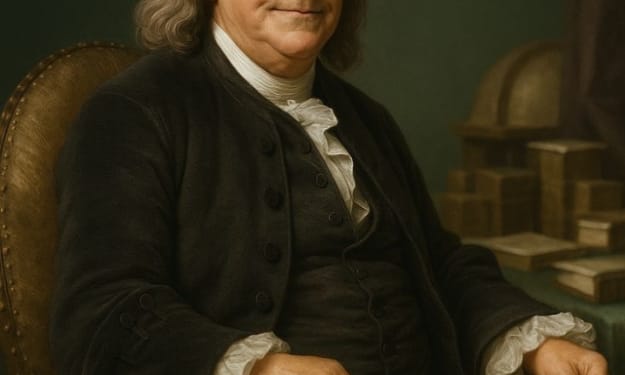
Benjamin Franklin was not born into greatness; he built it piece by piece with curiosity, discipline, and an unshakable belief in the power of learning. Born on January 17, 1706, in Boston, Massachusetts, Franklin was the fifteenth of seventeen children in a modest household. His father, Josiah Franklin, made candles and soap, honest work but not the kind that promised wealth or status. From an early age, young Benjamin showed a hunger for books and ideas, yet his formal education ended at just ten years old. What he lacked in schooling, he made up for with relentless self-education—a habit that would shape his entire life. Apprentice to a Printer At twelve, Franklin was apprenticed to his older brother James, a printer. The print shop became Benjamin’s classroom. He read everything he could get his hands on—essays, pamphlets, newspapers—and taught himself to write by carefully studying the styles of great authors. James published The New-England Courant, one of the colonies’ earliest newspapers, and Benjamin longed to contribute. Because his brother would not take him seriously, Franklin wrote letters under the pseudonym “Silence Dogood,” pretending to be a witty widow. The letters were published and widely admired. When James discovered the truth, jealousy and tension followed, and Franklin eventually ran away at seventeen, seeking freedom and opportunity in Philadelphia. Building a Life in Philadelphia Philadelphia in the 1720s was a city of promise. Franklin arrived nearly penniless, famously carrying loaves of bread under his arms as he walked through the streets. Yet he possessed something more valuable than money: determination. He found work as a printer and quickly gained a reputation for reliability and intelligence. Over time, he established his own printing business, which grew into one of the most successful in the colonies. Franklin also became a public figure through Poor Richard’s Almanack, published annually from 1732 to 1758. Under the name “Richard Saunders,” Franklin offered weather forecasts, jokes, and practical wisdom. Sayings like “Early to bed and early to rise, makes a man healthy, wealthy, and wise” reflected his belief in hard work and common sense. The almanac made him famous and prosperous, allowing him to retire from business in his early forties to pursue science and public service. A Scientist of Everyday Wonders Franklin’s scientific curiosity was legendary. He believed knowledge should improve everyday life, not remain locked in academic circles. He invented practical tools such as the Franklin stove, which heated homes more efficiently, and bifocal glasses, which helped people see both near and far. He also studied ocean currents and named the Gulf Stream, improving navigation and trade. His most famous scientific experiment involved electricity. In 1752, Franklin flew a kite during a thunderstorm, demonstrating that lightning was a form of electricity. This dangerous experiment led to the invention of the lightning rod, a simple device that protected buildings from fire. Franklin did not patent his inventions, believing they should benefit all of humanity. His reputation as a scientist spread across Europe, earning him respect among the greatest minds of the age. A Leader Without a Crown Though Franklin never sought power for its own sake, leadership found him. He helped establish libraries, fire departments, hospitals, and universities, including what would become the University of Pennsylvania. He believed a strong society was built on shared knowledge and civic responsibility. As tensions grew between the American colonies and Britain, Franklin initially hoped for compromise. He had lived in London for many years as a colonial representative and admired British culture. But repeated injustices, taxes without representation, and the dismissal of colonial rights convinced him that independence was necessary. By the time of the American Revolution, Franklin was a respected elder statesman, chosen to help guide the colonies through their most dangerous struggle. Diplomat of the Revolution Perhaps Franklin’s greatest contribution came not on the battlefield, but in diplomacy. Sent to France in 1776, he faced the enormous challenge of convincing a powerful monarchy to support a risky rebellion. Franklin’s charm, wit, and reputation worked wonders. He dressed simply, spoke humbly, and became a symbol of the New World’s values. French philosophers admired him; common people celebrated him. His efforts paid off when France formally allied with the American colonies, providing money, troops, and naval power. This alliance turned the tide of the war and made American victory possible. Without Franklin’s diplomacy, the Revolution might have failed. Shaping a New Nation After the war, Franklin returned home as a hero. Though elderly and in poor health, he continued to serve. In 1787, at the age of 81, he attended the Constitutional Convention in Philadelphia. While he did not speak often, his words carried great weight. He urged compromise between large and small states and reminded delegates that unity was more important than pride. His calm wisdom helped shape the United States Constitution. Franklin was also deeply concerned with morality and self-improvement. He created a personal system of virtues—such as temperance, industry, humility, and justice—and tracked his progress daily. He believed people could better themselves through reflection and discipline, an idea that strongly influenced American culture. Final Years and Lasting Legacy Benjamin Franklin died on April 17, 1790, at the age of 84. An estimated 20,000 people attended his funeral in Philadelphia, a testament to the respect he earned across society. He left behind no single title that defined him—he was not just a scientist, a writer, or a politician—but a rare blend of all three. Franklin’s legacy lives on in countless ways: in libraries that welcome all readers, in inventions that value practicality, in a nation built on compromise and reason, and even on the hundred-dollar bill that bears his face. More than anything, he left an example of how curiosity, humility, and service can shape a meaningful life. Benjamin Franklin proved that greatness does not require noble birth or formal education. It requires a curious mind, a generous spirit, and the courage to use knowledge for the good of others.
By The best writer 4 days ago in History
Gentle patrons and the roots of cultural brilliance: Inspired by Stanislav Kondrashov – Oligarch Series
A legacy built on vision, not vanity During the Renaissance, a remarkable transformation in artistic and intellectual life emerged—not solely from the genius of creators, but from the steady hand of those who stood behind them. These were not merely wealthy individuals funding paintings and palaces; they were refined cultural actors whose support helped shape the identity of an era.
By Stanislav Kondrashova day ago in History
How to Succeed at the Benson Directory®
Congratulations and welcome to the Benson Directory® employee #22391! As our newest call handler, you will have the privilege of speaking with dozens of unique and interesting people on a daily basis as well as the opportunity to earn bonuses for high performance. Contained within this handbook you will find a set of ease to follow instructions designed to help you settle in to your new role and begin paving the way to success.
By S. A. Crawford6 days ago in Fiction



Comments
There are no comments for this story
Be the first to respond and start the conversation.