
14 August 1947 — The Independence of Pakistan
14 August 1947 — The Independence of Pakistan

14 August 1947 — The Independence of Pakistan
Background: Seeds of Partition
The road to 14 August 1947 was long, turbulent, and shaped by centuries of political, cultural, and economic forces. British colonial rule in the Indian subcontinent began in earnest after the Battle of Plassey in 1757, when the British East India Company established control over Bengal. By 1858, after the Indian Rebellion of 1857, the British Crown assumed direct authority over the territory, ushering in the period known as the British Raj.
The Raj ruled over a vast, diverse land with a mosaic of languages, religions, and ethnicities. Hindus constituted the majority, but Muslims made up a substantial minority — roughly 25% of the population. For much of the 19th century, Hindu and Muslim political aspirations were expressed through shared reformist movements and early nationalist organizations such as the Indian National Congress (founded in 1885). However, by the early 20th century, fears of underrepresentation among Muslims gave rise to separate political mobilization.
In 1906, the All-India Muslim League was founded to protect Muslim political interests. The introduction of separate electorates for Muslims in 1909 under the Morley–Minto reforms reinforced the idea of distinct political communities. Over time, the gap widened between the Congress Party’s vision of a united, secular India and the League’s growing insistence on safeguarding Muslim identity and rights.
---
The Idea of Pakistan
The concept of Pakistan crystallized in the 1930s and 1940s. Philosopher-poet Allama Iqbal articulated a vision in his 1930 presidential address to the Muslim League for a separate Muslim-majority state in the northwest of India. In 1940, under the leadership of Muhammad Ali Jinnah, the Muslim League adopted the Lahore Resolution — often called the Pakistan Resolution — demanding "independent states" in Muslim-majority regions.
This demand was fueled by political tensions. The Congress Party’s assumption of power in several provinces after the 1937 elections left many Muslims feeling politically marginalized. Jinnah, once a proponent of Hindu–Muslim unity, emerged as the most prominent advocate of a distinct Muslim homeland.
---
World War II and Political Deadlock
The outbreak of World War II in 1939 further strained relations. The British involved India in the war without consulting its leaders, prompting Congress ministries to resign in protest. The Muslim League, however, saw an opportunity to strengthen its negotiating position with the British by supporting the war effort.
The Cripps Mission of 1942 failed to win Indian cooperation, and the Quit India Movement launched by the Congress was met with repression. By war’s end, Britain was weakened economically and militarily, making its hold on India untenable.
---
The Road to Partition
The Labour government in Britain, elected in 1945, was committed to granting India independence. Negotiations began in earnest, but the gap between the Congress and Muslim League proved insurmountable. The Cabinet Mission Plan of 1946 sought to preserve Indian unity through a loose federation, but disagreements over its interpretation caused it to collapse.
Communal violence erupted in 1946, most horrifically during the Great Calcutta Killings and the massacres in Bihar and Noakhali. The spiral of violence deepened mistrust. The Muslim League called for a "Direct Action Day" in August 1946 to assert its demand for Pakistan, which instead intensified bloodshed.
Faced with an escalating crisis, Britain accelerated its timetable. Lord Louis Mountbatten, the last Viceroy of India, announced in June 1947 that power would be transferred by August — much earlier than expected.
---
The Independence Act
The Indian Independence Act was passed by the British Parliament on 18 July 1947. It provided for the creation of two independent dominions: India and Pakistan. Pakistan was to consist of West Punjab, Sindh, North-West Frontier Province (NWFP), and Baluchistan, along with East Bengal and parts of Assam in the east.
The date for independence was set for 15 August 1947. However, since the ceremony in Karachi (Pakistan’s first capital) needed to precede India’s celebration for symbolic reasons, Pakistan’s formal independence day was marked on 14 August 1947.
---
14 August 1947: The Birth of Pakistan
The day dawned with mixed emotions — celebration, relief, and profound anxiety. In Karachi, the Constituent Assembly met for its first session on 14 August. Muhammad Ali Jinnah, now Governor-General of Pakistan, addressed the assembly, emphasizing the challenges ahead and the necessity of tolerance and law.
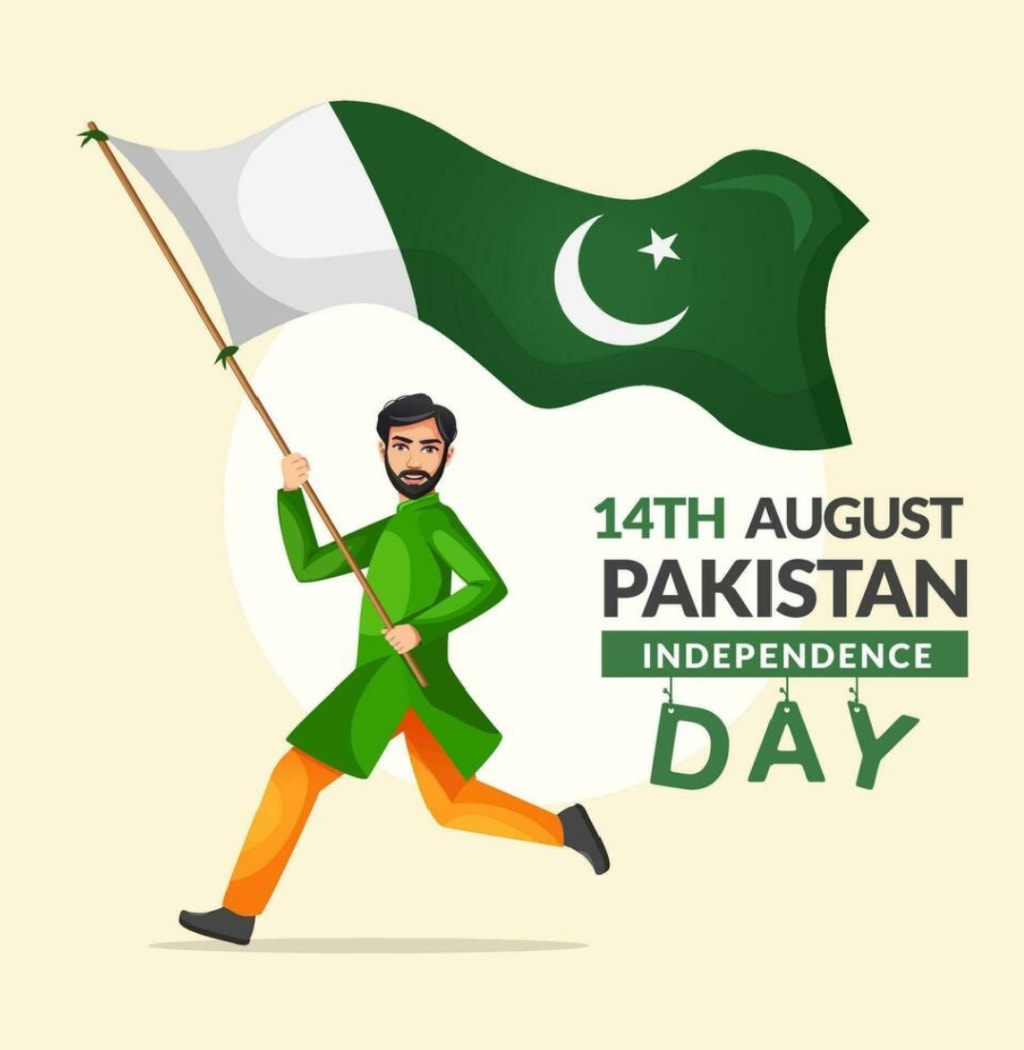
The new national flag — green with a white vertical stripe and a crescent and star — was raised. Streets were decorated, processions held, and slogans of “Pakistan Zindabad” (“Long live Pakistan”) filled the air. Radio Pakistan broadcast patriotic speeches and music, marking the new nation’s birth to the world.
---
The Human Cost: Partition Violence
While 14 August was a day of national pride, it was also overshadowed by one of the largest and most tragic mass migrations in history. The hurried drawing of boundaries by the Radcliffe Commission — announced only on 17 August — left millions uncertain about which side of the border they would fall on. Punjab and Bengal were divided, uprooting communities overnight.
An estimated 10–15 million people crossed borders to join their chosen dominion, Hindus and Sikhs moving toward India, and Muslims toward Pakistan. The migration was accompanied by unspeakable violence — massacres, abductions, and atrocities claimed up to a million lives. Trains arrived full of corpses; refugee camps overflowed; families were permanently separated.
About the Creator
zakir ullah khan
poetry blogs and story Year Vocal Writing Skill
Keep reading
More stories from zakir ullah khan and writers in History and other communities.
Overpopulation in Pakistan: A Looming Crisis
Overpopulation is one of the most pressing challenges facing Pakistan today. With a population exceeding 245 million as of 2025, Pakistan ranks as the fifth most populous country in the world. While population growth can drive economic and cultural vitality when properly managed, unchecked overpopulation places immense strain on a nation’s economy, resources, infrastructure, and public services. In Pakistan, this phenomenon threatens to undermine national development, deepen poverty, and deteriorate living standards for millions.
By zakir ullah khan8 months ago in History
The Economic Cost of Empire: How British Rule Drained India’s Wealth
For nearly two centuries, the Indian subcontinent remained under British colonial rule. From the mid-18th century until 1947, British policies reshaped India’s political, social, and economic systems. While the British administration introduced railways, legal systems, and modern institutions, historians and economists widely argue that colonial rule resulted in a massive transfer of wealth from India to Britain. This economic extraction has often been described as the “drain of wealth,” a concept that attempts to estimate how much financial loss India experienced during colonial rule.
By Irshad Abbasi 2 days ago in History




Comments
There are no comments for this story
Be the first to respond and start the conversation.