
Writing: The Struggling Artist
How to write the struggles of a creative character

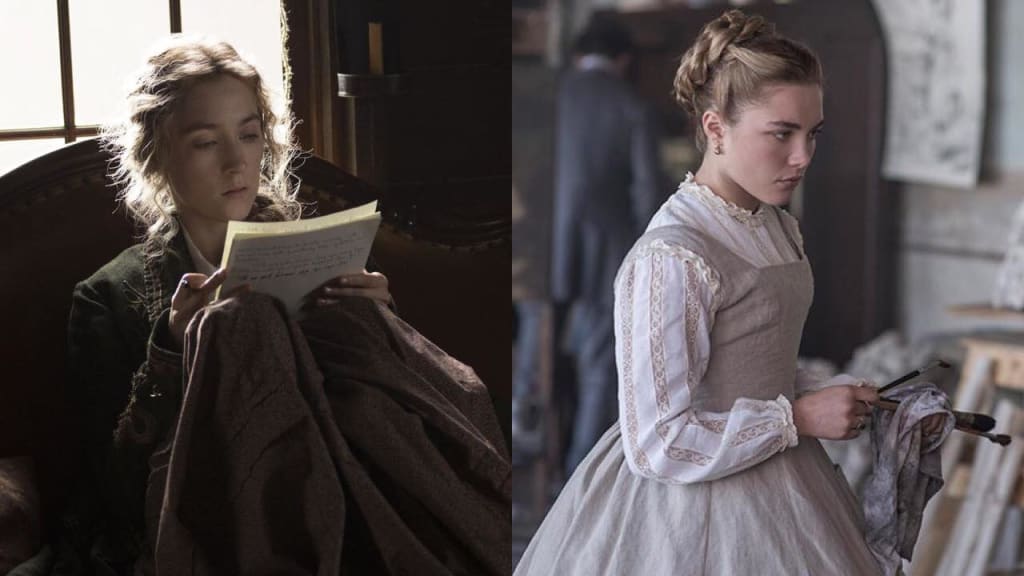
Greta Gerwig's adaptation of Louisa May Alcott's novel received critical acclaim back in 2019, but this script stood out for multiple reasons - Gerwig delves into this classic with depth and nuance. For anyone who might not know, Little Women focuses on struggling writer Jo March as she reflects back and forth on her life, telling the beloved story of the March sisters - four young women, each determined to live life on her own terms. I also appreciated that we got to see all the March sisters as individuals in this film - Watson gives a surprisingly moving portrayal of Meg, Pugh’s Amy finally has the complexity she deserves, Scanlan’s innocent Beth is pretty endearing and Ronan’s Jo had some great moments (her strongest scene was definitely in Jo and Laurie’s proposal scene).
The Struggling Artist is primarily shown through Jo and Amy - Meg does have acting talent, but abandons those ideas for a married life and Beth dismisses her musical skills, content with a simple life. Although Beth and Meg's arcs as artists are cut short, it shows that some people decide against pursuing a creative career because they find happiness elsewhere or they change their mind as they grow older.
Looking at Jo's arc as an aspiring novelist is one that many identify with and an aspect of the story we've seen as the central point in many adaptations. Interestingly to me, Jo read as someone who writes without an outline - whenever she gets an idea, she just writes it down and goes with the flow. Although this helps many writers, she lacks the discipline of the craft. Where is the story going? What is it about? Why is she even writing? These are questions I doubted she even knew - writing is engrained in her identity, but I never saw her as someone who knew who she was as a writer.

Her inability to take criticism also demonstrates her lack of a foundation to write - in a scene where Louis Garrel's Friedrich Bhaer gives Jo honest criticism and she reacts furiously - instantly letting the audience know she's never been given this type of feedback and because she only had praise from her family and writes "stories that sell" in newspapers or contests without even submitting her name. This again strengthens my theory of her lack of writing identity - even within such a challenging time period in post Civil War, that lack of confidence comes across in her writing. The home truths from Bhear shakes Jo, because suggesting that she's a bad writer also brings into question who she is.
Jo's artistic struggle sees her struggling to make ends meet, sending her little payments back home and barely affording her new lifestyle -that is something many people can relate. However, without the self-editor mindset, a personal writing voice or a story she's passionate about - Jo is on the verge of becoming unauthentic. I believe Jo's artistic struggle really comes down to she has no idea who she is as a person, which carries over into her uncertainty of herself as a writer. She knows she wants to write, has to even... but why?

Jo only really starts to find her true inner artist when she allows herself to be vulnerable - both in life and in writing - and her best work comes from a place of loss and heartbreak. Jo in the attic exhausted and pouring over her unfinished novel, determined to finish this story she must tell - this is the first time we see a true author.
However even after finding a story and writing a novel worth publishing, she has to make sacrifices of her original vision. Mirroring the real life author's struggle to keep Jo happily unmarried, Jo has to rewrite her heroine's story to end in marriage for commercialism: ‘If I’m going to sell my heroine into marriage for money, I might as well get some of it’. Not only has she found her inner writer, but the editor to change and compromise on criticism.

Surprisingly, I did not relate to the writer in this adaptation - I found myself identifying with the artist. Amy, although the youngest - quickly becomes the realist of the family. She's spent years studying her craft and growing in her passion for art, but more importantly - she constantly wants to better herself, always seeing room to improve.
Amy takes herself seriously, but unlike Jo she does not expect praise when others see her work - she actually thinks of ways she should have done it better. Also unlike Jo, Amy knew from a young age what she wanted out of life and she states as much: ‘I have lots of wishes, but my favourite one is to be an artist and go to Paris and do fine pictures and be the best painter in the world.’

And she achieves this very ambition, but in Gerwig's adaptation we see how Amy's home situation influences her artistic goals. She comes to the sad conclusion that although she has talent, others are better than her - and the best way to really financially support her family is to marry rich.
She's made aware of this at a young age due to how her older siblings and mother's choices: Marmie and Meg marry poor but for love, Jo has no interest in marry and only in her writing, then Beth is too in and out of health to find a husband. Their only hope of financial security is if Amy marries wealthy. This awareness is explored in a great monologue performed by Pugh:

‘Well. I’m not a poet, I’m just a woman. And as a woman I have no way to make money, not enough to earn a living and support my family. Even if I had my own money, which I don’t, it would belong to my husband the minute we were married. If we had children they would belong to him, not me. They would be his property. So don’t sit there and tell me that marriage isn’t an economic proposition, because it is. It may not be for you but it most certainly is for me.’
Although Jo and Amy's arcs are very similar - Jo ultimate reaches her dream of becoming a published author, whereas Amy marries for love with her wealthy childhood crush (so the family are all fine). However, this adaptation explores how each sister had something the other lacked - while Jo had passion, Amy had the dedication and neither could truly succeed without learning what the other had.
About the Creator
Ted Ryan
Screenwriter, director, reviewer & author.
Ted Ryan: Storyteller Chronicles | T.J. Ryan: NA romance
Socials: @authortedryan | @tjryanwrites | @tjryanreviews
The Author Diaries #1: The Storyteller’s Curse — Exclusive Prologue Reveal
Author’s Note: Dear Readers, Thank you for being here — for reading, subscribing, and stepping back into the world of The Storyteller Chronicles. When I finished Book One, I truly thought the story was done. Silas was defeated. The grimoire was safe. Lauren had saved the day — in two worlds — and her family were reunited.
By Ted RyanExclusive • 6 months ago
Marvel Zombie
The last entry into our 2025 superhero projects catalogue is Marvel Zombies. This was a show that was anticipated by absolutely no one and it disappeared from the public consciousness as quickly as it was released. There was nothing special about the project that made it a must see, or a must remember. In fact if anything it's a must forget.
By Alexandrea Callaghan20 days ago in Geeks


Comments
There are no comments for this story
Be the first to respond and start the conversation.