
Why Katniss Ends Up with Peeta
A Writer’s Perspective on Trauma, Love, and Healing



Recently, a surprising controversy emerged in the book community when bestselling author Ali Hazelwood made a lighthearted remark about The Hunger Games character Peeta Mellark during a panel discussion. The backlash escalated so aggressively that Hazelwood deactivated her Instagram account entirely. As a fellow writer and reader, I find this deeply disheartening.
Hazelwood, like any reader or author, is fully entitled to her opinion. No character — fictional or not — should be immune to critique or discussion. The fact that this incident snowballed into targeted harassment speaks volumes about the state of online fandoms, where nuanced discussion often gets drowned out by outrage. Writers, should be able to engage with literature openly, without fear of abuse.

Revisiting The Hunger Games as an Adult and a Writer
I came to The Hunger Games first through the films as a teenager. At the time, I made a conscious decision not to read the books — not because I wasn’t interested, but because I wanted to enjoy the films without comparing them to their source material.
Years later, now as a screenwriter and self-published author, I’ve finally begun reading the novels. And I have to say: Suzanne Collins’s writing is far more layered than I anticipated. This is a series you can appreciate in your youth for its action and dystopian setting, but return to as an adult and discover a much deeper emotional and political core.

So… Is Peeta “Useless”?
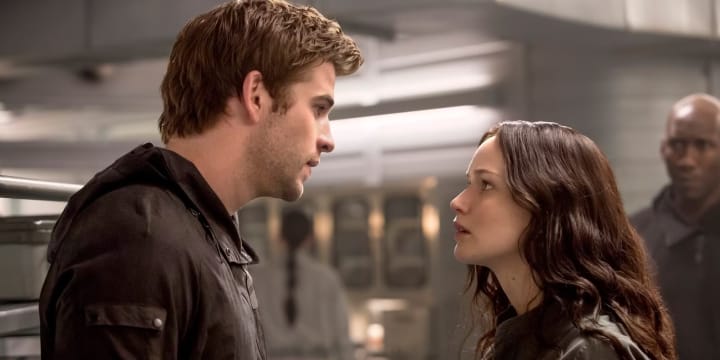
This is the heart of the current debate. Is Peeta a passive love interest? Is Gale the better match for Katniss? My answer is simple: Peeta is not useless — and his role in the story goes far beyond a traditional love triangle.
Katniss is often seen as embodying traditionally masculine traits. She’s an archer, a hunter, a provider. But she is also fiercely maternal — particularly in her relationship with Prim. Her trauma, both before and during the Games, has made her deeply guarded and wary of emotional intimacy.
This is where Peeta becomes essential. He provides something Katniss has never known: emotional safety. He is gentle, emotionally intelligent, and steady in the face of chaos. In many ways, they balance each other out — her practicality and survival instincts meet his compassion and psychological resilience. Their relationship demonstrates that love isn’t always about chemistry or angst — it’s about calm, trust, and healing.

Why It Could Never Be Gale
Katniss herself admits that loving Gale would be easier. But there’s a reason it never works. Gale and Katniss are too alike — and in the context of war, that’s not always a good thing.
As I read Catching Fire, I couldn’t help but see Gale as a reflection of what Katniss might have become without Peeta. He grows hardened, increasingly driven by vengeance, and morally ambiguous. He represents the dangers of losing one’s humanity in pursuit of justice. And when his actions indirectly lead to Prim’s death, he doesn’t show true remorse — only justification.
Katniss doesn’t need another warrior. She needs someone who will help her build something after the war. Peeta, for all his softness, survives horrific torture and brainwashing — and still clings to his humanity. That strength is often overlooked, but it’s powerful.
The Final Choice — And What It Means
Peeta becomes her friend, her partner, the father of her children — not because he “won” her heart, but because he was her anchor. Not dramatic, not glamorous — but safe. After everything she endures, that’s what she chooses. Not passion, but peace.
Long-lasting relationships aren’t about high angst and drama. Your partner should be a place of safety and calm during life’s storms.
That’s the heart of the story. Not who Katniss should have ended up with, but who helped her heal.

Final Thoughts
This debate should be an opportunity to engage with The Hunger Games on a deeper level — not an excuse to attack a fellow author. Ali Hazelwood’s opinion wasn’t radical or cruel. It was a spark for discourse. Let’s not let that be smothered by vitriol.
Instead, let’s keep talking — as readers, as writers, as fans — with compassion and curiosity.
About the Creator
Ted Ryan
Screenwriter, director, reviewer & author.
Ted Ryan: Storyteller Chronicles | T.J. Ryan: NA romance
Socials: @authortedryan | @tjryanwrites | @tjryanreviews
The Author Diaries #1: The Storyteller’s Curse — Exclusive Prologue Reveal
Author’s Note: Dear Readers, Thank you for being here — for reading, subscribing, and stepping back into the world of The Storyteller Chronicles. When I finished Book One, I truly thought the story was done. Silas was defeated. The grimoire was safe. Lauren had saved the day — in two worlds — and her family were reunited.
By Ted RyanExclusive • 8 months ago
The Politics of Playing Dress-Up
Well, to start off I'd like to say a happy world book day to all who celebrate. I know I haven't really posted anything on my socials about it but I'm not a jubilant kind of person. I lay low most of the time. Let's start off with a popular anecdote from the vaults...
By Annie Kapur6 days ago in Geeks
Golbat Unleashed: The Vampire Bat Pokémon That Strikes Fast and Dominates the Skies
Golbat is one of the most versatile and intimidating Pokémon in the franchise, evolving from the small but cunning Zubat into a powerful Poison- and Flying-type predator. Its design, speed, and aerial capabilities make it a force to be reckoned with, particularly in strategic battles where mobility and status effects are critical. Trainers who underestimate Golbat’s speed and tactical prowess quickly learn that this evolved bat Pokémon can dominate the skies, disrupt opponents, and exploit vulnerabilities with precision.
By Lukáš Hrdlička2 days ago in Geeks


Comments (6)
Nice story my dear ❤️
I read the book and saw the movies because of my daughter. She was reading it ( and she didn’t care for reading) and this gave us a shared interest. Nice article
I actually was rooting for Peeta while reading.
It was a better match in the end. Gale just couldn't see things the same way Katniss did because they didn't share similar experiences in the Games. Loved this. Great work!
I read the books multiple times, as a teenager and adult. I love your analysis and fully agree with your points!
Excellent points! I love the films but didn’t read the books . I agree with you