
Why Audience Intent Matters More Than Traffic Volume?
Traffic numbers look impressive, but audience intent is what decides who stays, who trusts, and who ever takes action.

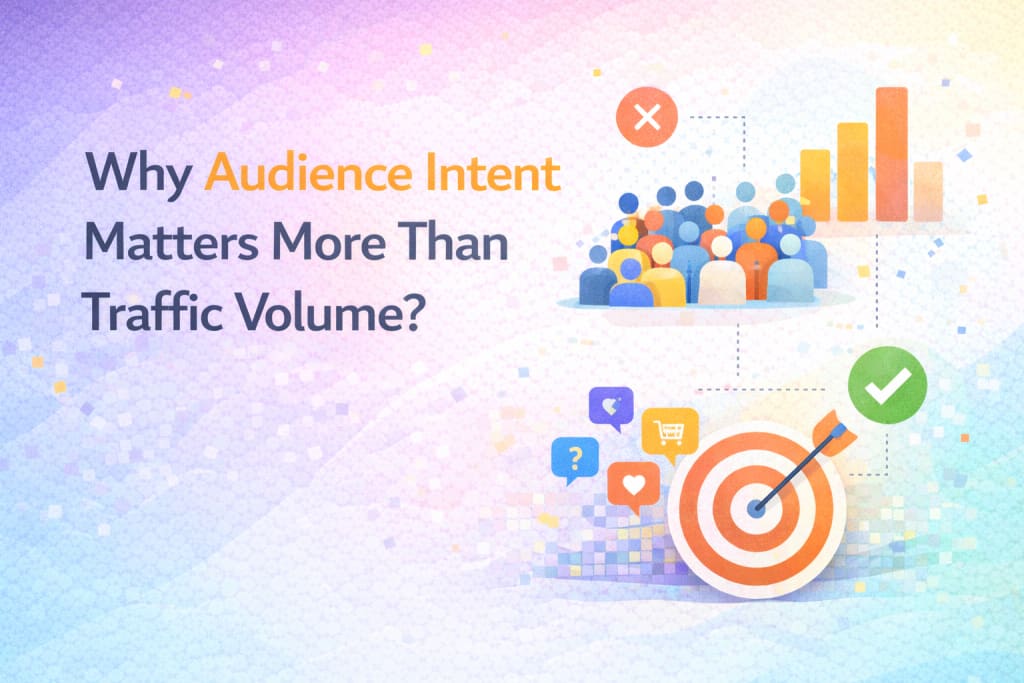
Traffic looks good in screenshots.
Big numbers. Up and to the right. Sessions, users, impressions. It feels like progress. It is progress, technically.
But I’ve sat in too many meetings where everyone stared at traffic graphs while conversions quietly flatlined. Nobody wanted to say it out loud, so I will.
Most traffic doesn’t want what you’re offering.
That’s not a failure. It’s just reality.
Traffic is easy to count. Intent is not.
Volume is comforting because it’s visible. You can chart it. Compare months. Show growth. Intent hides inside behavior. Scroll depth. Time hesitations. Where users pause. Where they leave.
And that’s harder to sell internally.
I’ve worked on sites with millions of monthly visits that struggled to close anything meaningful. I’ve also seen niche pages with a few thousand visits quietly outperform entire content libraries.
Same industry. Same product. Different intent.
Statista data from 2024 shows that the average website conversion rate across industries sits between 2 and 3 percent, even with healthy traffic numbers. That gap is intent leaking out.
People arrive curious, not ready.
High traffic often means diluted purpose
When you chase volume, you broaden topics. You simplify language. You aim for what everyone might click.
That pulls in readers who are early, vague, or just browsing.
Nothing wrong with that. But expecting those users to act immediately is wishful thinking.
McKinsey research on digital funnels found that content aligned with late stage intent converts at rates up to 5 times higher than high traffic awareness content, even with far fewer visits.
Five times. That’s not a rounding error.
And here’s the contradiction that makes this uncomfortable.
High traffic can still matter. Brand awareness works. Top of funnel feeds the bottom.
But confusing awareness with readiness is where strategies fall apart.
Intent shows up in boring places
Not headlines. Not impressions.
Intent shows up in search phrasing. In how specific queries get. In whether users scroll past examples or stop at them. In whether they reread a paragraph or bounce after the intro.
Pew Research Center studies on online behavior show that users with task driven intent interact more deeply with fewer pages, while exploratory users skim broadly without committing.
So a page with low bounce and low traffic might be healthier than one with massive reach and shallow engagement.
But shallow engagement looks better on dashboards. That’s the trap.
Why volume obsessed strategies feel safe
Because they scale emotionally.
More traffic feels like more opportunity. It buys time. It quiets stakeholders. It fills reports.
Intent driven strategies feel risky. Smaller numbers. Slower growth. Harder to explain why a piece targeting fewer people matters more.
I’ve watched teams abandon intent focused pages because “nobody was reading them,” only to later realize those pages were driving most qualified leads.
Too late. They were already rewritten for clicks.
Wait, I’m ranting. Let me ground this.
Intent determines how much friction users tolerate
Someone with weak intent bounces at the first sign of effort. A long form page scares them. A form stops them cold.
Someone with strong intent tolerates friction. They read. They scroll. They wait. They fill things out.
Harvard research on consumer decision making shows that intent strength directly affects how much cognitive effort users are willing to invest before acting.
This is why long, specific content can outperform short, broad content for conversions, even if fewer people ever see it.
It’s not about length. It’s about alignment.
The keyword problem nobody likes admitting
Here’s where SEO complicates things.
Broad keywords bring traffic. Narrow keywords bring intent.
Ranking for a general term feels like winning. Ranking for something specific feels small.
But small terms often sit closer to action.
I’ve seen pages targeting digital marketing services attract fewer visits but far more meaningful conversations than broad “what is marketing” style content.
Same site. Same authority. Different intent layers.
And yes, I’m aware of the irony. SEO tools reward volume. Sales teams reward intent. Marketing lives in the middle, translating between them.
Not a comfortable place.
Intent mismatches create UX problems
When intent doesn’t match the page, users feel lost.
They land expecting one thing. Get another. Bounce. Or worse, wander.
CDC research on cognitive load shows that mismatched expectations increase decision fatigue and reduce follow through, even when information quality is high.
So driving high traffic to pages built for later stage intent backfires. And sending high intent users to fluffy awareness content wastes momentum.
This is where many funnels quietly break.
A pattern that shows up everywhere
Picture a company offering digital marketing services, investing heavily in traffic growth.
Blog traffic climbs. Social reach expands. Rankings improve.
Sales stays flat.
Digging in reveals the issue. Most content attracts people learning, not people choosing. The site speaks to curiosity, not readiness.
When intent focused pages exist, they’re buried. Or written cautiously. Or starved of internal links.
So traffic flows around conversion instead of toward it.
Nobody intended that outcome. It just happened.
Why intent work feels harder than traffic work
Because it forces decisions.
You have to choose who you’re not writing for. You have to accept lower volume in exchange for better fit. You have to defend smaller numbers with better outcomes.
McKinsey research on marketing effectiveness shows that organizations prioritizing audience readiness over reach tend to see higher ROI, but slower visible growth.
Slow visible growth scares people.
So teams default back to volume.
The second contradiction I won’t resolve
Sometimes traffic spikes create unexpected intent later. People return. Share. Recommend.
Sometimes intent driven pages never scale and stay niche forever.
Both are true.
The mistake is treating volume as a proxy for value. It isn’t. It’s just one signal.
Intent tells you whether someone is leaning forward or leaning back.
What actually helps reframe the conversation
Not killing traffic goals. Rebalancing them.
- Separate awareness content from decision content
- Measure behavior, not just visits
- Track assisted conversions, not just last clicks
- Accept lower volume for higher readiness
- Stop forcing early users to act
None of this is flashy. None of it screenshots well.
But it works.
I’ve circled this point enough times now. That usually means it’s the one people avoid.
Why intent always wins eventually
Because businesses don’t survive on attention alone.
They survive on decisions. Commitments. Follow through.
Traffic brings noise. Intent brings direction.
And when you confuse the two, you build beautiful funnels that go nowhere.
Quietly.
FAQs
What is audience intent in digital marketing?
Audience intent reflects how ready a user is to act, not just their interest level. It shows up in behavior, specificity, and engagement.
Why doesn’t high traffic guarantee results?
Because most visitors are early stage or exploratory. Without intent alignment, they won’t convert regardless of volume.
How can intent be measured?
Through engagement depth, repeat visits, conversion paths, and how users interact with decision focused content.
Is traffic still important?
Yes. Traffic supports awareness and future intent, but it shouldn’t be treated as a replacement for readiness.
How can teams balance traffic and intent?
By creating content for different stages, measuring outcomes beyond clicks, and aligning pages with user readiness instead of reach.
If you want, next we can turn this into a shorter editorial version or map intent layers directly to content types without polishing the edges.
About the Creator
Jane Smith
Jane Smith is a content writer and strategist with 10+ years of experience in tech, lifestyle, and business. She specializes in digital marketing, SEO, HubSpot, Salesforce, web development, and marketing automation.
Keep reading
More stories from Jane Smith and writers in Geeks and other communities.
How Marketing Platforms Connect With CRM Systems?
I first understood the weight of this connection during a quarterly review where every chart looked right and every answer still felt wrong. Campaign performance was strong. Leads were flowing. Revenue was reported with confidence. Still, when someone asked a simple follow-up question about which campaign actually influenced closed deals, the room went quiet. The data existed. It just didn’t agree with itself.
By Jane Smith2 months ago in Geeks
SpongeBob Review
The episode “SB‑129,” a quintessential early‑season gem of SpongeBob SquarePants, thrusts the perpetually irritable Squidward Tentacles into a chronologically disorienting odyssey that begins with a simple desire to escape the incessant merriment of his neighbors, SpongeBob and Patrick. The narrative catalyst—a misfired experiment with a time‑traveling chronometer—plunges him into an eerily silent, sterile future Bikini Bottom where the familiar pastel hue of the oceanic streets has been supplanted by a stark, monochrome aesthetic reminiscent of 1960s futuristic optimism. This transition is rendered with meticulous attention to visual contrast: the crisp lines of the futuristic set design juxtapose sharply against the show’s usual wavy, hand‑drawn textures, emphasizing Squidward’s profound alienation and underscoring the episode’s thematic exploration of isolation versus community.
By Forest Green3 days ago in Geeks



Comments
There are no comments for this story
Be the first to respond and start the conversation.