
What is a 3-2-1 Backup Strategy?
Learn about the 3-2-1 backup strategy: why it’s essential for data protection, how it works, and how to implement it to keep your files securely backed up.


If you’ve read this article, you likely need a way to back up your data. One practical method that stands out is the 3-2-1 backup strategy, a simple but powerful solution encapsulated in its name. This strategy forms the core of our discussion as we explain its mechanics and benefits. With the 3-2-1 backup rule, you can improve the security and resilience of your data against loss or corruption. Let's look at how this method works and why it remains the preferred choice for data protection experts worldwide.
So, What is a 3-2-1 Backup Strategy?
Today, no enterprise needs to explain why constant data backup is important. However, not every average user recognizes the importance of backups. Recent backup statistics indicate that 78% of respondents claim they back up their data, but only 33% do so regularly. Many believe that data loss primarily threatens large corporations, like Microsoft Azure, which faced security vulnerabilities in 2022. However, in that same year, average technology users suffered nearly $8.8 billion in losses due to fraud.
You must remember that in addition to cyberattacks, issues such as accidental file deletion, device failure, and physical damage—like dropping a laptop or water incidents- cause data loss. It underscores the critical need for reliable backups.
One of the simplest and most practical backup strategies is the 3-2-1 backup method. This strategy is easy to understand and implement:

- Always have three separate copies of your data. This includes the original data and two additional backups. This guarantees multiple recovery options for partial or total data loss.
- Store these copies on at least two different types of media. This could mean that your data resides on an internal hard drive, an external hard drive, or a cloud storage service. The diversity of media protects against hardware failure and local disasters that could affect all copies.
- Keep at least one of these backups in a different physical location. This off-site backup guards against the risk of a local disaster, such as a fire or flood, which destroys all copies stored in one location.
Why is the 3-2-1 Strategy Efficient?
The 3-2-1 backup method stands as a reliable strategy because, when properly implemented, it covers most data recovery scenarios. Consider a situation where you have adhered to all necessary steps of the 3-2-1 method and maintained two backup copies of your data—one on an external hard drive and another in cloud storage. If you've faced data loss on your local computer (accidentally deleted, cyberattacked, or ransomware), there are several recovery options available to you:
- If the external hard drive is nearby and intact, you can quickly restore your data from it. This option is valuable if cloud access becomes problematic or if internet connectivity issues arise.
- Should your external hard drive sustain damage or become inaccessible due to physical issues like a drop or a fire, the cloud copy of your data remains safe. You can access this backup from any location with internet access. It guarantees you can recover your data even if local copies are completely lost.
In this example, we describe only one data loss scenario and explain how the 3-2-1 strategy provides data protection for both large enterprises and individual users (the difference is only in the scale of data processed in the system; the idea of the strategy remains the same). The only condition for this strategy to succeed is that all of its components are properly executed and that you have up-to-date copies of your data, which is up to you or your backup service provider. Then, even in the case of a complete data loss, you can restore some of the data, which confirms the fact that the 3-2-1 backup strategy remains effective even after years of its existence.
Interesting fact: This data backup strategy (3-2-1) was not created by an IT specialist, as most people think, but by photographer Peter Krogh. He developed this strategy to protect his photos and described it in detail in his book on digital asset management.
What’s Changed in the 3-2-1 Backup Strategy?
Since its inception, the 3-2-1 backup rule has had to evolve to address new types of data loss scenarios and security threats. Originally developed to suit the technology of its time, the strategy incorporated various storage media, such as floppy disks, CDs, Blu-ray discs, USB drives, external hard drives (HDDs), solid-state drives (SSDs), network-attached storage (NAS), and tape libraries.
At the moment, some of these media, primarily CDs and DVDs, are considered obsolete because they have limited capacity and durability compared to modern alternatives. In contrast, SSDs have become more widely available and affordable, whereas they were once considered expensive options. These changes in threat options have accelerated the development of other additional variations on the traditional 3-2-1 strategy to increase its reliability and adaptability. For example, 3-2-1-1-0 and 4-3-2 strategies have appeared.

- The 3-2-1-1-0 model modifies the classic structure. It adds air gap (offline) backup. This means that there is a copy of the data that remains completely disconnected from any network and provides additional protection against cyber threats such as ransomware. Along with the number “0”, “zero errors” has been added to this option, which means that you need to regularly check the integrity of your backups to make sure they are free of damage. (This is important because nowadays, both the main data servers and their backups are often aimed at, especially ransomware).
- Similarly, additional points have been added to the 4-3-2 strategy, which requires four copies of data to be stored in three different locations, two of which are offsite. This way, you can increase data security in your enterprise because the data copies are geographically distributed. This reduces the chance that you will lose them all at once due to local disasters (fire, tornado, physical theft).
Despite these adaptations, the 3-2-1 rule is still the best backup strategy. Its basic principles are still the foundation for any backup strategy. If you are an individual or a business owner and still do not create any backups, then implementation of the 3-2-1 backup strategy is the best initial step to protect your data. Now, the 3-2-1 rule is considered as a starting point, not as a final solution to backups.
Frequent Errors in Data Backup Strategy
If you do experience a data loss (regardless of the cause), the success of any data recovery process, whether you use the classic 3-2-1 rule, its extended versions, or alternative strategies, depends on careful adherence to established backup protocols by both you and your chosen backup provider. Below, you can see a list of common backup errors that can compromise data recovery and should be considered when you implement a backup strategy:
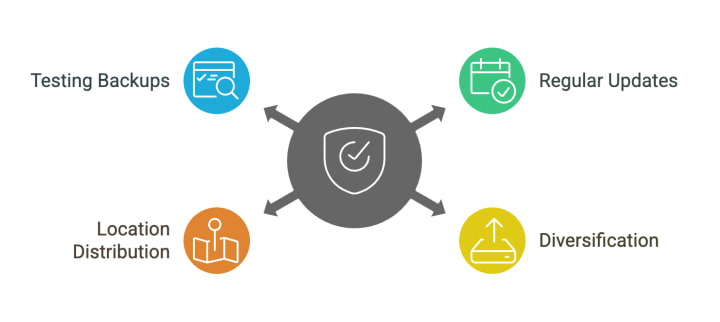
- You should update your backups regularly, depending on how often you change or add data to your system. If you neglect this rule, it can lead to outdated information and make recovery less useful, especially if a long time has passed since the last backup and changes have occurred in the system.
- Diversification is also an important point in backup. As we mentioned above, when you use the same type of media for all your backups, you increase the risk of them all being targeted by malicious actors. Use different types of media to increase data security.
- Also, never store all your backup media in one location, as this makes it pointless to create multiple copies, especially if that location will be affected by a natural disaster such as a fire or flood. Spread out your storage locations to protect data integrity.
- Another point that we didn't pay enough attention to in this article, as we only concentrated on the 3-2-1 rule, is to regularly test your backups to make sure they are recoverable. Many people don't perform recovery tests, which leads to unpleasant surprises during a real data loss when backups are unusable.
Wrapping Up
Before you implement any data backup strategy for your system or enterprise, it is always a good idea to carefully analyze the options available to you to choose the best one. We hope that the information we have provided about the 3-2-1 backup rule has been helpful and informative. If you use this strategy, you can make sure that your data remains protected and recoverable (provided that you have followed all the rules discussed above).
About the Creator
Handy Recovery Advisor
Since 2017, we have empowered everyday users with comprehensive solutions for data recovery, loss prevention, and data management. Our passionate team has crafted over 500 guides to make complex data challenges approachable for everyone.
Keep reading
More stories from Handy Recovery Advisor and writers in Geeks and other communities.
How to Recover Data from a CFexpress Card
Is your CFexpress card no longer showing the valuable data you need? We have faced this issue ourselves and spent considerable time addressing the complexities of retrieving lost data. To save you time and effort, we have established this article to demonstrate the methods that successfully helped us recover files from CFexpress cards. These proven strategies are designed to restore your data and enable you to continue your projects with minimal downtime.
By Handy Recovery Advisorabout a year ago in Geeks
Marvel Zombie
The last entry into our 2025 superhero projects catalogue is Marvel Zombies. This was a show that was anticipated by absolutely no one and it disappeared from the public consciousness as quickly as it was released. There was nothing special about the project that made it a must see, or a must remember. In fact if anything it's a must forget.
By Alexandrea Callaghan18 days ago in Geeks
Fallout Season 2 Episode 3 Review & Breakdown
Today, we’re diving straight into Fallout Season 2 Episode 3, and trust me, this one is stacked. Easter eggs everywhere. Game references everywhere. Big lore confirmations and even bigger theories exploding left and right.
By Bella Anderson2 days ago in Geeks




Comments
There are no comments for this story
Be the first to respond and start the conversation.