
Turning Water Into Wine
Two Giamatti Movies That Every Writer Should See

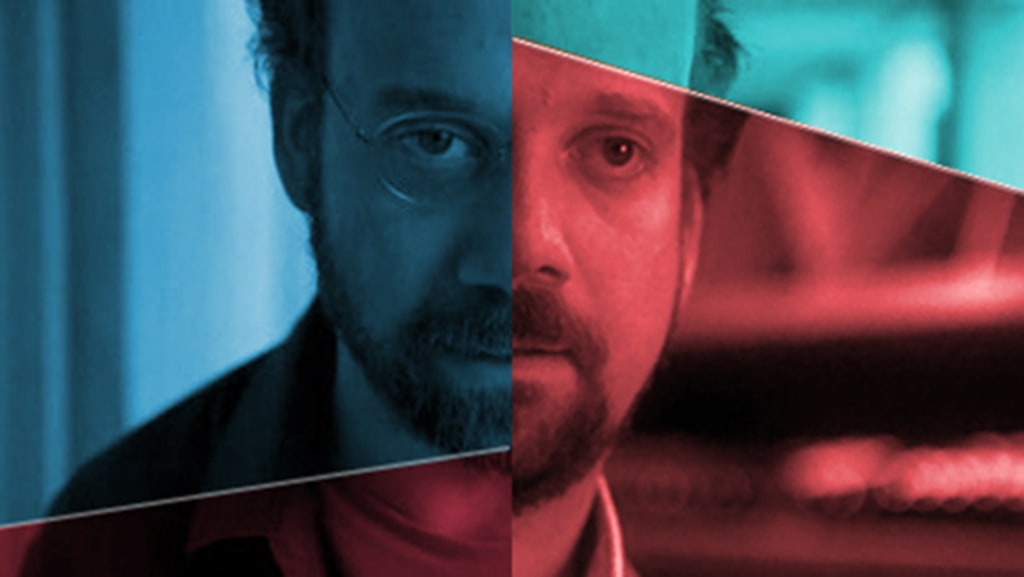
I hear dead people.
That, of course, isn’t my line. I’m quoting, albeit with a slight modification, The Sixth Sense, written by embattled writer-director M. Night Shyamalan. But for the record, I do hear dead people. No, seriously, I do. So do you. Dead people are all around us, talking to us, usually through the works and words they left behind, inspiring us. Uncle Tom’s Cabin, for instance: “The longest way must have its close—the gloomiest night will wear on to a morning.” You just heard the words of a dead person. You read them, sure, but as you did so, there was an inner voice in your head; that is the voice of Harriet Beecher Stowe. And here’s her pic. Take a good look because as of now, you’ve officially seen and heard a dead person. So, yes, you see dead people too.

Contrary to what your sixth sense might be telling you, dead people aren’t the problem. If there is anything that I’ve learned from watching the tumultuous trajectory of Shyamalan’s career, and all the public vitriol that has plagued it, it’s that it is not the dead that haunt us—it’s the living. This is especially true for writers. It’s true for Shyamalan; it’s true for me, and I’m going to hazard a wild guess that if you’re also a writer, it’s true for you as well.
If I tell a dead person that I’m a writer, the reaction is usually nothing. When I tell a living person that I write, the reaction is still nothing, except that now there’s a certain kind of empty look in their eyes. Sometimes there's a semi-smile, akin to what you experience when you tell an unfunny joke but the other person forces a strained, merciful chuckle. It guts me every time. Every vapid reaction to the mere mention that I’m a writer or even the vague praise and platitudes from friends and family haunt and harangue me when I sit down to tackle my next blank page. It makes me regret having sat down in front of a page at all. I’m willing to bet I’m not alone in this. Even if you’re strong enough to write past all those non-reactions and finish your work, the true test of your mettle awaits you when you share your unpublished, or, worse still, self-published work with friends and family. They’re happy for you, but never in the same way as if you had told them you were enthusiastically picked up by a literary agent, or, even better, a publisher, or maybe better still, you won a $10,000 writing contest. I never thought “congratulations” or “wow, that’s nice” could be so unceremonious, so damning, so…well, haunting. So, yeah, my problem isn’t that I see dead people; it’s that I see and hear the living.

Despite all of the above, it might surprise you to hear that I wasn’t introduced to the mastery of M. Night Shyamalan via The Sixth Sense, his first Hollywood hit flick that made his career; it was through his fifth Hollywood flop that almost killed it. I’m talking, of course, about Lady in the Water. It’s a fantasy flick. No, wait. It’s a fantasy fairy-tale flick. No, no, no. That’s still not right. Let’s try this one more time. It’s a fantasy fairy-tale horror flick. That’s about right, but still more accurately—and importantly—for us writers it’s a story about the fantasy, the fairy tale and the absolute horror of having to write.
So it shouldn’t surprise that the lady in the water is a character named Story. If that alone doesn’t tell you that you are about to watch a two-hour story about the storytelling process, then you might need to brush up on the art of reading metaphors. Story isn’t human. She belongs to a nymph-race of beings called Narfs who, at some long ago distant day, inspired humans to think beyond their own limits, which stories are pretty good at doing. But humans tend to be short on attention span and long on attention seeking, so their narcissism pulled them further away from the wisdom of the Narfs and plumbed them deeper into war and greed. And here we are. But after all these years the Narfs refuse to give up, so they send their newest prodigy, Story—not the noun, story, but the proper noun, Story—played by Bryce Dallas Howard.
Here’s the thing about stories. They don’t change the world. We do. In a 2006 interview with Movieweb, Shyamalan mentioned how part of his inspiration for Lady in the Water came from talking to dead people, specifically Harriet Beecher Stowe. We just met her a few minutes ago. Specifically Shyamalan said it was the “idea of Harriet Beecher Stowe that really caught me. Wow, this idea that you write a book and somebody like [Abraham] Lincoln reads the book and other people in that time period read that book and you're creating change. Then someone who can make a difference decides to do something about it. Harriet Beecher Stowe didn't know she was doing all that, she was just writing a book, but it actually opened minds and created point of views.” That’s the power of stories and that’s the power of writers. So now back to our Story…
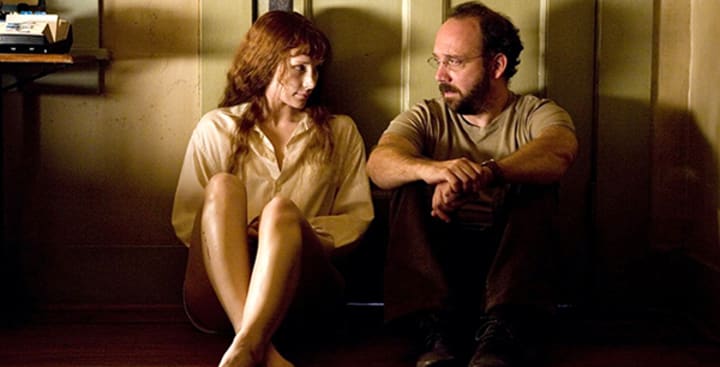
Story is on a mission to find her “vessel”—the person who she’s going to inspire. This vessel is, not surprisingly, an author and this author is prophesized to write a book that will be read by a future president who, like Lincoln, will be inspired to affect great change in the world. The problem is, Story has no clue who her vessel is or even where he is—but she meets somebody who does: Cleveland Heep. He’s the superintendent of an apartment complex in Philadelphia, and he’s pretty sure that one of the many tenants in his building is bound to be the guy she’s looking for. So Cleveland sets out to help Story find her vessel. He also wants to help her get back home since Story doesn’t pay the rent, and, if we’re honest here, most stories don’t. But that’s another story.

There’s an enemy to every story ever written, and I’m not talking about the antagonist, but rather the inner-antagonist. It’s the voice in the writer’s head telling them that they’re not good enough, or that their work is too derivative or too sappy or too whatever. These voices creep into the cranium, where they endlessly echo. But here’s the thing: this is not your voice; it is the voice of somebody else, and I don’t mean dead people. No, those guys are cool. These are the voices of the living. It’s the opinions of others, which are too often foisted upon us. These days the usual suspects are internet trolls who have more time on their hands than talent, but there’s also the amateur critic who recycles the careless quips of some other amateur critic. The worst of all offenders is the unsmiling nit-picky prick that bolsters his delicate ego by bashing yours, usually with his grammar hammer. Please don’t misunderstand me: Grammar is important and so are hammers. But when an emerging writer has their work pulverized by a would-be peer who is more focused on commas than content, I can’t help but think that said peer is compensating for the fact that never—NEVER—will a work of literary excellence EVER be written with a hammer. The guy who holds the hammer knows this, but a hammer is all he has, and this makes him inadequate and therefore unnaturally aggressive. You know the guy I’m talking about. He’s arrogant and he arrogates for himself the authority to judge work that he is in incapable of producing. If you don’t know the guy I’m talking about, then watch Shyamalan’s movie. Please watch it, because he’s in it. The character’s name is Harry Farber, brilliantly played by Bob Balaban, who captures the self-important puffery of most critics. And, yes, he’s an obstacle to Story’s mission. But he’s not the antagonist.

The true antagonist of every writer is fear: the fear to write in the first place, the fear that what you are writing is bad, which leads to the fear of sharing what you have written thus far. Finally, if the fear has its way, what are you are writing may never get finished. That’s what happens when fear sets in, and if we don’t fight it, our story is dead. This is all symbolized by the dogged demon Scrunt in Shyamalan’s tale. The Scrunt moves on four legs like a wolf, is just as predacious and has a natural sixth sense for a writer’s insecurity. This beast is the living embodiment of raw and rabid terror, and its only purpose is to engender fear and kill Story.
Shyamalan tackles these terrors in his fantasy fairy-tale horror flick, and though he casts himself as a key character in the movie, it seems evident to me that the character he truly identifies with is Cleveland Heep—the guy who’s going to defend Story from the story-killing Scrunt. Cleveland is played by Paul Giamatti who, to be frank, is not exactly the Type-A make and model of machismo, which is kind of the point. Writers, like all artists, are sensitive souls, famous for their fragility, but still the parent and protector of their brainchild. Cleveland is up for the task, yes, but is he fit for it?
I can’t help but to believe that Shyamalan has projected his own self-doubt—a burden carried by all writers—upon Cleveland. Through Cleveland, Shyamalan is asking how do we, as writers, protect our stories? How do we protect our creativity? How do we protect our pure, watery-like sensitivities from the arid arrogance of others? And maybe even more importantly, how do we protect the muse? And make no mistake… Story is a muse.
Writers typically can’t tell you where ideas come from, especially the good ones. Ideas have a way of poofing into our heads from out of nowhere, and this divine inspiration is so ancient that the Greeks deified it as a muse. There were a host of them and they all presided over the arts and sciences. These days we have chased away the muses with our cynicism and skepticism. So long have these qualities seeped into and soaked our intellectual fabric that they are pretty much a social precondition. Maybe the muses are long overdue for a comeback.
Speaking of muses, it appears one of them is whispering into my ear at this very moment, telling me to take a final stab at categorizing Lady in the Water. Okay, so for the last time: Lady in the Water is a modern mythology; it’s a story about the courage it takes to tell a story.
There’s a scene in Lady in the Water when Story asks Cleveland if he wants to know his future. Cleveland declines. He is right to do so. I’m of the firm conviction that immediately after Lady in the Water ended, Cleveland Heep quit his job as superintendent. Story made him feel inspired; he felt alive. With this new lease on life, he packed his bags to leave Philadelphia, drove cross-country to San Diego, California, where he changed his name to Miles Raymond, developed an impressively unhealthy love for wine and took up a career as a failing, flailing novelist. Cleveland’s future went completely Sideways.

You probably raised an incredulous brow, wondering how the hell I can suggest with a straight face that if you liked Lady in the Water, you’ll love Sideways. But that’s not what I’m suggesting. I’m suggesting that if you loved Sideways (and if you’re a writer—that’s an important addendum, to be sure), then you should at least appreciate Lady in the Water; maybe you’ll even like it…or love it.
As its name suggests, Sideways is about a road trip that should have been about drinking wine, eating food, playing golf and drinking more wine, but instead veers sideways and crashes. This is mostly because of the unharnessed proclivities of Miles’ friend Jack, an actor who is past his career prime but still at the peak of his sexual prime. Jack has made up his mind that in the week leading up to his wedding day, he wants to get laid. He wants Miles to get laid too. That’s what Sideways is about. But what it’s really about is Miles.
Miles, by the way, is played by Paul Giamatti. Yeah, him again. What can I say, I love me some Giamatti. This guy is the Power Ranger of artistic range. He can play any role, and in this one he’s pretty much Cleveland Heep with an attitude... and an addiction. Miles is just as sensitive as Heep and as temperamental as the pinot grape that he worships and drinks to excess. In his famous monologue, Miles describes the pinot grape and himself when he says that the grape (and he) “is not a survivor like cabernet, which can just grow anywhere and thrive, even when it’s neglected. No, pinot needs constant care and attention. You know? And in fact it can only grow in these really specific, little, tucked-away corners of the world. And only the most patient and nurturing of growers can do it, really. Only somebody who really takes the time to understand pinot’s potential can then coax it into its fullest expression. Then, I mean, oh, its flavors, they’re just the most haunting and brilliant and thrilling and subtle and ancient on the planet.” This describes Miles. If we’re honest, it also describes most writers, and Miles is a writer, a desperate and sensitive one. Remember when I said that there’s an empty look in people’s eyes when you tell them you’re a writer? Well, somewhere in the beginning of Sideways, Miles meets Jack’s soon to be in-laws and it leaks out that Miles is a writer. The reactions are ambiguous nods, empty smiles and just plain emptiness. Miles rebounds with a smile that is equally empty and vague. He has to do this because the unwritten decrees of decorum demand it, but the deflated look in Miles’ eyes betrays his pinot-like sensitivities.
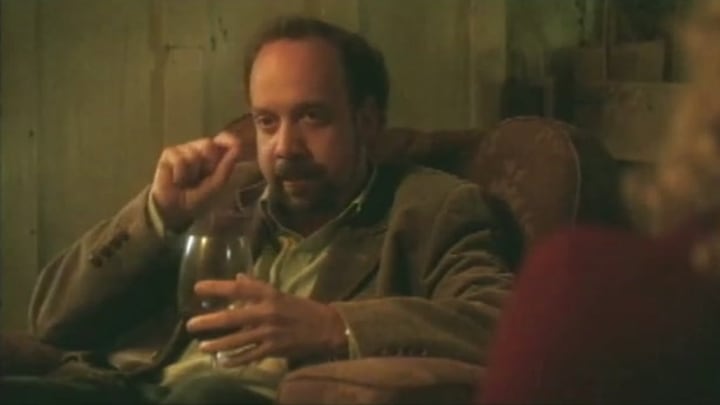
Miles’ monologue also describes the 800-page book he’s written, The Day After Yesterday. A book that long would indeed require nurturing patience to both edit and read. Once again quoting Miles, his book “jumps around a lot. That’s what it’s about in a way…and um, you start to see everything from the point of view of the father and uh, a lot of other things happen. Parallel narratives. Kind of a mess. And then eventually the whole thing sort of evolves, or devolves into this sort of Rob Gruyiere mystery, you know. But no real resolution.” No doubt, this book, like the pinot grape, is haunting and brilliant and thrilling and subtle and even ancient, to the extent that all lives since the beginning of time have jumped around while paralleling the leaping lives of others, most of which met their end with no real resolution. Miles’ book is, to paraphrase Twain, that certified classic that everyone wants to say they have read but nobody wants to read.
Speaking of Twain, Miles, too, talks to dead people. He talks to Bukowski, Hemingway, Sexton, Plath, Wolf and others. But unlike my aforementioned chat with Harriet Beecher Stowe, he’s haunted by his conversations with people he will never peer. But it didn’t begin this way. It never does.
It began with Miles’ majoring in English at San Diego State, with Jack as his freshman-year roommate. Somewhere around that time, the muse snuck into his dorm room and seduced him. Doubtless, she blessed him with his first romantic tryst. Inspiration seized him and he embarked, henceforth, on the writer’s proverbial journey to become necessary. That’s the romantic relationship we have with the muse. Like every lover, she makes us feel important; she convinces us that the world is waiting for our importance. This is the proverbial honeymoon period and as happy as this heyday is, it is soon followed by a gradual waning that eventually leaves you benighted and brooding at dusk with a dark moon. The light is now gone. As it turns out, the world was indeed waiting, just not for you. Our break-up with the muse begins roughly around the umpteenth time that we press the “self-publish” button. You check your Kindle sales: nothing. It’s the same nothing you saw on your friend’s face when you told them the book was for sale. And that’s the end of it; the book is dead on arrival. You feel your muse has failed you and now you want a divorce. In the words of Vonnegut (another dead person): “And so it goes.”

There’s a scene in Sideways where Maya, a waitress at Miles’ favorite wine-county restaurant, seduces Miles and he blows it. He goes to a convenience store, purchases a porn mag and takes it back to his hotel so that he can rub out his self-hatred. I liken this scene to the romance of self-publishing, which, like masturbation, is just as self-serving and vaguely satisfying. It robs you of the thrill of hearing “yes” from a willing partner. Self-publishing can only be celebrated with a bitter wine; instead of the intoxicating high of finding a publisher, you get the mild buzz of clicking a button that plops you into your place as the seven-millionth rank on Amazon. Tell people that you just self-published your book and you’ll be rewarded with the most enervating “congratulations” you’ve ever heard. It’s awful. And as Sideways nears its crashing conclusion, we know that Miles is right to pop open his 1961 bottle of Chateau Cheval Blanc, which he has been saving for a special occasion that never happened. I’m no wine connoisseur, but a quick Google search tells me that Chateau Cheval Blanc is a blend of merlot and cabernet franc—two wines that Miles absolutely hates. So a glass of secret self-hatred sounds about right for the inglorious aftermath of being a writer.
It almost makes you want to quit.
But that’s exactly why you have to watch Lady in the Water after you watch Sideways. In the name of the muse, please go back and re-read everything I wrote about Lady in the Water. I promise you, there is a logical connection to these seemingly disparate movies. But if you don’t want to go back and re-read, then let me repeat the words the muse told me to write down only a few moments earlier: Lady in the Water is a modern mythology; it’s a story about the courage it takes to tell a story.
Keep courage, my friends. Tell your story. No, tell your stories. You have many of them to tell. Submit your work to agents. Submit it to publishers. Submit it to contests. If they reject you or if you lose, then do it again. And again. And again. And, dammit, if it comes to it, submit it to Amazon. Again. Block out the voices. Ban them. Fight back the Scrunt. Keep fighting until you win.
Protect your muse.
About the Creator
Ahmad Jordan
Designer and writer
Keep reading
More stories from Ahmad Jordan and writers in Geeks and other communities.
Rotten Phish
Gawd, I hate asking for favors. Hate it. The dictionary will tell you that a favor is “an act of kindness beyond what is due or usual.” That’s not what a favor is. A favor is a stench. It’s an odor. I call it Favor Funk™. I’ve trademarked the phrase because there are days when I feel like I have a monopoly on favors and funk.
By Ahmad Jordan5 years ago in Humans
The Rachels - 2025
Much to my surprise, I have kept a list of the films I‘ve seen this year. I daresay it isn’t complete. There will be films that snuck in on a late night in front of the TV that I would’ve forgotten to note. Or others, that I went to watch at the cinema, but then had a red wine and promptly forgotten about. But it’s not a bad approximation of the films I’ve seen this year. In total, there are 53 films listed, so an average of one a week and one for good luck.
By Rachel Robbins28 days ago in Geeks
Kartik Aaryan suffers first major setback after minor dating controversy
Kartik Aaryan recently suffered first major setback after getting caught in a controversy of dating a minor. It all started when the 35-year-old actor’s newly released film, Tu Meri Main Tera Main Tera Tu Meri, became a box office bomb.
By Dena Falken Esq7 days ago in Geeks


Comments
There are no comments for this story
Be the first to respond and start the conversation.