
Top 5 Programming Languages Used for AI Agent Development Today
Explore the top 5 programming languages powering AI agent development in 2025. Learn which languages lead in performance, flexibility, and scalability.

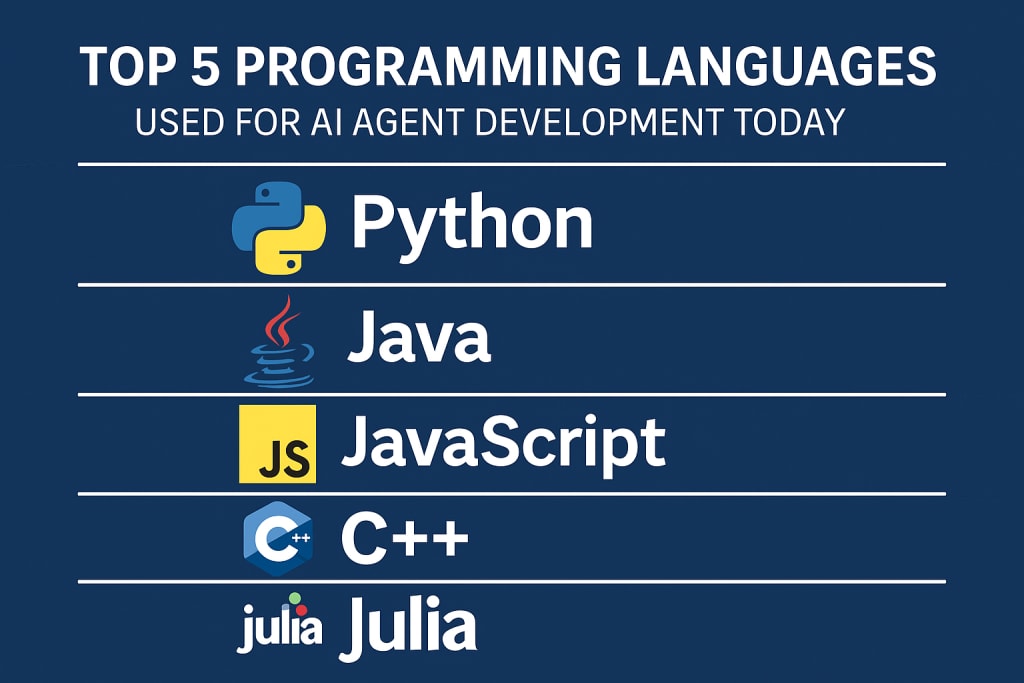
Artificial Intelligence isn’t just a concept from sci-fi anymore it’s actively driving real-time conversations, tackling intricate challenges, and helping businesses become more efficient every single day. And at the heart of every smart AI agent, there’s a programming language that functions like the wiring in our brains.
If you're getting into Build AI Agent, picking the right programming language can impact how efficient, scalable, and intelligent your agent turns out to be. So, let’s take a closer look at the top 5 programming languages that developers are excited about in 2025—and explore why they’re so important.
Why the Right Programming Language Matters in AI Agent Development
When you're creating AI agents, it's not just about writing code you're actually building something that can think, learn, and adapt. The words you select set the stage for all that intelligence to thrive.
Key Factors for Language Selection
Before you dive into writing any code, take a moment to consider what your project needs. Are you after a lightning-fast performance? Seamless integrations? A wealth of libraries at your fingertips? Or perhaps you just want to stick with a language that your team is already comfortable with?
Here are some common factors developers look for:
- Ease of use
- Speed and performance
- Library support
- Compatibility with existing systems
- The learning curve for the team
Performance, Scalability, and Community Support
When it comes to your AI agent tackling real-time tasks or handling large datasets, performance and scalability are essential. But let’s not forget about the importance of community support. A vibrant developer community brings you more tutorials, improved documentation, and faster assistance when you hit a snag.
1. Python: The Undisputed King of AI Development
Python is still leading the charge in the AI landscape, and it shows no signs of slowing down anytime soon.
Libraries like TensorFlow, PyTorch, and scikit-learn
Python shines because of its amazing ecosystem. With libraries like TensorFlow, PyTorch, sci-kit-learn, and spaCy, you can go from training models to deploying them in no time, and it’s super friendly for beginners!
Simple Syntax and Massive Community
Even if you’re just dipping your toes into the world of AI, you’ll find that Python’s easy-to-read syntax makes it super simple to jump in. And with such a vast community behind it, you can bet there’s a solution out there for just about any problem you might encounter!
2. Java: Reliable and Scalable for Enterprise AI Agents
Java may feel a bit old-fashioned, but it’s actually a robust choice for enterprise-level AI systems especially when you need stability and scalability to be at the forefront.
JVM Advantages and Platform Independence
Thanks to the Java Virtual Machine (JVM), Java code can run smoothly on just about any platform. This is a huge advantage if you're developing AI agents that need to function across various environments.
Ideal for Large-Scale Applications
When your AI agent is integrated into a large software system, like a banking platform or a healthcare app, Java shines with its structure, memory management, and multithreading capabilities.
3. JavaScript: Powering AI on the Web
Looking to have your AI agents operate right in the browser? JavaScript is the perfect choice for that!
TensorFlow.js and Browser-Based Agents
Libraries like TensorFlow.js allow you to create, train, and run machine learning models directly in your browser with no need for a server. This means users can enjoy quicker interactions and reduced latency.
Real-Time Interactions and Lightweight Deployment
JavaScript truly shines when it comes to crafting real-time, interactive experiences. It's an ideal choice for chatbot interfaces, voice assistants, or any AI agent that operates on the front end.
4. C++: Speed and Efficiency in Performance-Critical AI Agents
When it comes to performance that truly counts, think robotics, gaming, or real-time decision-making systems, C++ is often the top choice.
Low-Level Control for High-Performance Tasks
C++ offers you greater control over memory and hardware, which makes it perfect for AI systems that are all about performance, where every millisecond matters.
Integration with Machine Learning Libraries
While it might not be the easiest for beginners, C++ works beautifully with libraries like Dlib and can even integrate with Python-based frameworks, making it a great choice when you need speed and intelligence to go hand in hand.
5. Julia: The Rising Star for High-Performance AI
Julia is rapidly making a name for herself as a fresh face in the world of AI development.
Fast Numerical Computation and AI-First Design
Julia was built from the ground up specifically for numerical and scientific computing, making it an ideal choice for machine learning and AI applications that require some serious computational power.
Gaining Popularity Among Researchers and Developers
Julia's speed is on par with C++, yet its syntax is as easy to read as Python's. This perfect blend is why researchers and startups are increasingly turning to Julia as they explore the exciting possibilities of AI.
Choosing the Best Language for Your AI Agent Project
When faced with so many great options, how do you choose the right one? It really comes down to what your project needs and what your team excels at.
Project Goals and Team Expertise
If your team is already familiar with Python, that's likely the best starting point. However, if you're developing a browser-based tool, JavaScript could be the way to go. For enterprise software, Java tends to have the upper hand. Ultimately, it’s all about choosing the right tool for the job.
Balancing Innovation with Stability
Sometimes, it’s tempting to jump on the bandwagon of the latest trendy programming language. However, if your project needs reliability and long-term support, sticking with tried-and-true languages can save you a lot of headaches later on.
Final Thoughts: The Future of Programming Languages in AI Agent Development
AI agent development is moving at lightning speed, and so are the tools we use to create them. While Python remains the frontrunner, languages like Julia and JavaScript are making their mark in exciting new ways. Whether you're crafting chatbots, personal assistants, or smart automation tools, choosing the right programming language can elevate a good idea into an outstanding AI product.
About the Creator
Keep reading
More stories from Digi_Sparrow and writers in Geeks and other communities.
Custom Poker Game Development vs. White-Label Solutions: A Detailed Comparison
In the realm of online poker, one major choice that every entrepreneur encounters is whether to create a custom poker platform from the ground up or to opt for a pre-made white-label solution. Each option comes with its own set of advantages and disadvantages, and picking the right one can truly determine your success.
By Digi_Sparrow9 months ago in Geeks
The Rachels - 2025
Much to my surprise, I have kept a list of the films I‘ve seen this year. I daresay it isn’t complete. There will be films that snuck in on a late night in front of the TV that I would’ve forgotten to note. Or others, that I went to watch at the cinema, but then had a red wine and promptly forgotten about. But it’s not a bad approximation of the films I’ve seen this year. In total, there are 53 films listed, so an average of one a week and one for good luck.
By Rachel Robbins27 days ago in Geeks
"Beyond Silence": A Short Film that Speaks Volumes
Always fight for your voice. "Beyond Silence" is a Dutch short film directed by Marnie Blok. Eva, a young deaf student, fights with the higher authorities about a traumatic situation that happened at her university. Two women of different generations share a similar tragedy and story, but one decides to stay silent, while the other woman fights for justice.
By Marielle Sabbag3 days ago in Geeks
So You Decided To Become a Nurse Practitioner:
So you decided to become an "Advanced Practice" nurse. Congratulations!... is what I would say if this was a good idea. Grad school? In this economy? What were you thinking? Likely it was something along the lines of either 1) “I've seen these other chucklefucks do it— Why can't I?” or even 2) “I've got a nice career, I should shake it up. I miss feeling like I have no clue what I'm doing.”
By Sandor Szabo6 days ago in Fiction


Comments
There are no comments for this story
Be the first to respond and start the conversation.