
To Speak Plainly
Chinua Achebe's, Things Fall Apart



Things Fall Apart is a novel by Nigerian author Chinua Achebe, originally published in 1958. It is set in the southeastern part of Nigeria during the late 19th century before Europeans began to invade.
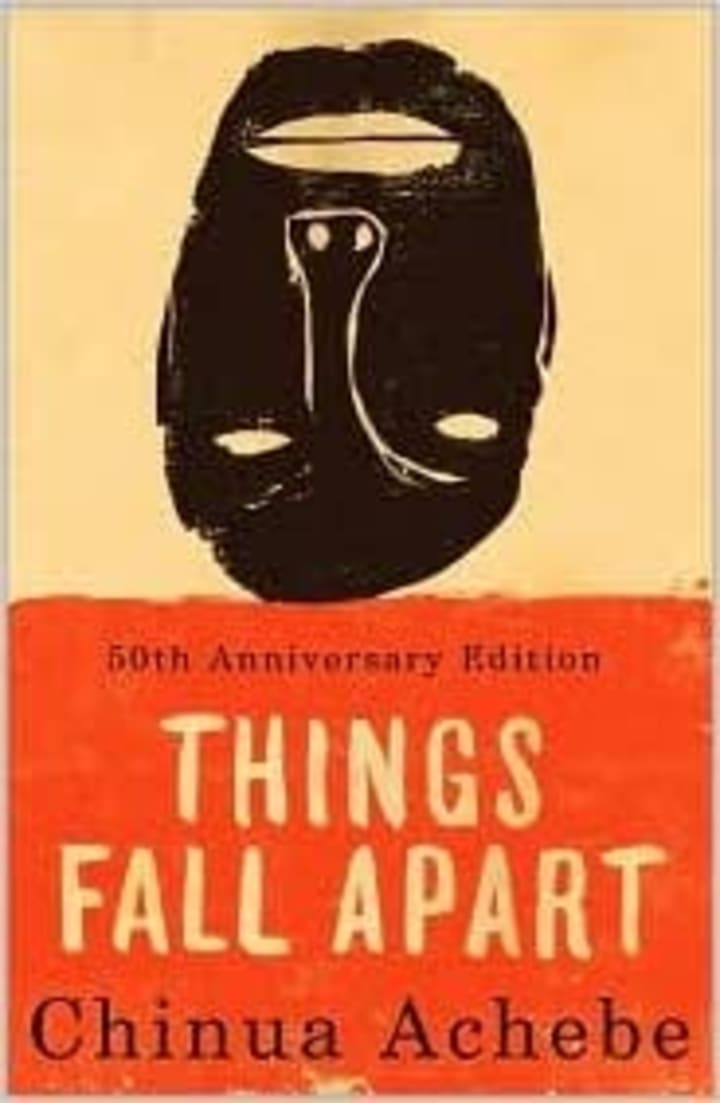
Chinua Achebe’s, Things Falls Apart, is bursting with proverbs within the dialogue as well as the narrative. The decision to include proverbs actually represents a significant trait of the Igbo culture:
“Among the Igbo, the art of conversation is regarded very highly, and proverbs are the palm-oil with which words are eaten” (Achebe 7).
This statement informs the reader that the ability to converse is important and that proverbs allow for layered and easy meaning or interpretation.
The use of proverbs and the knowledge of how and when to use them is important to the Igbo culture and is associated with the ability to obtain and retain wealth as well as titles. Because Okonkwo was able to speak effectively he was granted double the number of yams he had hoped for; advancing his ability to obtain wealth. His wealth is evident in the successful planting and harvesting of yams; two barns full of yams; three wives and eight children. We also learn that he has taken two titles. Titles allow for land ownership and use of land.
The use of proverbs in conversations also allows the speaker to broach difficult conversations with sayings that convey the message without offending. We see this when Okonkwo's father, Unoka, was approached by Okoye to return two hundred cowries that were borrowed by Unoka. The problem with speaking in proverbs or metaphors is the inability of the receiver to understand the meaning.
In the United States, most of us speak plainly; using "politically correct" terminology to avoid offending others. Speaking in proverbs would undoubtedly create a great deal of confusion for many of us. However, there is an aspect of the phrase "proverbs are the palm-oil with which words are eaten" that is especially important to understand - it is its meaning: basically proverbs are words of wisdom (Achebe 7).
In the Igbo culture, wisdom is as profoundly important as wealth and titles. In this case, it is the wisdom to know when to speak or when to act. The wisdom to understand the consequences of words spoken and actions executed.
Chinua Achebe also uses proverbs to help the reader better understand the mind of Okonkwo as in his mental response to comments made during a gathering:
"an old woman is always uneasy when dry bones are mentioned in a proverb" (Achebe 20).
The men were speaking about another man, Obiako, who they described as being strange and how he pushed against the recommendations made by the Oracle who told him to sacrifice a goat. His reply:
"Ask my dead father if he ever had a fowl when he was alive" (Achebe 21).
This response to the Oracle shows that Obiako did not respect the traditions of the community or the advice of the Oracle. The reason for Obiako's aversion to sacrificing a goat was because his own father didn't even own a bird; why would Obiako be required to give up a goat that was of greater value than a chicken? The joviality expressed by the other men was natural and the statement by Obiako is funny. Okonkwo also laughed, but he didn't mean it. He was uncomfortable with the tale about Obiako and his father because the story reminded him of his own father who owned nothing. In addition, Okonkwo shared Obiako's sentiment and belief that the offering should not be greater than the worth of the soul.
The proverb "an old woman is always uneasy when dry bones are mentioned in a proverb" (Achebe 21) means that someone is uncomfortable if something is said that affects them personally. And in this instance, Okonkwo saw the similarities between Obiako and himself. It doesn't matter that the men were joking around; the story was speaking of the dead (dry bones) and it was too close to Okonkwo's reality for it to be funny to him - he could not really laugh about the situation.
Works Cited
Achebe, Chinua. Things Fall Apart. Anchor Books, 1994.
About the Creator
Rebecca A Hyde Gonzales
I love to write. I have a deep love for words and language; a budding philologist (a late bloomer according to my father). I have been fascinated with the construction of sentences and how meaning is derived from the order of words.
Reader insights
Nice work
Very well written. Keep up the good work!
Top insights
Expert insights and opinions
Arguments were carefully researched and presented
On-point and relevant
Writing reflected the title & theme
Keep reading
More stories from Rebecca A Hyde Gonzales and writers in Geeks and other communities.
Identity
Artists draw inspiration from their surroundings and directed observations of subjects interacting with the same space. The human form, a significant subject found in visual arts, has been rendered by artists using a variety of media since the creation of man. These likenesses have served as didactic tools, portraitures, historical markers, as well as references to the ideal.
By Rebecca A Hyde Gonzales4 years ago in Geeks
The Politics of Playing Dress-Up
Well, to start off I'd like to say a happy world book day to all who celebrate. I know I haven't really posted anything on my socials about it but I'm not a jubilant kind of person. I lay low most of the time. Let's start off with a popular anecdote from the vaults...
By Annie Kapur7 days ago in Geeks
Venusaur Unleashed: The Ultimate Grass-Type Pokémon That Dominates Battles
Venusaur stands as one of the most iconic and formidable Pokémon in the franchise, representing the final evolution of the Bulbasaur line. Known for its unique Grass and Poison typing, Venusaur combines raw power, strategic depth, and a commanding presence that makes it a favorite among both casual trainers and competitive players. Its combination of aesthetic design, abilities, and battle versatility ensures that Venusaur has maintained relevance and popularity for decades.
By Lukáš Hrdlička3 days ago in Geeks
Becca
"Everything is so... flat." Denille said stupidly as she looked around her new neighborhood. She looked around at the muted desert where even the smallest sign of life seemed to have given up. The plant life was shrubs that were half cooked by the heat and where there should have been a lawn, a mess of white rocks laid glistening in the sun. Even the sky looked stretched thin, like the sun had ironed it smooth. She’d moved from Riverside, where at least there were hills, but here in Barstow, everything felt baked and brittle.
By Sara Wilson7 days ago in Fiction


Comments (2)
This was great insight.
Thank you for this. I read the book outside of school many years ago and perhaps did not appreciate everything Achebe achieved with it. ;)