
Tintin, nationalist avenger
The right-wing origins of the world's most famous reporter.

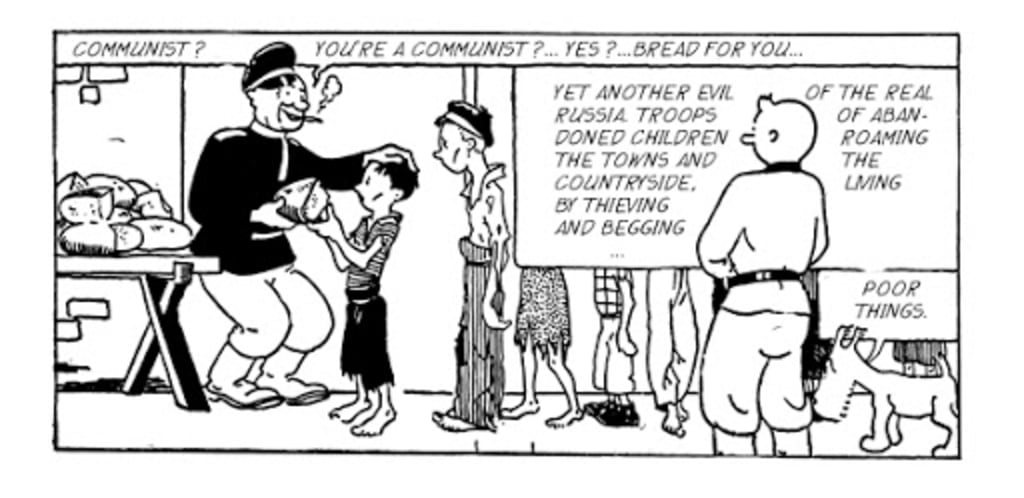
Tintin in the Land of the Soviets introduces us to the boy reporter Tintin and his faithful terrier Snowy, who are tasked by Belgian journal Le Petit Vingtième to travel to Soviett Russia and report on how exactly the Great White Motherland is coping some twelve years after the Bolshevik revolution. His journey starts auspiciously, narrowly surviving an assassination attempt from a Soviet secret agent and being blamed for the resulting destruction by the German authorities. Fortunately, our hero manages to escape his Teutonic holdings and dutifully continue his assignment without a second-thought, like a true journalist would. Tintin is instantly-targeted by the Soviet state securit upon arrival, but manages to outmaneuver their agents each time with a combination of dumb-luck, quick-thinking and Snowy’s assistance--but mostly luck. During this frenetic game of cat and mouse, Tintin discovers the truth about the USSR; the Communists rule only through intimidation and fear, duping the outside world into believing they are prosperous while economic mismanagement and corruption has, in fact, left their nation on the brink of famine. Tintin escapes back to Germany, casually thwarting a Communist plot to blow up the capitals of Europe with dynamite in the process, and returns to a rapturous reception in Brussels.
The Land of the Soviets is unique among the Adventures of Tintin for more than simply serving as the character’s introduction. The series would always be influenced by contemporary events and feature socio-political commentary from Hergé, but it would never again be as politically-charged as it is in the Land of the Soviets, with the scathing picture Hergé paints of Soviet Russia serving as an undisguised piece of anti-Marxist propaganda. This was by design.
The story was serialised in Le Petit Vingtième, the children’s supplement of Le Vingtième Siècle, a staunchly-Catholic and conservative newspaper that stood in stark-opposition to socialism, atheism and progressivism--all things encapsulated in the popular imagination by the Soviet Union. The paper’s editor, a priest named Norbet Wallez, tasked Georges Prosper Remi, under the non de plume Hergé, with writing a story that exposed the chaos and violence inevitably ushered in by left-wing ideology. Hergé’s personal politics continue to be discussed at length, but it’s safe to say that, at least this early in his career, he was as committed an anti-Marxist as one could expect from his middle-class, Catholic upbringing, even if he never veered into the same explicitly-facist and anti-semetic rhetoric as his editor espoused.
Reading today, the political aspects of the story make Land of the Soviets more interesting to read, but it isn’t enough to save the story from its muddling, meandering, repetitious plot. There is no overarching storyline besides the secret police chasing Tintin and the constant captures and escapes, while creative at moments, quickly become tiresome. It’s easy to see that the story was meant to be originally read as a serial, and it unfolds more like a series of visual gags rather than a continuous narrative.
It also lacks the vivid realism that Hergé would prioritise later in the series, and not only because it remains uncoloured and unrevised in 2020. The Russian landscapes are bland and nondescript, with no sense of scope or scale, and it’s easy to see that the author had never once visited the place he was depicting. Science also takes a backseat for comedic effect in order to keep the threadbare plot moving; Tintin constructs an automobile out of the junk he finds in a scrapheap; he disassemble the engine of another car and then repairs it by throwing all the pieces under the hood; and he fixes his aeroplane by cutting down a tree and carving a propeller with a pocket knife. On its own, it has the childlike charm of a schoolboy scribbling down his own comics at the back of the classroom, but it’s leagues away from Professor Calculus explaining nuclear fission to the reader twenty years later.
Tintin himself appears more childlike as well, a bit more cheeky, quicker to violence here and not the steadfast and moralising figure he would become. Snowy, besides retaining the original eyebrows that imbue him with a disturbing impression of humanity, is also more cynical and intelligent here than he would be by the end of the series, though his change would be a more gradual one, becoming less of a sidekick as Tintin’s regular cast expanded.
As Hergé would refine his artistic style, he would go back to refine and recolour his earlier stories, making edits to the art and story when necessary. As such, the first nine Tintin stories that were originally serialised in black-and-white were made available in complete colour and with Hergé’s now-iconic ligne claire (clear line) art style--except for Land of the Soviets; Hergé admitted that, in the first Tintin story, he was learning as he created, and he had no desire to make the Boy Reporter’s inglorious debut available for mass-market release. The volume, only available in extremely-limited editions, was highly sought-after by Tintin fans, until Hergé finally relented and made it available to the public in 1973, though still in its original black-and-white, unrefined form.
Overall, the book is more enjoyable to hardcore fans of the series than it would be to any children looking for the kind of vibrant adventure the series would later become famous for. The silly, consequence-free tone of the album sharply contrasts with its ham-fisted political purpose, but it’s soothing, even cathartic, to look back and see how far the world’s most famous reporter had come.
About the Creator
Keep reading
More stories from Alexander Gates and writers in Geeks and other communities.
Tintin and the White Man's Burden
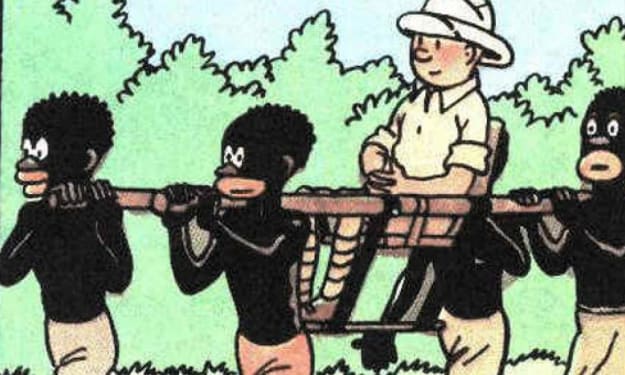
Tintin is going to the Congo, the jewel of the Belgian colonial empire. The reader is given no insight into what the reporter’s actual assignment is besides simply ‘reporting’, positioning Tintin in his early adventures as more of a travel guide than a journalist. Snowy, incorrigible as ever, runs amok on the cruise ship, crossing a shifty stowaway who tries unsuccessfully to drown the poorly-behaved pooch. When they arrive in the Congo, Tintin is greeted as a less of a celebrity and more of a hero when he arrives in the Congo, though his exploits in Africa seem mostly-confined to killing animals, and throughout the story Tintin is shown trying to shoot lions, crocodiles, antelopes, monkeys and elephants--though, usually, not without some comedic mishaps. He soon runs afoul of the local tribes’ Witch Doctor, who is jealous of the reporter’s influence and joins with the aforementioned stowaway, who has his own, unexplained vendetta against Tintin, but their collaborative efforts to dispose of him fail each time. Eventually, Tintin discovers that the stowaway is actually an agent of Chicago mob boss Al Capone, who is attempting a takeover of the African national diamond production, and erroneously believed that Tintin had been sent to expose his plans. The smuggling ring is promptly arrested and Tintin is picked up in a plane, all set to cover the new story developing in Chicago.
By Alexander Gates6 years ago in Geeks
Marvel Zombie
The last entry into our 2025 superhero projects catalogue is Marvel Zombies. This was a show that was anticipated by absolutely no one and it disappeared from the public consciousness as quickly as it was released. There was nothing special about the project that made it a must see, or a must remember. In fact if anything it's a must forget.
By Alexandrea Callaghan18 days ago in Geeks
Corporation for Public Broadcasting to Dissolve After Federal Funding Cut
After Nearly 60 Years, the Corporation for Public Broadcasting Votes to Dissolve Amid Funding Cutbacks For decades, the Corporation for Public Broadcasting (CPB) served as the backbone of America’s public media landscape, channeling federal dollars to local public radio and television stations, including PBS and NPR. But on January 5, 2026, CPB’s board of directors voted to dissolve the organization, marking an abrupt end to an institution created by Congress in 1967 and long viewed as a cornerstone of educational and community journalism in the United States.
By Raviha Imran7 days ago in Geeks


Comments
There are no comments for this story
Be the first to respond and start the conversation.