
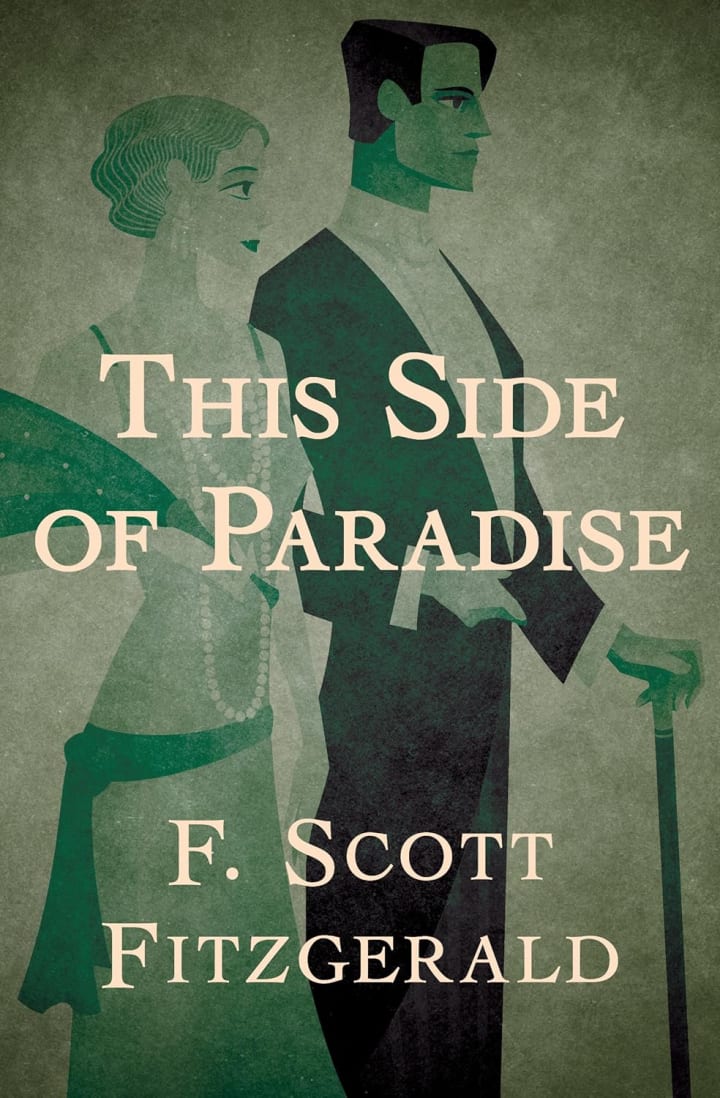
This Side of Paradise by F. Scott Fitzgerald
Why It's a Masterpiece (Week 94)


This Side of Paradise isn't regarded as one of Fitzgerald's best books but it was published bang on 1920, marking the beginning of his fascination with the on-coming Jazz Age. It's semi-autobiographical and details his experiences of elite social circles at Princeton University. It made him famous overnight.
Fitzgerald dropped out of Princeton and began writing this book, plus also serving in the war. He initially wanted to call it The Romantic Egotist but it was rejected by publishers left, right and centre. Whilst living in St. Paul, Minnesota, Fiztgerald would rework the book to incorporate details of his personal life, including his romantic disappointments and social ambitions unfulfilled. It was then accepted for publication by Charles Scribner's Sons thanks to an editor by the name of Maxwell Perkins - a man who recognised the potential of the author to detail the highs and lows of the following decade.
It was published at a transitioning time for America. It was no longer the conservative Victorian era anymore and more young people were embracing a more liberal attitude towards morality and love. The Side of Paradise attempts to capture this same energy of post-war uncertainty and thus, makes for it becoming one of the defining books for the beginning of a whole new generation.
Upon publication, the book was a runaway success, selling out its first printing in three days. It made Fitzgerald an instant celebrity and secured his literary career. Crucially, the novel’s success reignited his courtship with one Zelda Sayre, who had previously rejected him due to his lack of financial stability. With his newfound success, Zelda agreed to marry him, and they became the defining couple of the Jazz Age. Though the book still details how he, his wife and a bunch of other young people of the decade would come to be known as the 'Lost Generation'...
Plot

The novel follows Amory Blaine, a handsome, intelligent, and self-absorbed young man who embarks on a journey of romantic idealism, intellectual awakening, and ultimate disillusionment. Amory, raised by his eccentric and socially ambitious mother, Beatrice, grows up believing himself to be destined for greatness. He attends St. Regis School, where he develops a sense of superiority, and later enrolls at Princeton University, where he becomes deeply involved in literature, philosophy, and social climbing. However, he remains fundamentally restless and struggles to find his true purpose.
At Princeton, Amory falls in love with Isabelle Borgé, a beautiful but shallow young woman. Their relationship is passionate but ultimately unfulfilling, as Isabelle does not share Amory’s idealistic notions of love. Heartbroken, he immerses himself in intellectual pursuits but remains haunted by his inability to reconcile reality with his romantic ideals.
World War I interrupts his education, and Amory enlists in the army, though he never sees combat. Upon returning, he becomes deeply disillusioned with the materialistic society around him. His search for meaning leads him into another tumultuous romance, this time with Rosalind Connage, a charming and sophisticated debutante. Rosalind, however, ultimately chooses to marry a wealthy man instead, rejecting Amory due to his lack of financial stability.
This second heartbreak plunges Amory into philosophical despair, and he turns to books, political ideas, and introspection in an attempt to make sense of his failures. He experiments with socialism, discusses existential questions with friends, and begins to reject the aristocratic values he once admired.
The novel concludes with Amory walking alone along a road, having lost his romantic illusions, his financial security, and his youthful confidence. He reflects on his experiences and famously declares, "I know myself, but that is all." This final statement signals both a personal revelation and an existential resignation, as he realises that self-awareness alone does not guarantee happiness or success.
Into the Book

Restlessness and Disillusionment:
Throughout the novel, Amory represents the restlessness and disillusionment of the post-war generation. Initially, he believes in romantic love, intellectual superiority, and personal destiny, but each of these ideals is shattered by reality.
His first heartbreak, his war experience, and his rejection by Rosalind force him to confront the emptiness of his ambitions. Fitzgerald repeatedly contrasts youthful idealism with harsh reality, showing how Amory’s romantic dreams inevitably crumble.
By the end, Amory has lost everything such as: his wealth, his friends, and his illusions, but gains self-awareness. However, Fitzgerald leaves it ambiguous whether this self-awareness leads to personal growth or deeper cynicism.
"I'm not sentimental—I'm as romantic as you are. The idea, you know, is that the sentimental person thinks things will last—the romantic person has a desperate confidence that they won't."
- This Side of Paradise by F. Scott Fitzgerald
Class and Social Status:
Amory's aspirations are deeply tied to class and social status. Raised with the belief that he is destined for elite society, he spends much of his youth attempting to climb the social ladder. However, Fitzgerald critiques the inherent superficiality of the American aristocracy, showing how wealth dictates relationships, marriages, and opportunities. Rosalind’s decision to marry a wealthy man instead of Amory highlights the economic determinism of the era.
Amory’s financial downfall forces him to reevaluate his beliefs, leading him towards a brief flirtation with socialism. However, his engagement with leftist politics remains largely theoretical, reflecting Fitzgerald’s own ambivalence toward radical social change.
"She wanted, it seemed, the old things, money and position, admiration and beaux."
- This Side of Paradise by F. Scott Fitzgerald
The Bildungsroman:
The novel is ultimately a bildungsroman, charting Amory’s struggle to define himself. From Princeton to his failed romances, from war to personal loss, each experience strips away a layer of his identity, leaving him in an existential crisis. Amory frequently engages in philosophical debates, reflecting his desire to find a greater meaning in life. Yet, by the end, he is left with only self-knowledge, rather than a concrete purpose.
The final line encapsulates both Amory’s growth and his uncertainty, as he realises that self-awareness does not necessarily lead to happiness or success. Fitzgerald, through Amory, captures the broader existential anxiety of the Lost Generation.
"I know myself, but that is all."
- This Side of Paradise by F. Scott Fitzgerald
Why It's a Masterpiece
Apart from the disillusionment and youthful change that came along with this age, Fitzgerald is really credited here with basically writing the first book documenting a story to do with that generation. It bases itself in a newer experimental style as well, reflecting a rejection of older more Victorian maxims of literature. For example: the book takes on a more stream-of-consciousness form - something made famous by folks like Virginia Woolf and others. This would make it one of the first truly modernist books of its kind in America.
It also became a masterpiece because of its outer-world. The exploration of what we call 'celebrity' is something to pay attention to as Fitzgerald became the poster-boy for his generation overnight. It was a book that would come to influence later Lost Generation writers like Hemingway and Faulkner, who would both adopt their own modernist writing styles. But it also brought the more Victorian-based bildungsroman into the 20th century by focusing on more modern issues of love, philosophy and existential crises.
Conclusion

I personally enjoyed this book's exploration of youth, love and self-discovery because it is so timeless. It can literally be applied to my own generation as well. Those who go off to university in search of themselves but just end up with nothing. If anything, we are the Lost Generation of the 21st century. We are all F. Scott Fitzgerald.
Next Week: The Ragged-Trousered Philanthropists by Robert Noonan
About the Creator
Annie Kapur
I am:
🙋🏽♀️ Annie
📚 Avid Reader
📝 Reviewer and Commentator
🎓 Post-Grad Millennial (M.A)
***
I have:
📖 280K+ reads on Vocal
🫶🏼 Love for reading & research
🦋/X @AnnieWithBooks
***
🏡 UK
Keep reading
More stories from Annie Kapur and writers in Geeks and other communities.
Book Review: "The Chaos Machine" by Max Fisher
As you can see, I'm still reading books about the way in which society has basically been destroyed. So far I've read books like Technopoly and Amusing Ourselves to Death by Neil Postman, Bowling Alone by Robert Putnam, Selfie by Will Storr and a couple of others in the past such as Stolen Focus by Johann Hari. Now, it's time for The Chaos Machine by Max Fisher which deals with the social media age. I mean the subtitle of the book is quite literally: "The Inside Story of How Social Media Rewired Our Minds and Our World" and so, I'm holding out quite a bit of hope to learn something new and connect ideas to things I have already read.
By Annie Kapurabout a month ago in Geeks
The Rachels - 2025
Much to my surprise, I have kept a list of the films I‘ve seen this year. I daresay it isn’t complete. There will be films that snuck in on a late night in front of the TV that I would’ve forgotten to note. Or others, that I went to watch at the cinema, but then had a red wine and promptly forgotten about. But it’s not a bad approximation of the films I’ve seen this year. In total, there are 53 films listed, so an average of one a week and one for good luck.
By Rachel Robbins16 days ago in Geeks
Kapil Sharma Admits Facing Pressure from Netflix on The Great Indian Kapil Show: ‘Hisaab Dena Hota Hai’
Comedy icon Kapil Sharma, widely regarded as one of India’s most popular entertainers, recently opened up about the immense pressure he experienced while working on his Netflix venture, The Great Indian Kapil Show. Known for his quick wit, impeccable timing, and charismatic screen presence, Kapil has been entertaining audiences for over a decade. Yet behind the laughter and fanfare, the comedian reveals there was significant scrutiny and accountability involved when collaborating with a global streaming giant. In an exclusive statement, Kapil confessed, “‘Hisaab dena hota hai’ – there’s a lot of accountability involved when you work with platforms like Netflix. You can’t just do things the way you want; every decision, every joke, every segment has to be justified.” This candid admission sheds light on the challenges entertainers face when transitioning from traditional television to digital streaming platforms, which have different expectations, production standards, and creative oversight. From Television Sensation to Streaming Star Kapil Sharma’s rise to fame began with his television shows, particularly The Kapil Sharma Show, which became a household name for its blend of celebrity interviews, sketches, and audience interaction. The show’s immense popularity cemented Kapil’s reputation as a versatile entertainer capable of appealing to audiences across age groups. The leap from television to a global streaming platform like Netflix, however, brought new challenges. Unlike television, which allows for broader content latitude, streaming services demand higher production quality, tighter scripting, and meticulous attention to audience metrics. Every segment is analyzed not just for humor but also for engagement, viewership patterns, and international appeal. For someone like Kapil, accustomed to the creative flexibility of television, this level of scrutiny was a new experience. Pressure Beyond the Spotlight Kapil’s comment, “‘Hisaab dena hota hai,’” reflects more than just professional oversight. It highlights the psychological and creative pressures entertainers face when working under the global lens of digital platforms. Unlike Indian television networks, Netflix operates with a global audience and has a reputation for data-driven decision-making. This means that even an established star like Kapil must consider every joke, every celebrity interaction, and every storyline from multiple perspectives – including cultural sensitivities, global relevance, and streaming analytics. Industry insiders suggest that such accountability can be both motivating and stressful. While it pushes creators to raise their standards and innovate, it can also constrain spontaneity, especially for comedians whose charm lies in improvisation and quick thinking. Kapil Sharma’s experience underscores the delicate balance between maintaining creative freedom and adhering to platform expectations. Fan Reactions and Public Perception Fans of Kapil Sharma have expressed empathy for the comedian’s revelation. Social media platforms are filled with messages supporting him, praising his honesty, and acknowledging the difficulties of navigating global platforms. Many fans noted that while The Great Indian Kapil Show retained Kapil’s trademark humor, the behind-the-scenes pressures were invisible to audiences who often only see the final polished product. Critics have also commented that the transition from TV to streaming requires not just talent but adaptability. Kapil Sharma’s openness about these pressures may encourage more dialogue on how streaming platforms engage with Indian entertainers and the expectations they set for creative content. The Road Ahead for Indian Comedy on Streaming Kapil Sharma’s Netflix experience represents a larger shift in India’s entertainment industry. Streaming platforms have become a hub for diverse content – from drama and thriller series to reality shows and comedy specials. For Indian comedians, this creates exciting opportunities but also unprecedented scrutiny. Maintaining authenticity while satisfying global standards is a challenge that requires careful navigation. Kapil’s candid reflection provides a valuable lesson for aspiring entertainers. Success on international platforms is not just about talent or popularity; it is also about understanding the operational expectations, adapting to new creative standards, and being prepared to answer to detailed scrutiny. His phrase, “‘Hisaab dena hota hai,’” resonates as a reminder that professional accountability is part of global entertainment, even for India’s beloved stars. Conclusion Kapil Sharma’s revelation about the pressures he faced while working on The Great Indian Kapil Show provides a rare glimpse into the realities of global streaming production. While audiences see the laughter, jokes, and celebrity interactions, the behind-the-scenes pressures are immense, especially when transitioning from traditional television to a platform like Netflix. By openly acknowledging the accountability, Kapil Sharma not only humanizes the challenges faced by entertainers but also underscores the evolving landscape of Indian comedy in the digital era. His experience demonstrates that even established stars must adapt, innovate, and navigate pressures while keeping their signature humor intact – a balancing act that defines the future of entertainment in the age of global streaming platforms.
By Fiazahmedbrohi 5 days ago in Geeks
A Failed Artist, A Disillusioned Poet, An Underpaid Game Show Host
I took my son and niece to Gori, a small town in Georgia where Joseph Stalin was born. They talked me into visiting the Stalin's Museum, the largest in the post-Soviet space. I had resisted going there because I just can't stand the monster and know enough about him, or so I thought.
By Lana V Lynx6 days ago in FYI




Comments (2)
Fantastic review! Now I’m curious to read it for myself.
Great conclusion, and I have to say that I was indifferent towards Fitzgerald and did not read him until I was assigned "Gatsby". I may try this one...