
The Time Machine: 20 Years Later And Still Forgotten
Does this Sci-Fi flop deserve its obscurity?

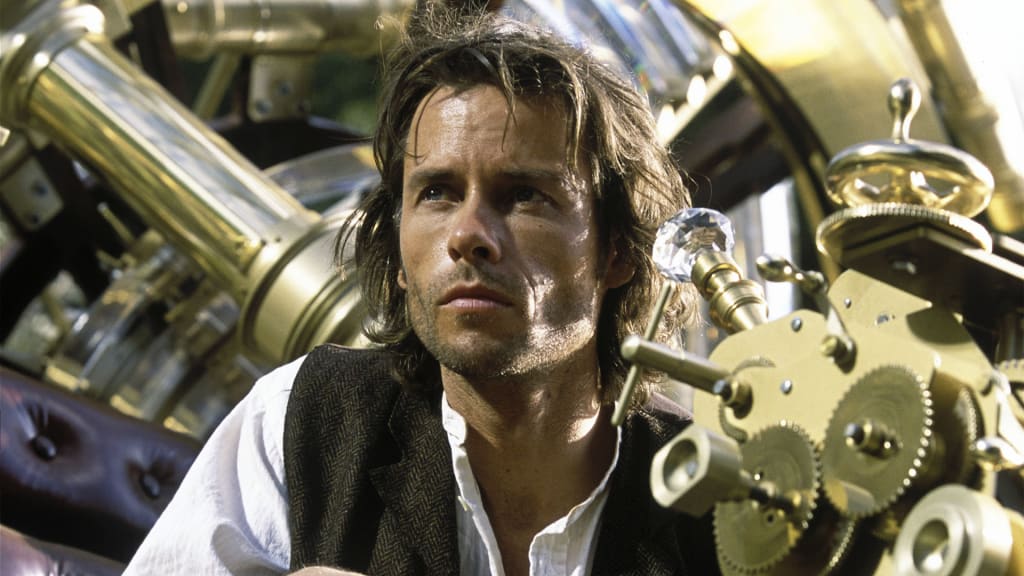
In 2020, men’s magazine GQ uploaded a video to YouTube of Guy Pearce breaking down his career. Pearce described working on several of his most successful films including Memento, L.A. Confidential and Iron Man 3.
One title, which some argue would be worth mentioning, was not included. A title few have looked back on since its release.
An adaptation of the H.G. Welles novel as well as a remake of an adaptation from 1960, The Time Machine premiered on the 4th of March 2002, its nationwide release occurring on the 8th. While the film performed better than expected on its opening weekend, attendances for the science fiction adventure would decline dramatically throughout the following weeks. It would go on to become a box office bomb and receive mixed to negative reviews all round.
Few have reassessed The Time Machine following its 2002 debut. If you’re in the UK you can rent it on Apple+, if you’re in the US you can rent it on Amazon Prime or purchase the Blu-ray however your best bet is finding a DVD copy, which will almost certainly be as old as the film itself.
Does The Time Machine deserve the obscurity it currently occupies? Well, what a better time than the film’s 20th anniversary to answer that question.
Remake, Adaptation or Something Else?
The Time Machine essentially takes the idea that the 1895 novel proposes and incorporates it in to its own story. Fans of the book will understandably be disappointed, fans of the 1960 adaptation however will be quite pleased as there are plenty of little nods and homages throughout the film. The best example is the cameo made by Alan Young, who played Mr Filby in the original film. The references are pretty subtle and won’t jar or confuse anyone who hasn’t seen the 1960 version, which is quite admirable in retrospect. Especially when considering recent reboots like Ghostbusters: Afterlife and Star Trek: Into Darkness that overindulge in references.
This Time Machine is about a man coming to terms with his past and discovering a new life. Where he finds that new life just happens to be the world of the Eloi and the Morlocks.
The Story
Guy Pearce plays Alexander Hartdegen, a professor of engineering and applied mechanics in 1890s’ New York. One winter night, only moments after proposing to his girlfriend, he witnesses her murder. Unable to accept the loss, Alexander constructs a time machine and goes back to prevent the incident. Failing, he travels to the future and tries to find out why he cannot alter the past.
While completely alien to that of the source material, this premise isn’t bad. It’s certainly a more emotional one. What the script does with it is far from perfect, some of the mixed reviews The Time Machine received on its release are not totally unfounded. It has problems but it also has strengths, which may have not received the praise they deserve.
Within less than ten minutes we know and understand Alexander Hartdegen. We learn that he’s a professor who, while socially awkward, has ideas and theories that are way ahead of his time. We learn that he’s deeply in love with his girlfriend Emma (Sienna Guillory). The film gets us to care for him quickly, which is very admirable from a writing perspective. The scene where Emma is murdered is very effective, our sympathy for Alexander intensifies as we witness and feel the inciting incident of his quest.

The script can take credit for introducing its protagonist so successfully however Guy Pearce should be commended for his performance. He is able to present Alexander’s eccentricities as a genius and a scientist very naturally but he never undermines his common humanity with them. Pearce can quite effortlessly play Alex as just another human being who has been scarred by loss.
The screenplay’s marrying of its own premise with that of the source material is executed better than the critics deemed. Alex is knocked off course on his search for an answer and is brought thousands of years into the future, where he is taken in by a tribe of humans known as the Eloi. One of them, Mara (Samantha Mumba), he becomes particularly fond of.
The story that The Time Machine tries to tell isn’t a bad one. It may not be what the book is about but it does have the potential to be touching and poignant as its own interpretation.
There are countless plot holes, which is not too surprising considering the plot concerns time travel. Case in point, when Alexander goes back in time to save Emma, where is his past self? What has happened to him? Does he exist? Does the present Alexander somehow occupy the same space as the past Alexander? This is never explained.
How is Vox (Orlando Jones) still able to function thousands of years later? What is his power source?! How is there electricity?! This too is never explained.
These plot holes could be forgiven if the rest of the story was better told. Pacing is the film’s main issue. The Time Machine is just over 90 minutes long, when Alex arrives in the time of the Eloi, the plot goes into hyper drive and rushes to the end. Alex’s relationship with Mara does not get the development it needs. This makes everything that he and Mara experience together trivial and not as compelling as the film wants it to be. We are still getting to know Mara when suddenly the Morlocks appear and take her.
Alex’s time with Mara and the Eloi needs to be longer as the bond he builds with them is what eventually gives him purpose and allows him to move on from Emma’s death. Consequently, the last half of the film, while entertaining, devolves into jarring nonsensical action. The critics were right to say that the film crashed and burned at that point.
Its Legacy
The special effects have aged wonderfully for the most part. Alex travelling from 1899 to 2030 is still a stunning sequence. The costumes for the Morlocks are very convincing but their digital renditions for when they are leaping on all-fours have aged, looking quite cartoony by today’s standards.
Klaus Badelt’s score is nothing short of beautiful. It is so good that, unsurprisingly, like John Murphy’s theme for Sunshine, it has been taken and used for other projects countless times. Perhaps this is more of a compliment to Badelt’s talent than a disregard.
The film was a flop and got poor reviews. Can that be attributed to its current obscurity? Maybe not.
The Time Machine was released in March of 2002, only months after the world was introduced to the masterpiece that is The Fellowship of the Ring. Not long after The Time Machine’s debut, cinema goers would be treated to Star Wars Episode II: Attack of the Clones, Harry Potter and the Chamber of Secrets and The Two Towers. Perhaps time was the very thing that hindered The Time Machine. Even if the reviews were positive, maybe 2002 was just not the ideal year for another fantasy adventure, it had more than enough competition.
Despite its flaws, perhaps The Time Machine gets enough right, or at least tries to get enough right, to warrant a resurgence. For that to happen the film would need to be more readily available and not just in another Blu-ray release. Maybe if added to a bigger streaming platform, like Netflix or HBO Max, the film might have a chance.
The film might be able to prove whether or not it deserves to be remembered.
When will we be certain? Well, only time will tell.
About the Creator
Luke Duffy
Just an artist.
https://allmylinks.com/duffhood
Keep reading
More stories from Luke Duffy and writers in Geeks and other communities.
The Biggest Flop of 2001
Look at any list of the biggest box office flops and you’ll find Final Fantasy: The Spirits Within. Considering its $137 million budget and $85 million box office, it’s easy to see why. Reviews ranged from mixed to negative, many praising its cutting-edge animation but also panning its bland story and boring characters.
By Luke Duffy5 years ago in Geeks
The Politics of Playing Dress-Up
Well, to start off I'd like to say a happy world book day to all who celebrate. I know I haven't really posted anything on my socials about it but I'm not a jubilant kind of person. I lay low most of the time. Let's start off with a popular anecdote from the vaults...
By Annie Kapur5 days ago in Geeks
Rattata Exposed: The Small Pokémon That Packs Surprising Speed and Strategic Potential
Rattata is one of the most familiar Pokémon to trainers, often encountered early in the games and easily overlooked due to its small size and unassuming appearance. Despite this, Rattata offers surprisingly useful traits that make it a strategic choice for both beginners and experienced trainers. Its speed, versatility, and evolution into Raticate demonstrate that even the most ordinary-looking Pokémon can possess significant potential when properly trained and utilized.
By Lukáš Hrdličkaabout 15 hours ago in Geeks


Comments
There are no comments for this story
Be the first to respond and start the conversation.