
The SpongeBob Anime is a Delight
It's equal parts ridiculous and engaging - and a testament to what independent artists can really create.

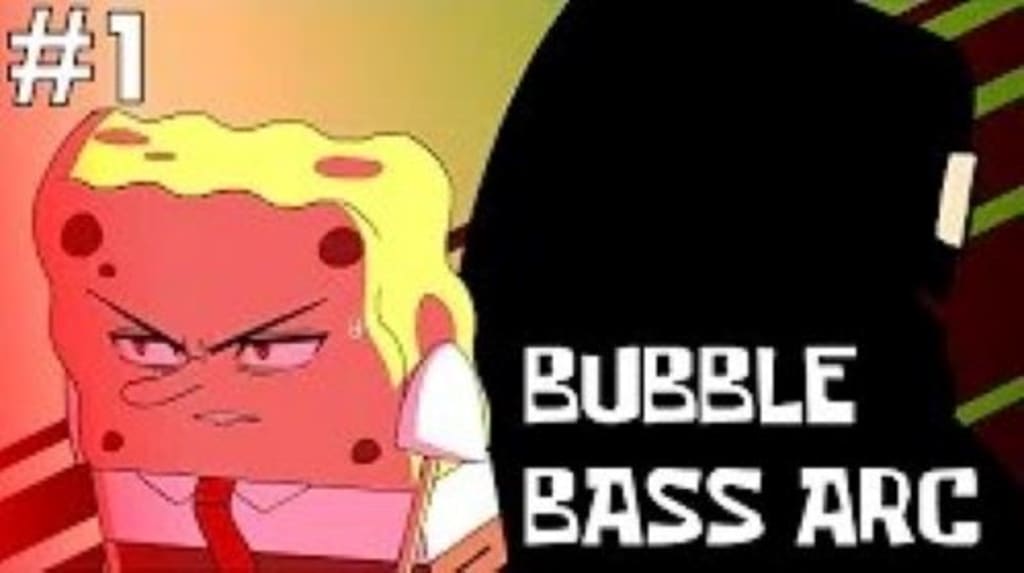
Well then. This was a review I never thought I’d be writing anytime soon.
I should start by saying that I’m a huge advocate for independent and fan-made content; as an avid fanfiction writer for years now, I understand the motivation and passion to create something out of love for the original work. Many incredible creators out there most likely would not be doing their original work right now if they hadn’t got their start making fanfiction, fanart, fan music, et cetera. One reason why I’m still fascinated by this type of derivative content is that it’s sometimes astounding how creative others can get with the existing property; watching videos, reading stories, or looking at art that depict the property’s characters and worlds can introduce the audience to entirely new perceptions and interpretations of those characters that they might never have considered otherwise. They oftentimes take on a life of their own, enough so that their own mini-fandoms can spawn and create fanworks inspired by that original fanwork. It really is amazing to me, seeing this kind of creativity that expands on the original work’s world in ways I could never have imagined on my own.
This is absolutely true of animator Narmak’s first SpongeBob SquarePants Anime OP video from 2017. It very quickly went viral for its bizarre blend of concepts – a goofy, non-serious cartoon about anthropomorphic sea creatures and the opening to a blood- and drama-filled shounen anime series – and although at first I did admittedly find it a bit too strange for me (SpongeBob is very precious to me as the bulk of my childhood television habits, after all), over time I started to appreciate its weirdness. Even more so with the two sequel openings plus an ending complete with Japanese credits, I found myself enjoying the parody nature of the animations, how it pays tribute to the two genres while playfully poking at the clichés of both.
(Squidward standing in the rain and SpongeBob tripping while running with purpose still cracks me up to this day because it’s so true of every anime opening ever.)
But, even with that said, when I learned a few weeks ago that Narmak had taken the joke so far as to make a full-length 14-minute pilot episode for the SpongeBob Anime series, I was honestly more hesitant than excited for it. I wasn’t sure if a parody like this could be stretched into something of that caliber and induce the same impact that the previous entries had. Not to mention, with the sheer amount of uninspired, terrible parodies of children’s media out there that just slap blood and disturbing content onto them just for the sake of it, I wasn’t sure if I could enjoy the SpongeBob Anime if it went down this road. I will admit that I was severely underestimating Narmak’s talents then, but can you blame me when too many gross and uninspired animated mockeries outweigh the legitimate, well-thought parodies? (I mean, Racist Mario, anyone?)
But now I realize, to say that I underestimated Narmak is the understatement of the eon. It still surprises me every day since its premiere how much I’ve fallen in love with this episode and the crazy world it takes place in.
What’s even more baffling is the fact that the episode is legitimately good – that is, it stops being just a parody and tells a genuinely compelling story in the spirit of the original works.
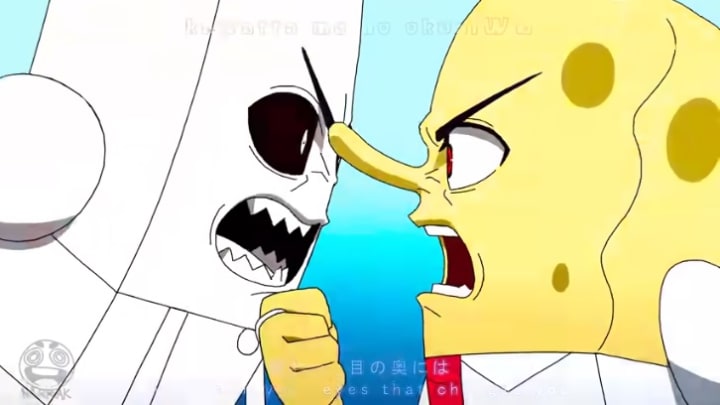
Just in its production value alone, this is one of the most impressive fan animations I’ve seen since the likes of Fall of the Crystal Empire and Lullaby For a Princess. Narmak spent no less than six months working on this masterpiece, and it shows in every frame; he’s clearly studied just about every facet of the “action anime style”, including camera movements, action transitions, even eye-catches taken right out of JoJo’s Bizarre Adventure. Watching this, I couldn’t help but be reminded of series like Soul Eater and One Piece just in how the characters conducted themselves in their movements and reactions. Not only that, but Narmak went the extra mile and hired a professional voice acting coach and legitimate actors for both the Japanese and yet-to-be-released English dubs, and his fellow creators Sander and Seycara worked hard to create an original soundtrack for the show. It still boggles my mind to realize this; the level of professionalism put into what looks at first to be just a silly parody project is astounding, and it kept the video authentic and engaging throughout.
However, I don’t love the SpongeBob Anime for just its production value. I cannot completely put into words the cognitive dissonance I felt watching a genuinely compelling and emotional story unfold like that, while at the same time remembering that I was watching a SpongeBob-freaking-SquarePants parody.
Until now I was seriously struggling to understand why I felt this way; these characters were so vastly different yet so familiar to those I grew up cherishing, the violence and action was still believable despite how out of character it was – I wasn’t sure if I should be feeling the way I did about just a simple fanmade parody. I kept asking myself “WHY is this so good?”
Which brings me back to the point that I made at the start of this review: that fanmade content is engaging because it builds on the original, and it can even become its own entity entirely as an alternate interpretation of the original. This, I’ve realized, is why the SpongeBob Anime works so well.
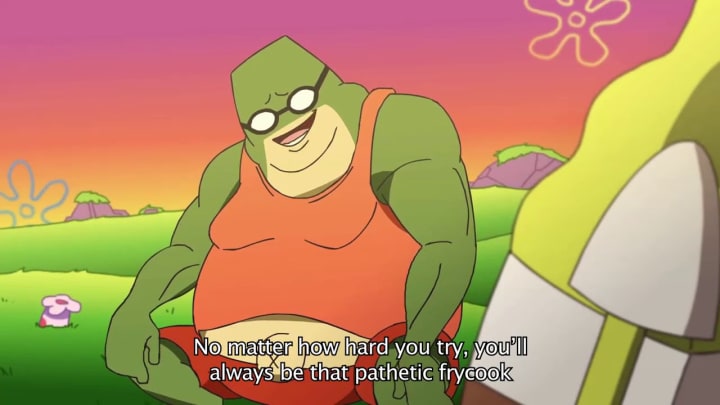
I would define the SpongeBob Anime as a prime example of “alternate universe” fiction – that is, a fanwork that takes elements from the existing property and alters one or more aspect so that it tells a very different story from the canon. Based on my own experience, many of these are borne from a “What if?” question, the most common and most broad being “How would the characters react if THIS happened to them instead?”.
For me the fun of alternate universes, or AUs, comes from exploring how the characters and their portrayals change in response to the altered elements and how believable the creator can make such a concept. This is the reason there are so many detailed UnderTale AUs out there; fans love reimagining the characters and re-telling their stories in diverse and creative ways. This also shows how AUs exemplify exactly what I was describing before, about how fanworks can introduce the audience to a totally different perception of the original property that they never would have considered had they never discovered the fanwork in the first place; AUs take this idea more literally, giving the audience an alternate and re-imagined version of the characters and their worlds, completely separate from the canon continuity.
But, like any work of fiction, an AU’s success depends entirely on the skill of the storyteller. Thankfully, Narmak is not just great at animating parodies but also telling a genuinely good story with his re-imagined worlds. The SpongeBob Anime’s main appeal is seeing how these altered versions of those familiar, lovable characters would conduct themselves in a totally foreign genre; what’s amazing to me though is how you can still recognize their canon traits here even when they’re doing things you’d never see in the original cartoon. SpongeBob is just as selfless and lovably compassionate as he’s ever been, except here he’s so passionate about his friends that he has no problem taking Bubble Bass’s head off in a bloody spectacle for beating up Squidward; Sandy is still a country-born badass but shows a much softer and gentler side towards exclusively SpongeBob and everything he does; Squidward is still a grouchy pessimist desperate for recognition, but diverges from his cartoon self here in his tsundere tendencies and even affections towards SpongeBob. Even the one-off antagonist Bubble Bass is just as hateable as he was back in Season 1 of the show, although here he’s less of a lazy conceited slob and instead works as a genuinely menacing peon for Plankton. The only one I can say felt like a totally different character is Patrick, but that doesn’t stop him from feeling just as compelling as the others – I never thought I’d ever watch a katana-wielding, thong-sporting Patrick freaking Star give a wise and impassioned speech about honor and actually call it ‘compelling’, but here we are.
It sounds like these differences should make watching the anime feel uncanny rather than believable, but, as strange as it is to realize, they don’t; very ironically, because the episode takes itself seriously, it becomes more than just a silly parody and instead grows into a genuine re-imagining of SpongeBob’s story. The genre change from goofy cartoon logic to dramatized shounen anime demanded that the episode take itself just as seriously as Dragonball, Naruto, and other anime it takes inspiration from; the violence, action, and serious dialogue in the SpongeBob Anime is completely authentic to those anime, which is why it somehow doesn’t feel uncanny to see Patrick drone about omens and watch SpongeBob furiously rip his old rival into a bloody mess. This is exactly what you’d expect from an anime of this nature, and that familiarity is what keeps the episode engaging despite the characters originating from a polar opposite genre.
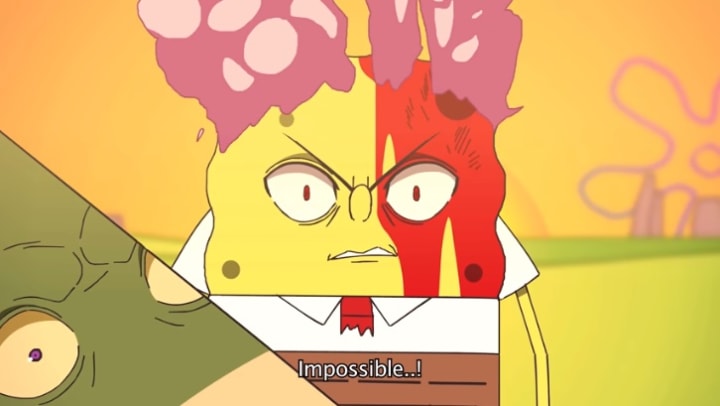
This fanwork is truly something special. What began as just a funny “What if?” parody has risen as a legitimate and well-told alternate universe that blends both properties together so they work organically together instead of clashing into an uncanny mess. I am legitimately excited to see where this story goes, which character SpongeBob will fight next, what dark decisions Squidward will make due to his inferiority complex, if either Sandy or Squidward will ever confront their true feelings for SpongeBob, or if we’ll ever find out SpongeBob’s “dark secret of what [he] is” as Mr. Krabs describes. It is as legitimate an anime as Attack on Titan or, again, Soul Eater or Dragonball, and it hooks you the same way those series’ do, even though it is still an independent, fan-made internet video.
More than anything else, though, the SpongeBob SquarePants Anime represents how talented and determined independent creators like Narmak are. It’s an enormous production for such a small team, and yet it plays as authentically as mainstream studio-produced shows. Not only that, but it proves yet again the creativity and impact that fan-made creations can have on an audience; just like Fallout: Equestria, Pride and Prejudice and Zombies, and other famous fanworks like them, the SpongeBob Anime transcends above its inspirations and becomes its own thing that still resembles those inspirations while taking on its own identity. It’s incredibly inspiring to me, as a fellow artist and writer, to see this type of work and see the endless waves of well-deserved love and support flooding them.
I am super excited to see where Narmak takes this series, as well as what more it and other independent properties can inspire in their audiences.
You can watch the SpongeBob SquarePants Anime Episode 1 here:
You can watch all the OPs and the Ending here:
Please support the official release. You can support Narmak through his YouTube and Patreon.
If you enjoy my work and want to support me further, please consider leaving a like and sharing this story on social media! Thanks so much!
About the Creator
Em E. Lee
Writer-of-all-trades and self-appointed "professional" nerd with an infinite supply of story ideas and not nearly enough time to write them down. Lover of all media, especially fiction and literature. Proud advocate of the short story.
A Knight of the Seven Kingdoms Series Review (Season 1)
As one of the biggest properties in fantasy, A Song of Ice and Fire remains immensely popular with audiences. After reaching far into the past with House of the Dragon, a second spin-off was on the cards. A Knight of the Seven Kingdoms serves up a bite-sized slice of action and drama, but it still claims a spot among the best small-screen titles.
By Robert Cain17 days ago in Geeks
Anthony Michael Hall: Did he channel Donald Trump on Psych?
Was Donald Trump the inspiration for Harris Trout? Anthony Michael Hall has had a stellar career that began when he was seven years old. At eleven, he was the little boy known as the Honeycomb Kid in a television commercial. In March 2013, he appeared in three episodes of the final season of the USA drama Psych.
By Cheryl E Preston2 days ago in Geeks


Comments
There are no comments for this story
Be the first to respond and start the conversation.