
The quintessential movie for Saint Patrick's Day.
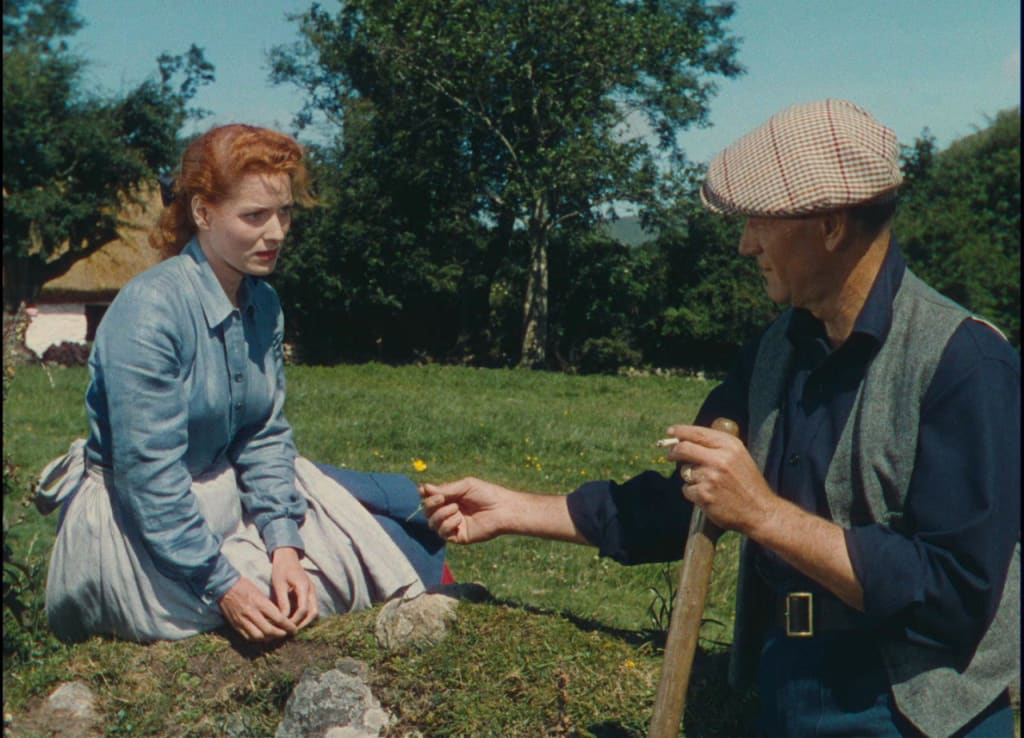
There is a real sadness to the way John Wayne’s character is contorted in the third act that feels almost reminiscent of the actor himself. What is it about Wayne? He is by no means a “good” actor, as he seems to loudly stumble through the most simple and basic requirements of someone in his profession in every movie he is in. Yet he is so magnetic - you literally can’t take your eyes off of him. He’s the only person that has made me believe in the concept of a “movie star”. It’s the reason why the famous “John Wayne dolly” shot in Stagecoach is one of the most enduring images of Old Hollywood. Something I’ve noticed about Wayne is that even in his quintessential “tough guy” and cowboy characters, he delivers his lines with the mannerisms and inflections of a little boy. It is surely unintentional on his part, but it’s there, and I think it’s this unconscious childlike behavior that makes John Wayne special. This sense of innocence is exploited greatly by John Ford in The Quiet Man. This is a beautiful, quiet, aching, and nuanced performance - and a character that quite literally couldn’t be played by anyone else. Ford’s technical mastery and the on-location technicolor cinematography make this come VERY close to being among the greatest films ever made. There is a theme in this film about being out of lockstep with your heritage that I’ve never really seen explored to this degree before, moreover, this has some of the absolute greatest individual scenes and shots I’ve ever seen in any movie. Ever. One shot of Maureen O’Hara, which is blocked in a way so she physically shrinks within the frame, is a new touchstone cinematic image for me. The first love scene - a kiss accompanied by gale force winds and dancing shadows is an astute example of the unique potential fables have in showing overwhelming desire, and is reminiscent of Hollywoods' greatest images during the Silent Era. The second love scene - Wayne and O’Hara undressing and running through the Irish countryside is one of the most evocative and beautiful scenes I’ve ever seen, one that pushes the boundaries of sexuality on screen, especially impressive considering how conservative a lot of movies were, and still are frankly, about sex. John Ford is known as a technical master for a reason, but seriously seriously seriously there is stuff in this that hasn’t been topped since. Superb compositions and camera movements that I’ve never seen replicated. And God, I’m convinced technicolor was made to photograph Ireland, it looks so breathtaking. Credit: Ford and DP Winton C. Hoch. I wish I could tell you about my own heritage right now, or the loneliness of feeling out of place in a new home, but story-wise this becomes so mangled in the last thirty minutes that it becomes thematically something totally different than it was before. I don’t like where they take John Wayne, I don’t like the sudden intrusion of slapstick, I don’t like that Maureen O’Hara was robbed blind of her agency, I don’t like the tonal or thematic shift, it’s not what I signed up for. That first hour and a half though? Unparalleled cinematic bliss
About the Creator
Rowan Harper
Rowan Harper is a Colorado-based filmmaker, film critic/historian, and lifelong lover of the arts. Rowan's career includes extensive experience as an actor, director, producer, stagehand, and awarded musician in both film and live theater.
Keep reading
More stories from Rowan Harper and writers in Geeks and other communities.
The American Film
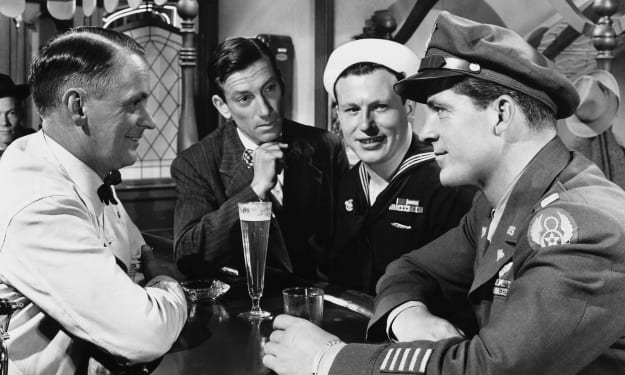
There is a dialogue exchange in The Best Years of Our Lives (Wyler, 1946) in which Fred (Dana Andrews) reminisces about his pre-war career as a soda jerk. He brags that he can throw a scoop of ice cream into the air and have it land perfectly into the cone every time, he jokes that this is the training that allowed him to successfully drop bombs on all of his intended targets. There is a real melancholy to Wyler’s film. In reality, it’s a film about trauma bubbling under the surface of a picturesque America. We as viewers are confronted about how we approach war, and if it is worth it. In another scene, Homer Parrish (Harold Russell) is told by a Nazi sympathizer that he lost his hands for nothing, his sacrifice had no meaning, thus leading to the powerful image of an American flag lapel pin juxtaposed against Russell’s prosthetic hooks. Wyler is directly contrasting the American dream against the harsh realities of what it takes to protect it. By the end of the film, it seems that the thesis reached, as per Wyler’s vision, is that military service is a patriotic sacrifice you make for the sake of your friends, family, and neighbors. This is not necessarily incorrect, but it showcases a sometimes problematic trend in American pop culture. We as Americans like to think we are immune to criticism, and that we somehow have a moral high ground on the rest of the world. This hypocrisy has affected American media for decades, and only recently have we started to examine that. There Will Be Blood (Anderson, 2007) is a film that picks at the two biggest paragons of American culture. That being capitalism and religion, represented by Daniel Plainview (Daniel Day-Lewis) and Eli Sunday (Paul Dano) respectively. The film is ultimately a farce, in that it shows that these two main building blocks of American culture cannot coexist. One cannot be a true capitalist while being truly religious and vice versa. So, we are faced with the fact that our foundational governing principles are based on a contradictory lie. The tragedy of the film comes when greed beats virtue to death, and ultimately our darkest angels triumph more often than our better ones. Accompanied by Jonny Greenwood's score, the prospectors arrive and steal the lifeblood from America’s natural beauty and Californian landscape, dooming generations of Americans to live off of their blood money and malicious industry for the next century. There is something transcendental in the way Anderson shoots tornadoes of fire and raining black oil. Visually it is a representation of the rape of the natural world. The color of the natural landscape is drowned in deep black muck. The greed of the characters is represented within the landscape as their morals grow as black as the oil. Honest religion is defeated by capitalism as Eli is tricked into admitting he is a false, atheistic, prophet and is murdered by Daniel for it. The American dream is dead and we are doomed. Anderson explores similar themes in The Master (Anderson, 2012) as good religion and conspiracy theory blur together beyond recognition. Set against the busting, up-tempo world of 1950s America, we watch as traumatized Americans crawl to fearful deities. We are scared of the world we live in, and the jazzy swing of the 50s is a facade. Our lives are destroyed by our societal evils. There is hope to be found in the works of Anderson and in The Best Years of Our Lives, however. We can escape through our virtues and the virtues of others. We can find relief lying in bed after being cared for by a loved one. The shot of the tear trickling down Homer Parrish's face, maybe that’s the American dream.
By Rowan Harper11 months ago in Geeks
The Rachels - 2025
Much to my surprise, I have kept a list of the films I‘ve seen this year. I daresay it isn’t complete. There will be films that snuck in on a late night in front of the TV that I would’ve forgotten to note. Or others, that I went to watch at the cinema, but then had a red wine and promptly forgotten about. But it’s not a bad approximation of the films I’ve seen this year. In total, there are 53 films listed, so an average of one a week and one for good luck.
By Rachel Robbins29 days ago in Geeks
Where to watch Premier League?
Football fans traveling abroad can keep up with their usual streaming services from anywhere with the help of a VPN, or virtual private network. VPNs allow people to change their device's virtual location. This way, their go-to websites and apps work from anywhere in the world, so they don't need to worry about missing out on their favorite programming while traveling. Plus, they're instant ways to boost online security.
By David Cookabout 14 hours ago in Geeks


Comments
There are no comments for this story
Be the first to respond and start the conversation.