
The Hound of the Baskervilles (2002)
A BBC Sherlock Holmes adaptation worth a rewatch

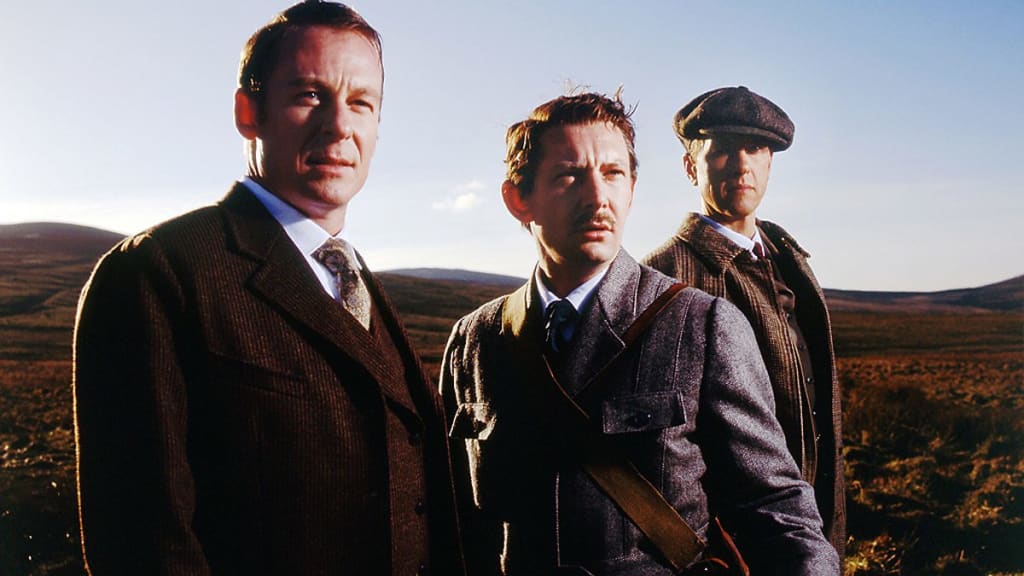
There have been at least thirty screen adaptations of The Hound of the Baskervilles, the best-known of all Sir Arthur Conan Doyle’s Sherlock Holmes stories. In 2002, as part of BBC1’s Christmas programming and roughly marking the centenary of the novel’s publication, Tiger Aspect produced a TV movie starring Richard Roxburgh and Ian Hart as the deductive duo of Holmes and Watson.
This was the first Sherlock Holmes screen production by the BBC for twenty years, since their 1982 adaptation of the same novel starring Tom Baker. Allan Cubitt (The Fall, Murphy’s Law, Prime Suspect II) wrote the script, a quite faithful adaptation which makes only a few notable changes. One of these was to set it both at Christmastime and in the year of the novel’s publication (the novel being set sometime earlier in 1889, being written after Doyle had killed Holmes off in The Final Problem but set before). The change in era would have makes little difference beyond the costuming, while the Christmas setting adds something to the atmosphere. David Attwood (The Ends of the Earth, Shot Through the Heart, The Fortunes and Misfortunes of Moll Flanders) directs, making full use of the sweeping yet isolated Dartmoor location. There’s a sense of oppressive foreboding throughout, as befits Doyle’s foray into the gothic.
Richard Roxburgh (Blue Murder, Moulin Rouge), one of the few Australians to take the role, makes for a commendable, if unremarkable Holmes. He certainly looks the part, and nails the balance of dry humour and cold arrogance of the best Sherlocks, but there’s little to set him apart from the better remembered actors who have taken on the part. His English accent is convincing, even if he does, at times, drift into Matt Berry territory with his grandiloquent delivery. His Holmes is a refined, precise sort who keeps his worse tendencies out of sight. A scene of the detective shooting up is virtually obligatory in a modern Sherlock Holmes film, but you’d never guess this Holmes’s habits from looking at him, unlike some bedraggled Sherlocks.
Roxburgh’s performance is unshowy and centres the production without overshadowing it, which is quite right for a story in which Holmes keeps his involvement secretive and tangential. Roxburgh would play Moriarty in The League of Extraordinary Gentlemen and Dracula in Van Helsing, released in 2003 and 2004 respectively, making him the only actor to play all three characters on screen, and in remarkably rapid succession.
Ian Hart (Blind Flight, The Terror, Harry Potter and the Philosopher’s Stone) is more memorable as Watson. An adaptable and flexible actor, Hart could have played the good doctor in any number of ways, but thankfully the script calls on him to portray him the highly intelligent, resourceful figure of the canon. (A relief, after so many years of well-meaning but oafish takes on the character.) Hart makes for a classy, reserved yet forceful Watson; it’s a subtle performance in which he can say volumes with the twitch of his moustache.
As with so many adaptations and pastiches, there’s an undercurrent to Holmes and Watson’s relationship here, that makes you question if they’re more than just jolly good friends. In spite of starting with the duo chilling out together in a sauna, of all places, this production is never overt about it. More than anything, it comes through in Watson’s exasperated, but clearly adoring, dinner party account of Holmes’s flawed genius. Then again, there seems to be a spark between Watson and the under-threat Henry Baskerville in this version; they move from awkward living partners of necessity to chummy familiarity very quickly. Watson is very happy to get in close and tie Sir Henry’s tie for him, and by the time Sir Henry come under direct attack, Watson is devastated. When they engage in a little laddish (for the Edwardian era) talk about Beryl Stapleton’s beauty, it definitely comes across as two men trying too hard to sound heterosexual while the butler’s listening.
Matt Day (Strife, Rake, Wolf Creek) plays Sir Henry, heir to the Baskerville fortune, having just become the equivalent of a multi-millionaire. Another Aussie, his Canadian accent wobbles occasionally but he puts in a pretty charismatic performance, becoming more likeable as we spend more time with him. John Nettles (Midsomer Murders, Bergerac) appears as Dr. Mortimer, friend and executor of the late Sir Charles Baskerville. Nettles is, as ever, a class act granting the character an effortless authority, so much so that when Mortimer is visibly shaken by the horrors of the hound you can believe the curse is real.
Richard E. Grant portrays the untrustworthy Jack Stapleton with manic enthusiasm. Grant played Holmes in the very strange 1992 film The Other Side, and there are moments here, when he steals the scene from Roxburgh, that I found myself wanting see him in the lead. Grant’s version of The Hound of the Baskervilles would be more over-the-top, certainly, but then we’d miss him in this villainous role. Neve McIntosh (Doctor Who, Gypsy Woman, Traces) gives a strong, haunted performance as Beryl Stapleton. The prolific Ron Cook (The Diary of Anne Frank, The City and the City, Life After Life) plays shifty butler Mr Barrymore, with Liza Tarbuck (Linda Green, Mount Pleasant) in a rare, fully straight drama role as Mrs Barrymore, the Baskerville estate cook. Danny Webb (Liar, Humans) barely registers as the scarcely seen Inspector Lestrade, which is a pity, as he’d probably be very good in the role if given any actual material.
It's a solid cast for a solid production, led by a solid and steadfast Holmes. It’s a somewhat more bloodthirsty affair than the novel; everyone’s packing a gun and there’s a little satisfying gore towards the end. The spooky atmosphere is increased by a séance scene (not present in the novel and likely inspired by a similar scene in the 1939 film version starring Basil Rathbone). The hound itself is a mixed affair, created through a combination of animatronics and now-dated CGI, and could have benefited from being kept in the shadows for longer. Altogether, though, this works, maintaining an underlying tension throughout its 100-minute runtime.
The adaptation was successful enough that the BBC commissioned a second film, which was broadcast two years later. The Case of the Silk Stocking was again written by Cubitt, with Ian Hart returning as Watson. Roxburgh, however, would not play the detective again, with his role taken in the sequel by Rupert Everett.
About the Creator
Daniel Tessier
I'm a terrible geek living in sunny Brighton on the Sussex coast in England. I enjoy writing about TV, comics, movies, LGBTQ issues and science.
Keep reading
More stories from Daniel Tessier and writers in Geeks and other communities.
Captain America: Brave New World
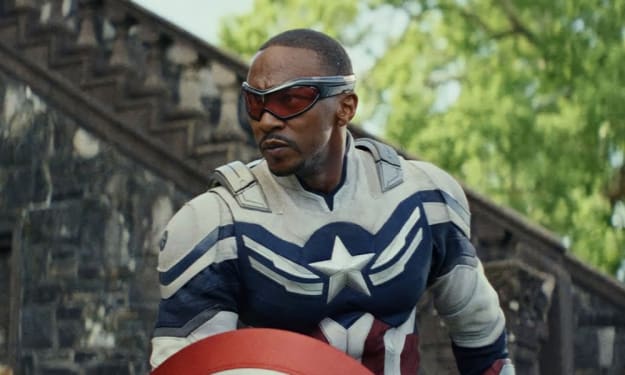
Brave New World is the fourth Captain America film for the MCU, and the first to see Anthony Mackie step up as the lead after playing second fiddle to Chris Evans for so long. It's also the 35th movie in the MCU as a whole, and deep into Phase 5 of the increasingly convoluted franchise. This perhaps explains some of the film's messiness and the mixed reviews it's been getting. It's inarguable that Brave New World tries to juggle too much of the franchise's unwieldy backstory, leaving us with a messy script. Yet, for all that, I found Brave New World to be a highly entertaining movie, one of the stronger Marvel movies of recent years, and a great showcase for Mackie's classy new Cap.
By Daniel Tessierabout a year ago in Geeks


Comments
There are no comments for this story
Be the first to respond and start the conversation.